Why act quickly after an accident in Scotland in 2026

After an accident, many victims believe they have plenty of time to pursue a personal injury claim. This dangerous misconception puts thousands of Scottish claimants at risk each year. Scottish law imposes strict three-year time limits on personal injury claims, and delays can irreversibly weaken your case through lost evidence and fading witness memories. Understanding why prompt legal action matters protects your right to fair compensation and ensures you meet critical deadlines that courts enforce without exception.
Table of Contents
Key takeaways
| Point |
Details |
| Three-year deadline |
Claims must typically start within three years of your accident under Scottish law |
| Evidence deterioration |
CCTV footage, witness memories, and physical proof degrade rapidly after incidents |
| Early legal advice |
Solicitors preserve evidence and navigate pre-action protocols to strengthen claims |
| Strict enforcement |
Courts rarely grant extensions, making timely action essential for claim success |
Understanding the strict time limits for personal injury claims in Scotland
Scottish personal injury law operates under rigid statutory deadlines that determine whether you can pursue compensation. The Prescription and Limitation (Scotland) Act 1973 establishes a three-year prescriptive period from either your accident date or when you first became aware of both your injury and its cause. This framework means claims must be initiated within three years to remain legally valid.
The 2018 amendments to this legislation clarified previous complexities whilst maintaining these strict boundaries. These changes apply to new claims from February 28, 2025, reinforcing Parliament’s commitment to prompt legal action. Claims initiated after the deadline face almost certain dismissal, regardless of injury severity or circumstances.
Understanding your personal injury rights in Scotland requires recognising that courts interpret these time limits strictly. Judges possess limited discretion to extend deadlines, and successful applications for extensions remain exceptionally rare. The prescriptive period exists to ensure cases proceed whilst evidence remains fresh and witnesses can provide accurate testimony.
Key aspects of the time limit framework include:
- The three-year period begins from the accident date for most claims
- Discovery rules apply when injuries manifest later or causation becomes apparent over time
- Children’s claims typically pause until they reach 16 years of age
- Mental incapacity can suspend the time limit under specific circumstances
- The 2018 Act simplified calculation methods but maintained strict enforcement
“Time limits exist to protect both claimants and defendants by ensuring claims proceed whilst evidence remains reliable and memories stay accurate. Missing these deadlines almost always results in permanent loss of legal rights.”
Early claim initiation preserves your ability to recover damages for medical expenses, lost earnings, pain and suffering, and ongoing care needs. Waiting until the deadline approaches creates unnecessary risk and limits your solicitor’s ability to build a comprehensive case. Courts show little sympathy for claimants who delay without valid medical or legal justification.
Why delays can severely weaken your personal injury claim
Time works against injury victims in ways that extend far beyond statutory deadlines. The practical consequences of delayed action can transform a strong claim into an unwinnable case, regardless of the merits of your injuries or the defendant’s liability. Understanding these risks motivates prompt engagement with the legal process.
Witness testimony forms the backbone of many successful claims, yet human memory proves remarkably unreliable over extended periods. People forget crucial details, conflate events, or simply become unavailable as they move, change contact information, or lose interest in participating. Research consistently shows witness memories fade significantly within months of an incident, reducing the accuracy and credibility of their accounts.

Physical evidence faces even more immediate threats. CCTV systems typically overwrite footage within 30 to 90 days unless specifically preserved. Accident scenes change as repairs occur, weather alters conditions, or businesses renovate. Damaged vehicles get repaired or scrapped. These irretrievable losses directly impact your ability to prove how the accident occurred and who bears responsibility.
Defendants and their insurers recognise these dynamics and may deliberately delay responses to exploit evidence degradation. When claims arrive years after incidents, insurers can legitimately question witness reliability and challenge liability assertions that would have been straightforward to prove immediately after the accident. Delay leads to loss of evidence, fundamentally harming your ability to establish both liability and the full extent of damages.
Medical evidence also becomes more difficult to obtain and less persuasive with time. Doctors struggle to connect current symptoms to historical accidents when significant time has elapsed. Treatment records may be archived or destroyed according to retention policies. Expert witnesses find it harder to provide definitive opinions about causation when examining someone years after their injury.
Pro Tip: Photograph accident scenes from multiple angles immediately after incidents, including wider context shots showing surrounding conditions. These images prove invaluable when memories fade and physical evidence disappears, providing your solicitor with concrete documentation to support your claim.
Prompt action strengthens every aspect of your case. Solicitors can secure witness statements whilst memories remain fresh, preserve CCTV footage before deletion, obtain contemporaneous medical records, and build a comprehensive evidence file that withstands defendant challenges. The difference between immediate action and delayed claims often determines whether you receive fair compensation or nothing at all. Understanding how to claim injury compensation Scotland requires recognising that timing significantly impacts outcomes.
The benefits of early legal consultation and investigation
Engaging a solicitor immediately after your accident transforms your claim prospects through professional evidence management, procedural compliance, and strategic case development. Legal expertise proves essential for navigating Scotland’s complex personal injury framework whilst maximising your compensation potential.
Solicitors provide immediate guidance on collecting and preserving critical evidence that laypeople often overlook. They understand which documents matter most, how to obtain police reports, what medical evidence courts require, and how to secure witness cooperation. This professional approach to early legal consultation aids preservation of evidence, including police reports, medical records, witness statements and expert opinions that form your claim’s foundation.
Pre-action protocols impose specific requirements on claimants before court proceedings can commence. The Compulsory Pre-Action Protocol applies to claims under £25,000 and mandates particular steps including notification letters, evidence disclosure, and settlement discussions. Non-compliance can result in cost sanctions, delayed proceedings, or weakened negotiating positions. Solicitors ensure you meet these obligations correctly and punctually.
Early legal involvement supports comprehensive case assessment that clarifies your claim’s realistic value. Solicitors evaluate liability strength, quantify potential damages across multiple categories, and identify any contributory negligence issues that might reduce compensation. This analysis helps you make informed decisions about settlement offers and litigation strategy.
Key advantages of prompt solicitor engagement include:
- Professional evidence collection ensuring nothing critical gets overlooked or lost
- Immediate preservation requests for CCTV footage and other time-sensitive materials
- Expert witness identification and instruction to assess injury severity and prognosis
- Strategic claim valuation considering all damage categories and future losses
- Protocol compliance preventing procedural errors that could harm your case
- Negotiation expertise maximising settlement prospects without unnecessary litigation
| Evidence Type |
Preservation Timeline |
Solicitor Action |
| CCTV footage |
30-90 days typical |
Immediate preservation request |
| Witness memory |
Degrades within months |
Prompt statement collection |
| Medical records |
Varies by provider |
Formal records request |
| Physical evidence |
Changes rapidly |
Professional documentation |
Pro Tip: Contact a solicitor within 48 hours of your accident, even if you’re unsure about making a claim. Initial consultations typically cost nothing, and early advice protects your rights whilst you decide how to proceed. Waiting weeks or months to seek legal help after accident can permanently compromise your case.
Solicitors also manage the emotional burden of claims, handling insurer communications, defendant challenges, and procedural complexities that overwhelm injured victims already dealing with recovery. This professional buffer allows you to focus on healing whilst your legal team builds the strongest possible case. The combination of technical expertise, procedural knowledge, and strategic thinking makes early solicitor involvement the single most important factor in successful claims.
Navigating time-sensitive personal injury claims: practical steps to act quickly
Taking immediate action after an accident requires following a systematic approach that protects your legal rights whilst building a strong compensation claim. These practical steps ensure you meet statutory deadlines and preserve evidence that determines case outcomes.
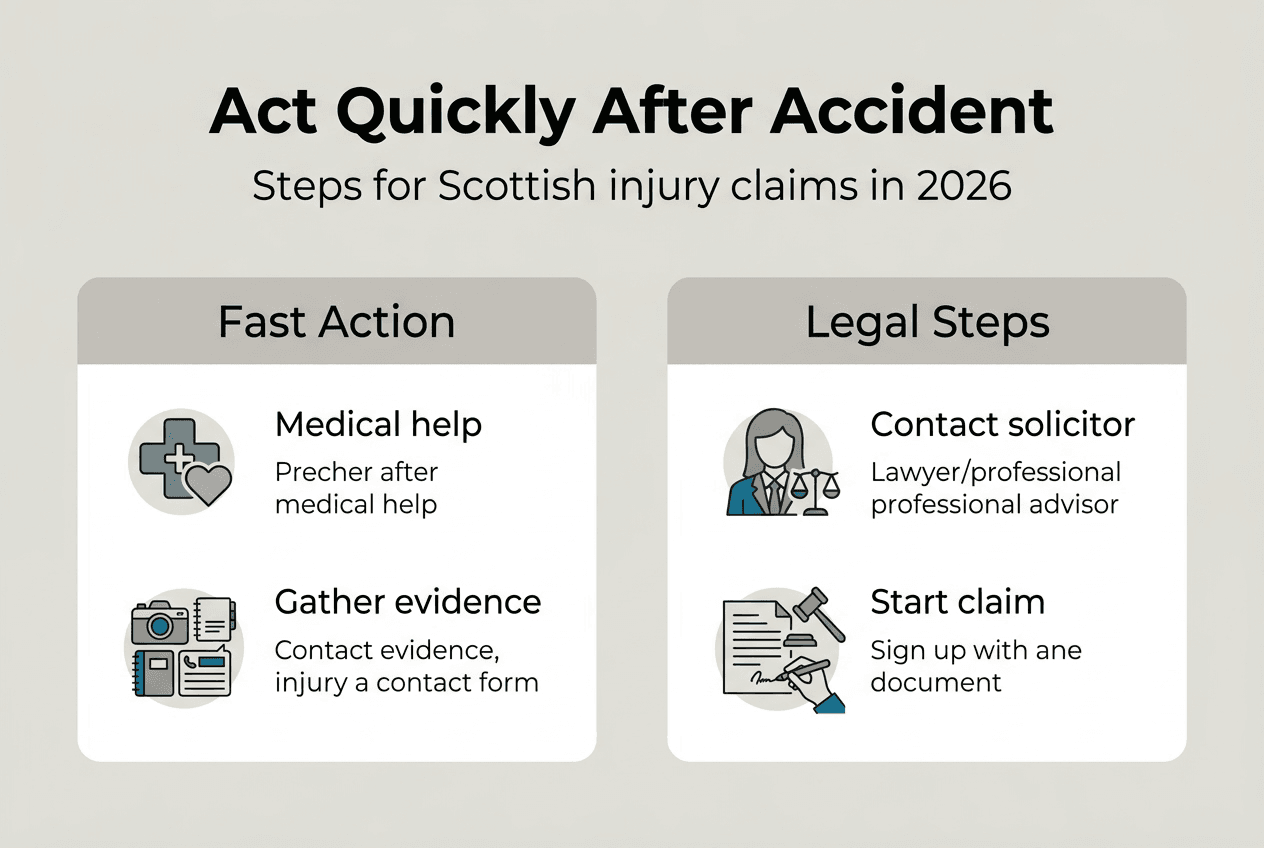
Your first priority involves seeking medical attention regardless of apparent injury severity. Some conditions manifest hours or days after accidents, and delayed treatment creates insurance company arguments that injuries weren’t serious or weren’t caused by the incident. Medical records from initial examinations provide crucial contemporaneous evidence linking your injuries directly to the accident. Doctors document your complaints, observations, and treatment plans that become foundational evidence for your claim.
Documenting the accident scene immediately yields evidence that disappears rapidly. Take photographs from multiple angles showing vehicle positions, road conditions, hazards, signage, and any relevant environmental factors. Record witness names and contact details before people leave the scene. Note weather conditions, lighting, and any other circumstances that contributed to or explain the incident. This information proves invaluable when formal investigations begin weeks later.
Contacting a solicitor specialising in Scottish personal injury claims should occur within days of your accident. Professional legal advice ensures you understand your rights, meet procedural requirements, and avoid common mistakes that weaken claims. Solicitors can immediately begin evidence preservation efforts that laypeople cannot effectively undertake. Understanding how to start injury claim Scotland properly requires professional guidance from the outset.
Essential immediate actions include:
- Seek medical examination within 24 hours, explaining all symptoms however minor they seem
- Photograph accident scenes comprehensively before conditions change or evidence disappears
- Collect witness details including full names, addresses, phone numbers, and email contacts
- Report the incident to relevant authorities such as police, employers, or property owners
- Preserve physical evidence like damaged clothing, broken equipment, or defective products
- Contact a personal injury solicitor within 48 hours for professional guidance
- Avoid discussing fault or making recorded statements to insurers without legal advice
- Keep detailed records of all accident-related expenses and income losses
| Action |
Timing |
Purpose |
| Medical examination |
Within 24 hours |
Documents injuries and causation |
| Scene documentation |
Immediately |
Preserves physical evidence |
| Witness information |
Before leaving scene |
Secures testimony availability |
| Solicitor consultation |
Within 48 hours |
Protects legal rights |
| Incident reporting |
Same day |
Creates official record |
Understanding that settlement can take months or years despite prompt action reinforces why early claim initiation matters. The three-year deadline marks when you must start proceedings, not when cases conclude. Complex claims involving serious injuries often require extended negotiations or litigation, making early action essential for timely resolution.
Pro Tip: Create a dedicated file for all accident-related documents including medical records, correspondence, receipts, and photographs. This organised approach helps your solicitor quickly assess your case and ensures nothing important gets lost during what may be a lengthy claims process.
Recognise that the prescriptive period is strictly enforced with extensions being exceptionally rare. Courts reject sympathy-based arguments for missing deadlines, requiring claimants to demonstrate extraordinary circumstances beyond their control. This harsh reality makes proactive claim management essential rather than optional. Following these practical steps immediately after your accident maximises compensation prospects whilst protecting your fundamental legal rights.
Get expert legal support for your injury claim in Scotland
Navigating Scotland’s personal injury claims system demands professional expertise that protects your rights whilst maximising compensation. Specialist solicitors understand the strict three-year deadlines, complex pre-action protocols, and evidence requirements that determine whether claims succeed or fail. Their experience proves invaluable for victims dealing with injuries, recovery, and financial pressures simultaneously.
Professional legal support ensures you meet every statutory deadline and procedural requirement without costly mistakes. Solicitors manage evidence preservation, witness coordination, medical record collection, and expert instruction that laypeople struggle to accomplish effectively. This comprehensive approach builds strong cases that withstand insurer challenges and defendant arguments designed to reduce or eliminate compensation.
No win no fee claims in Scotland provide accessible legal representation without upfront costs or financial risk. You pay nothing unless your claim succeeds, removing the economic barriers that prevent many injured victims from pursuing deserved compensation. This arrangement aligns solicitor interests with yours, ensuring they work diligently to achieve the best possible outcome.
Scotland Claims connects you with experienced injury lawyers in Scotland who specialise in your specific accident type. Whether you’ve suffered road traffic injuries, workplace accidents, or slip and trip incidents, specialist knowledge significantly improves claim prospects. Contact Scotland Claims today for a free consultation that clarifies your rights and starts the process of securing fair compensation for your injuries.
FAQ
What happens if I miss the three-year deadline for making a claim?
Claims initiated after the three-year prescriptive period face almost certain dismissal by Scottish courts. Missing the deadline usually means the claim is time-barred and cannot proceed regardless of injury severity or liability strength. Courts possess extremely limited discretion to extend deadlines, typically requiring proof of mental incapacity or other extraordinary circumstances completely preventing earlier action. The harsh reality means delayed claimants permanently lose their right to compensation, making prompt action essential rather than optional.
Why is early evidence gathering so important after an accident?
Immediate evidence collection dramatically increases the accuracy and reliability of witness testimony and physical proof that determines case outcomes. Witness memories fade and physical evidence may be lost or altered within weeks of incidents, fundamentally weakening liability arguments. CCTV footage gets overwritten, accident scenes change, and people forget crucial details that seemed obvious immediately after events. Delays often result in irretrievable loss of key claim elements that transform strong cases into unwinnable disputes, making prompt evidence preservation the difference between successful compensation and claim failure.
How can a solicitor help me act quickly after an accident?
Solicitors assist with preserving evidence, obtaining reports, and managing pre-action protocols that laypeople struggle to navigate effectively. They immediately request CCTV preservation, collect witness statements whilst memories remain fresh, obtain police and medical records, and instruct expert witnesses to assess injury severity. Professional legal guidance ensures you meet all procedural requirements, avoid common mistakes that weaken claims, and understand realistic compensation prospects. Solicitors also handle insurer communications and defendant challenges, allowing you to focus on recovery whilst they build the strongest possible case. Early engagement with legal help after accident specialists maximises your chances of receiving fair compensation within reasonable timeframes.
Does the three-year limit apply to all types of personal injury claims in Scotland?
The three-year prescriptive period applies to most personal injury claims under the Prescription and Limitation (Scotland) Act 1973, but specific exceptions exist for particular circumstances. Children’s claims typically pause until they reach 16 years of age, giving them until their 19th birthday to initiate proceedings. Mental incapacity can suspend time limits when claimants lack the cognitive ability to understand and pursue claims. Discovery rules apply when injuries or causation become apparent years after incidents, starting the three-year period from the date of knowledge rather than the accident date. Despite these exceptions, the vast majority of claims must commence within three years, making early legal consultation essential for understanding how deadlines apply to your specific situation.
Recommended