Start your injury claim in Scotland 2026: step-by-step guide

After an accident or workplace injury, many people in Scotland feel overwhelmed about where to begin with a compensation claim. You might wonder whether you have a valid case, what evidence you need, or how to access legal help without upfront costs. Understanding the claim process early protects your rights and maximises your potential compensation. This guide walks you through the essential steps to start your injury claim confidently in 2026, from understanding legal grounds to submitting your case with expert support.
Table of Contents
Key takeaways
| Point |
Details |
| Time limits matter |
You typically have three years from the injury date or knowledge to start your claim in Scotland. |
| Prove negligence |
Establishing duty of care breach, causation, and injury is essential for a valid compensation claim. |
| Seek advice early |
Early legal consultation preserves evidence and strengthens your case significantly. |
| Most settle outside court |
The majority of Scottish injury claims resolve through negotiation rather than courtroom proceedings. |
Understanding the legal basis of injury claims in Scotland
Before starting your claim, you need to grasp the fundamental legal principles that underpin personal injury compensation in Scotland. The core mechanism involves establishing duty of care, breach, and causation. These three elements form the foundation of every successful claim.
Duty of care means the responsible party owed you a legal obligation to act reasonably. Employers must provide safe workplaces, drivers must operate vehicles responsibly, and property owners must maintain premises without hazards. When someone fails to meet this standard, they breach their duty. A driver running a red light or an employer ignoring safety protocols demonstrates clear breach.
Causation links the breach directly to your injury. You must prove the negligent act caused your harm, not some unrelated factor. Medical evidence typically establishes this connection. If you twisted your ankle on a broken pavement, photographs and witness statements show the defect caused your fall.
“Proving each element requires solid evidence. Without establishing duty, breach, and causation, your claim cannot succeed regardless of injury severity.”
Contributory negligence occurs when you share partial fault for the accident. Perhaps you were not wearing a seatbelt during a collision or ignored warning signs before a slip. This does not eliminate your right to compensation but may reduce the amount awarded. Courts assess each party’s responsibility percentage and adjust settlements accordingly.
Understanding these principles helps you evaluate your case realistically. Consult resources on how to claim injury compensation Scotland to see how these concepts apply to specific injury types. Early recognition of these elements allows you to gather appropriate evidence from the start.
Essential preparation before starting your injury claim
Proper preparation significantly strengthens your claim and prevents common pitfalls that weaken cases. Gathering evidence immediately after an injury preserves crucial details that fade over time. Start by collecting medical records from every healthcare provider who treated your injury. These documents establish the nature and extent of your harm.
Accident reports provide official documentation of the incident. If injured at work, ensure your employer files a proper report and request a copy. For road accidents, obtain police reference numbers and driver details. Witness contact information proves invaluable, as independent accounts corroborate your version of events. Photograph injuries, accident scenes, and any hazards that contributed to your harm.
The three-year prescription period starts from the injury date or when you reasonably knew the cause. Missing this deadline typically bars your claim permanently. Exceptions exist for children, whose three years begin at age sixteen, and historic abuse cases with extended timeframes.

Pro Tip: Report injuries to relevant authorities within 24 hours when possible. Early documentation creates a contemporaneous record that insurers and courts find more credible than delayed reports.
The following table outlines key deadlines and requirements:
| Claimant type |
Time limit |
Special considerations |
| Adults |
Three years from injury or knowledge |
Must prove awareness date if delayed |
| Children |
Three years from 16th birthday |
Parents can claim on behalf before this |
| Historic abuse |
Extended periods apply |
Specialist legal advice essential |
| Fatal accidents |
Three years from death date |
Relatives must act as claimants |
Consulting a solicitor promptly protects your legal rights even if you are not ready to proceed immediately. Early advice identifies potential issues and prevents evidence loss. Many people delay seeking help, assuming they can handle claims themselves or that legal fees will be prohibitive. This misconception costs claimants thousands in lost compensation annually.
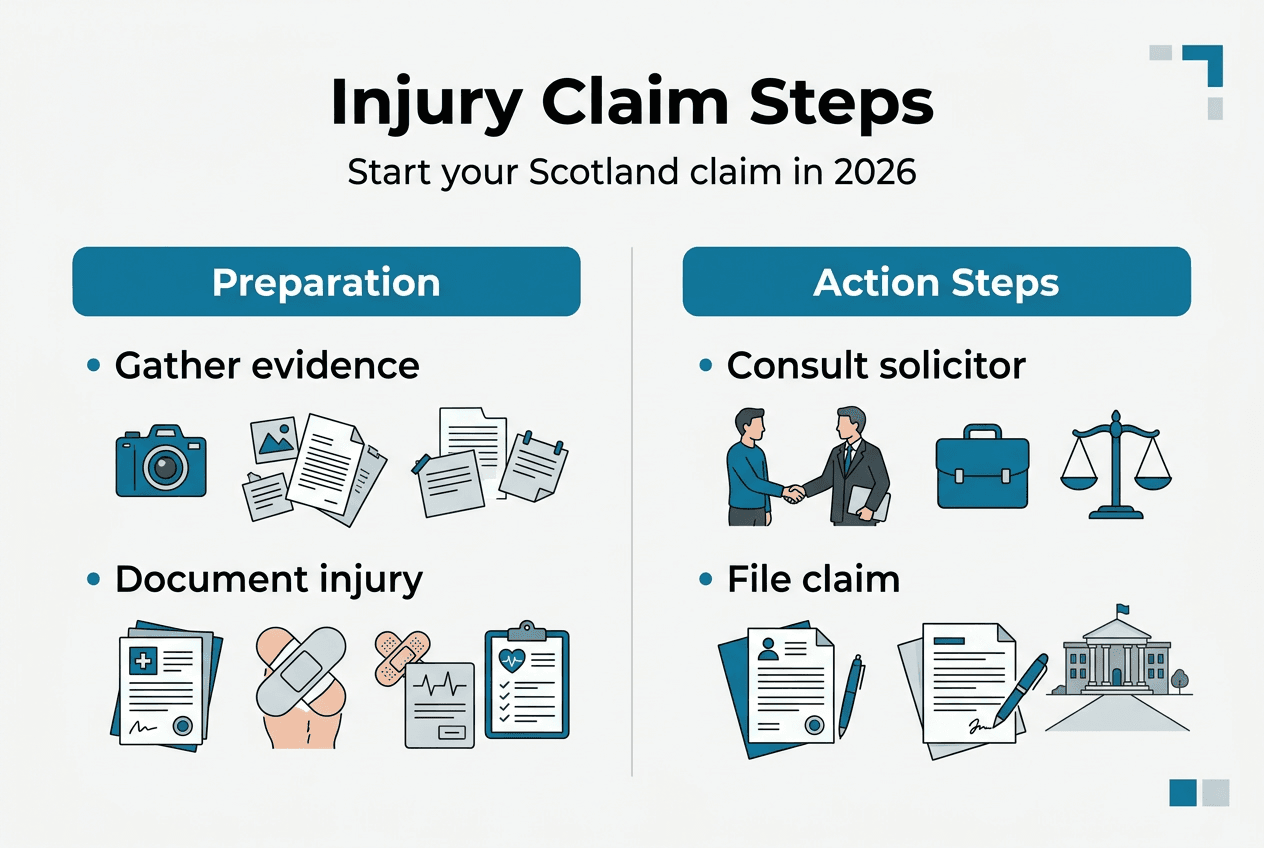
Explore injury compensation preparation steps and understand the benefits of early legal advice to avoid these mistakes. Proper preparation transforms uncertain claims into strong cases backed by comprehensive evidence.
Step-by-step process to start your injury claim in Scotland
Once prepared, follow these clear steps to initiate your claim formally and progress towards compensation. Each stage builds on the previous one, creating a structured path from initial contact to settlement negotiations.
-
Contact a specialist solicitor: Find a legal adviser experienced in Scottish injury claims who understands local courts and procedures. Specialist knowledge makes a substantial difference in claim outcomes compared to general practitioners.
-
Arrange a free consultation: Most injury solicitors offer no-cost initial meetings to evaluate your case. During this session, explain your accident circumstances, present your evidence, and ask about success prospects. Early consultation preserves evidence and clarifies rights, giving you a realistic assessment before committing.
-
Submit documents and evidence: Your solicitor will request all relevant materials, including medical records, accident reports, photographs, and witness statements. They may arrange independent medical examinations to assess injury severity and prognosis. Comprehensive documentation strengthens negotiating positions.
-
Formal notification begins: Your solicitor sends a letter of claim to the responsible party or their insurer, outlining the negligence allegations and compensation demand. This formal notification starts the legal process and triggers investigation by the defendant’s representatives.
-
Engage no win no fee arrangements: These agreements, also called conditional fee agreements, eliminate upfront legal costs. You pay nothing unless your claim succeeds, making justice accessible regardless of financial circumstances. Understand the terms fully, including success fee percentages and what expenses you might cover.
Pro Tip: Maintain a detailed injury diary recording pain levels, treatment appointments, work absences, and how injuries affect daily activities. This contemporaneous record provides powerful evidence of ongoing impact and supports higher compensation awards.
Explore no win no fee claims Scotland options and connect with experienced injury lawyers Scotland who can guide you through each stage. Professional representation dramatically increases settlement amounts compared to self-representation, often by thousands of pounds.
Managing your injury claim and what to expect next
After starting your claim, understanding the typical progression helps you participate effectively and manage expectations. Most cases follow a predictable pattern, though individual circumstances create variations.
The majority of claims settle through negotiation rather than court proceedings. Insurers prefer avoiding litigation costs and uncertainty, making settlement discussions the norm. Your solicitor exchanges evidence with the defendant, presents medical reports, and negotiates compensation amounts. This process typically takes several months, depending on injury complexity and liability disputes.
The following table compares negotiation versus court action:
| Factor |
Negotiation |
Court action |
| Timeframe |
6-18 months typically |
18-36 months or longer |
| Cost |
Lower legal expenses |
Higher fees and court costs |
| Control |
Parties agree terms |
Judge decides outcome |
| Stress level |
Generally lower |
More demanding and formal |
| Success rate |
High settlement rate |
Uncertain verdict risk |
Claims proceed to court when parties cannot agree on liability or compensation amounts. Perhaps the defendant denies negligence entirely, or their settlement offer falls far below your injury’s true value. Court proceedings involve formal procedures, witness testimony, and judicial determination. While more time-consuming and stressful, litigation sometimes secures substantially higher awards than initial offers.
Several factors influence your final compensation amount:
- Injury severity and permanence of symptoms or disability
- Impact on employment capacity and future earning potential
- Medical treatment costs, including ongoing therapy and medication
- Care needs and adaptations required for daily living
- Pain and suffering experienced both immediately and long-term
- Contributory negligence reducing awards proportionally
“Understanding these factors helps you evaluate settlement offers realistically. Accepting the first offer often means leaving thousands unclaimed, as insurers typically start low.”
Expect claim resolution timeframes between six months for straightforward cases and several years for complex litigation. Your solicitor provides regular updates and explains each development. Maintaining open communication ensures you understand progress and can make informed decisions about settlement offers.
Use the injury compensation calculator to estimate potential awards and review back injury claims details for specific injury type guidance. Realistic expectations prevent disappointment and help you recognise fair settlement offers when they arrive.
Explore expert legal support for your injury claim
Navigating injury claims without professional help often results in lower settlements or rejected cases. Scotland Claims connects you with specialist solicitors who understand Scottish law and maximise your compensation through no win no fee arrangements. You pay nothing upfront and retain 100% of your compensation if successful.
Free initial consultations assess your claim’s viability without financial commitment. Expert injury lawyers in Scotland handle all aspects, from evidence gathering to settlement negotiations, allowing you to focus on recovery. Specialist knowledge across injury types ensures tailored representation:
- Road traffic accidents and pedestrian injuries
- Workplace injuries and occupational diseases
- Slips, trips, and falls in public or private spaces
- Back injury claims and spinal damage
- Knee injuries and joint problems
Prompt contact protects your legal rights and prevents evidence loss. Early involvement by experienced solicitors significantly improves claim outcomes and settlement amounts.
Most asked questions about starting injury claims in Scotland
When must I start my injury claim to avoid losing my right?
You typically have three years from the injury date or when you reasonably knew the cause to start proceedings. Missing this deadline usually bars your claim permanently, though exceptions exist for children and certain historic cases.
Do I need to pay solicitor fees upfront for my injury claim?
No, most injury solicitors work on no win no fee arrangements, eliminating upfront costs. You pay nothing unless your claim succeeds, making legal representation accessible regardless of your financial situation.
What evidence is necessary to prove negligence in my claim?
You need medical records documenting injuries, accident reports or witness statements, photographs of the scene and injuries, and proof the defendant owed and breached a duty of care. Expert medical opinions often establish causation linking negligence to harm.
Can I still claim if I was partly at fault for the accident?
Yes, contributory negligence reduces but does not eliminate compensation. Courts assess each party’s responsibility percentage and adjust awards accordingly, so partial fault still allows recovery of substantial amounts.
How quickly can I expect a compensation settlement?
Straightforward claims typically settle within six to eighteen months through negotiation. Complex cases involving disputed liability or severe injuries may take two to three years, especially if court proceedings become necessary.
Recommended