Report an Accident in Scotland: 3-Year Limit & No Win No Fee

Many people in Scotland delay reporting accidents because they fear expensive legal fees and missing critical deadlines. Scottish law imposes a strict three-year time limit on personal injury claims, and failing to act quickly can mean losing your right to compensation entirely. This guide walks you through the essential steps to report your accident properly, gather the evidence you need, and secure expert legal support without paying a penny upfront through No Win No Fee arrangements.
Table of Contents
Key Takeaways
| Point |
Details |
| Report promptly |
Notify authorities and employers immediately to preserve your claim rights and evidence. |
| Seek medical care |
Visit your GP or A&E straight away and keep all records to document your injuries. |
| Gather evidence |
Collect photos, witness details, and official reports to build a strong claim. |
| Use No Win No Fee |
Scottish solicitors offer risk-free representation with no upfront costs and capped success fees. |
| Meet the deadline |
Scottish personal injury claims generally must be started within 3 years of the accident or you lose your right to compensation. |
Prerequisites: What You Need Before Reporting an Accident
Before you officially report your accident, gather key information to ensure you meet legal requirements and strengthen your claim. Having these details ready saves time and prevents errors that could weaken your case.
Start by recording the incident specifics accurately. Note the exact date, time, and location of the accident. Write down what happened while the details are fresh in your mind. Include weather conditions, lighting, and any hazards that contributed to the incident.
Next, have your personal identification and contact information ready. Keep your name, address, phone number, and National Insurance number accessible. If the accident involved another party, collect their details too, including insurance information if applicable.
Gather any initial medical records if you’ve already sought treatment. Even a quick visit to a pharmacy or walk-in clinic generates documentation that supports your claim. These early records prove you took your injuries seriously and sought help promptly.
Identify witnesses and note their contact details. Witnesses provide independent accounts that corroborate your version of events. Ask for their names, phone numbers, and email addresses while they’re still at the scene. Their statements can be decisive when liability is disputed.
Pro Tip: Keep a dedicated folder on your phone or in your home for accident-related documents. Store photos, receipts, and notes in one place so nothing gets lost.
Understand the Scottish three-year limitation period for claiming injury compensation in Scotland. This deadline starts from the date of the accident or the date you became aware your injury was linked to someone else’s negligence. Missing this window means losing your legal right to pursue compensation, no matter how strong your case.
Step 1: Reporting the Accident to Authorities and Employers
Once you’ve gathered your initial information, the next critical step is officially notifying the relevant authorities and your employer. This creates a formal record that preserves evidence and validates your claim.
For road traffic accidents, immediate reporting to Police Scotland is required in many cases, especially if someone is injured or vehicles are damaged. Call 101 for non-emergency incidents or 999 if there are injuries or the road is blocked. Police reports provide an independent account that insurers and solicitors rely on heavily.
If you’re injured at work, notify your employer as soon as possible, ideally on the same day. Your employer must record the incident in their accident book under health and safety regulations. Request a copy of this entry for your records. Workplace accidents often involve multiple witnesses and documented safety procedures, so official reporting protects your rights.
Follow these steps to ensure proper reporting:
- Contact Police Scotland or your employer immediately after the accident.
- Provide accurate details without admitting fault or speculating about causes.
- Request written confirmation or a reference number for the report.
- Obtain copies of all accident reports for your personal files.
- Follow up within 48 hours if you haven’t received documentation.
Pro Tip: Never say “I’m fine” or downplay your injuries when making an official report. Injuries can worsen over time, and early statements may be used against you later.
Timely official accident reporting in Scotland is crucial because memories fade, witnesses become harder to trace, and physical evidence disappears. Delays can raise doubts about the severity of your injuries or the accident’s legitimacy. Insurers and defendants often argue that late reporting suggests the incident wasn’t serious or didn’t happen as described.
Keep copies of all correspondence related to your report. Emails, text messages, and written statements all form part of your evidence trail. If anyone promises to handle the report on your behalf, get written confirmation to protect yourself.
Step 2: Seek Medical Attention and Document Injuries
After reporting the accident officially, prioritise your health by seeking immediate medical evaluation. Timely medical care not only aids your recovery but also creates the documentation your claim depends on.

Visit your GP, attend A&E, or contact NHS 24 as soon as possible after the injury occurs. Early medical documentation significantly strengthens personal injury claims because it establishes a clear link between the accident and your injuries. Delaying medical attention allows insurers to argue your injuries weren’t serious or were caused by something else.
Follow all medical advice and attend every follow-up appointment without fail. Missing appointments or ignoring treatment plans weakens your claim and can be interpreted as evidence that your injuries aren’t as severe as you claim. Your medical records will be scrutinised, so consistency matters.
Keep every piece of medical documentation safely organised:
- GP visit notes and referral letters
- A&E discharge summaries
- Specialist consultation reports
- Prescription receipts and medication records
- Physiotherapy or rehabilitation session notes
- Medical imaging results like X-rays or MRI scans
Pro Tip: Ask your doctor to include specific details about how your injuries affect your daily activities. General statements like “patient has back pain” are less powerful than “patient unable to lift objects over 5kg or sit for more than 30 minutes.”
Use NHS Inform resources to understand injury-specific care and recovery timelines. Understanding your condition helps you communicate effectively with medical professionals and ensures you receive appropriate treatment. It also prepares you to explain your injuries clearly to your solicitor and during claim negotiations.
Don’t dismiss symptoms that seem minor initially. Some injuries like whiplash, concussion, or soft tissue damage take days or weeks to fully manifest. Document every symptom, even if it seems trivial, because cumulative effects can significantly impact compensation.
Consider how No Win No Fee legal funding options can help you access private medical assessments if NHS waiting times are long. Quick access to specialist reports can strengthen your claim and speed up settlement negotiations.
Step 3: Gather and Preserve Evidence
With medical documentation secured, expand your evidence collection to build the strongest possible case. Comprehensive evidence transforms your account from a personal story into a compelling legal claim.
Collecting evidence like photographs and witness statements greatly increases claim success rates because it provides objective proof that supports your version of events. Start by photographing the accident scene from multiple angles. Capture hazards, road conditions, lighting, signage, and anything relevant to liability.
Photograph your injuries immediately and regularly during recovery. Visual evidence of bruising, swelling, cuts, or scarring is powerful. Take photos in good lighting and include a ruler or coin for scale when possible. Date-stamped photos create a timeline that demonstrates injury progression.
Secure witness statements as soon as possible. Contact the witnesses you identified earlier and ask them to write down what they saw. Witness statements should be detailed, dated, and signed. Independent witnesses who have no connection to you carry significant weight.
Obtain copies of all official reports related to your accident:
- Police incident reports
- Employer accident book entries
- CCTV footage requests
- Vehicle inspection reports
- Health and safety investigation findings
Pro Tip: CCTV footage is often deleted after 30 days, so request it immediately through written notice to the property owner or local authority.
Maintain a detailed injury diary documenting symptoms, pain levels, and how injuries affect your daily life. Record specific examples like “unable to play with children,” “needed help dressing,” or “couldn’t work full shift.” These personal impacts translate into compensation categories.
Organise receipts and financial documents to prove your losses:
| Evidence Type |
What to Keep |
Why It Matters |
| Medical costs |
Prescription receipts, parking fees, travel costs |
Proves out-of-pocket expenses |
| Lost wages |
Pay slips, employer letters confirming absence |
Demonstrates income loss |
| Care costs |
Receipts for hired help or family care logs |
Shows practical support needs |
| Property damage |
Repair quotes, replacement receipts |
Proves material losses |
Store all evidence securely in both physical and digital formats. Scan paper documents and back up files to cloud storage. Lost evidence can derail your claim, so redundancy is essential.
For more guidance on evidence collection for accident claims, remember that thorough documentation now prevents disputes later. The more evidence you have, the harder it is for insurers to dispute liability or undervalue your claim.
Step 4: Choosing the Right Solicitor and Understanding No Win No Fee
With your evidence assembled, securing expert legal representation is the next crucial step. The right solicitor maximises your compensation while a No Win No Fee agreement eliminates financial risk.
Choose solicitors who specialise in Scottish personal injury law. Scottish law differs from English law in important ways, including how compensation is calculated and court procedures. Specialist Scottish injury solicitors understand these nuances and have relationships with local courts, medical experts, and insurers.
Verify credentials before hiring. Check that solicitors are regulated by the Law Society of Scotland and have a proven track record in cases similar to yours. Read client reviews and ask about success rates. A solicitor experienced in workplace injuries may not be ideal for road accident claims.
No Win No Fee agreements have capped success fees and no upfront costs under Scottish law. This arrangement means you pay nothing to start your claim and nothing if your case fails. Success fees, typically 15-20%, are deducted only from your compensation if you win. This cap protects you from excessive charges and ensures you keep the majority of your award.
Pro Tip: Always get No Win No Fee terms in writing before signing. Ensure you understand exactly what percentage the solicitor takes and whether there are any other costs you might be responsible for.
Compare different solicitors to find the best fit:
| Factor |
What to Look For |
Why It Matters |
| Specialisation |
Scottish personal injury focus |
Ensures relevant expertise |
| Success fees |
Clear, capped percentage |
Protects your compensation |
| Communication |
Responsive, explains clearly |
Reduces stress and confusion |
| Resources |
Access to medical experts |
Strengthens claim evidence |
Understand what your solicitor will handle on your behalf. They negotiate with insurers, instruct medical experts, value your claim accurately, and represent you in court if settlement fails. Their expertise prevents you from accepting lowball offers or making procedural mistakes.
Ask about the likely timeline and what’s expected of you. Good solicitors keep you informed, answer questions promptly, and involve you in key decisions. You should feel confident and supported throughout the process.
Transparent No Win No Fee claims in Scotland level the playing field, allowing injury victims to access the same quality legal representation as wealthy defendants. This removes financial barriers and ensures everyone can pursue justice regardless of their economic situation.
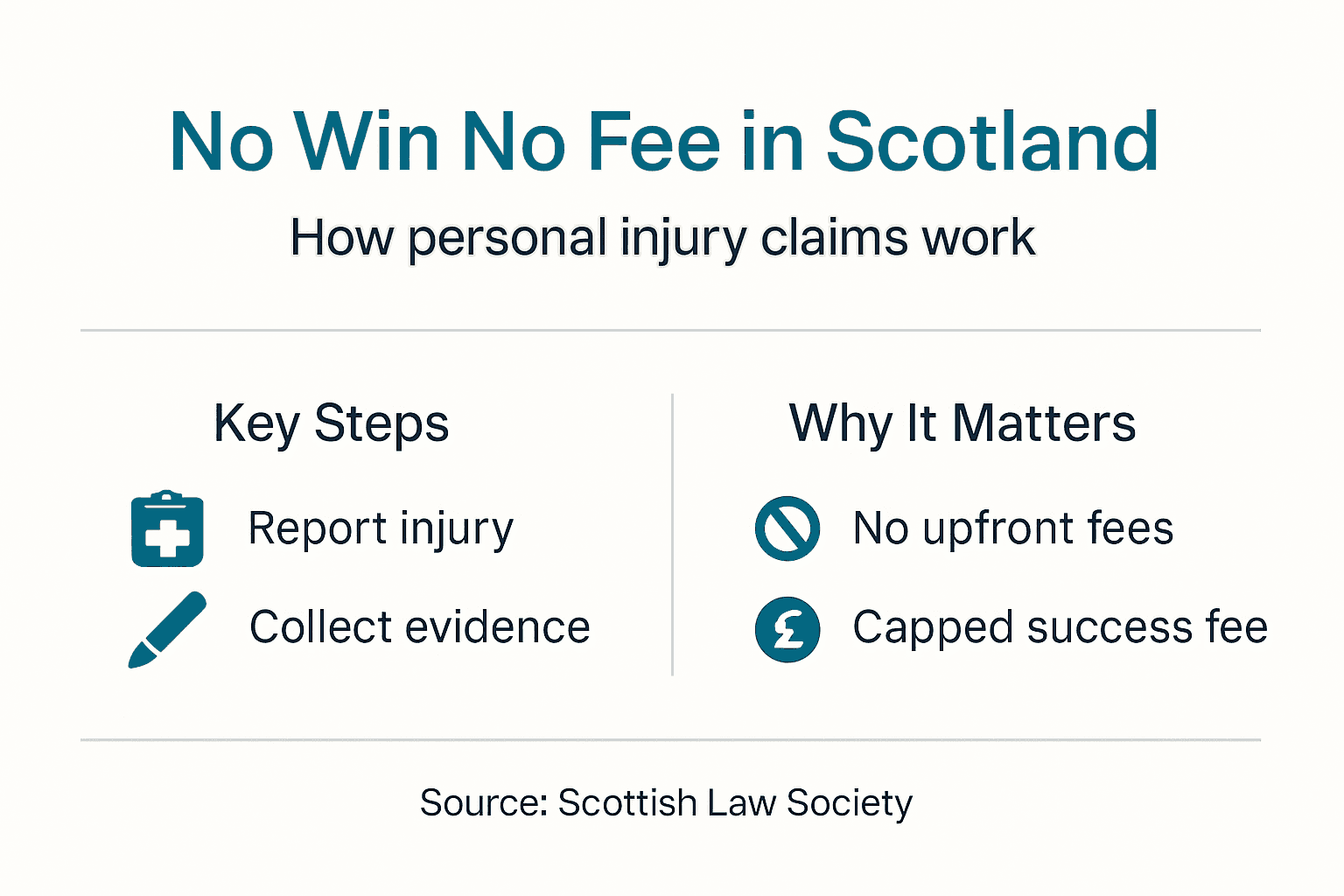
For more details on No Win No Fee legal fee arrangements, remember that legitimate solicitors never pressure you to sign immediately or charge consultation fees. Take time to compare options and choose a solicitor you trust completely.
Common Mistakes to Avoid When Reporting an Accident
Understanding the correct procedures is important, but knowing what not to do is equally crucial. Avoiding common mistakes protects your claim and maximises your compensation.
Don’t delay reporting the accident to authorities or your employer. Delays in reporting and insufficient evidence frequently cause claims to fail because late reports raise credibility questions. Immediate reporting creates a contemporaneous record that’s harder to dispute.
Avoid postponing medical treatment even if injuries seem minor initially. Insurers argue that delayed treatment means injuries weren’t serious or were caused by something else. Gaps in medical records weaken your claim significantly.
Never neglect evidence collection. Thinking “someone else will handle it” or “I’ll remember the details” leads to lost evidence and weakened claims. Accident scenes change quickly, and memories become unreliable. Act immediately to preserve crucial evidence.
Other critical mistakes to avoid:
- Missing the strict three-year limitation deadline for starting your claim
- Posting about your accident or injuries on social media, which insurers monitor
- Accepting early settlement offers without legal advice, which are often undervalued
- Signing documents or giving recorded statements to insurers without solicitor review
- Hiring solicitors who lack specific expertise in Scottish personal injury law
- Failing to clarify all No Win No Fee agreement terms before signing
Pro Tip: Never admit fault at the accident scene or in official reports, even if you think you’re partly responsible. Liability is complex and statements made immediately after accidents can be misinterpreted.
Don’t communicate directly with the other party’s insurers without legal representation. They’re trained to minimise payouts and may use your statements against you. Politely refer them to your solicitor once you’ve appointed one.
Avoid exaggerating injuries or providing inconsistent accounts. Honesty is crucial because insurers investigate claims thoroughly. Discrepancies between your statements and evidence destroy credibility and can lead to claim rejection.
For additional guidance on how to avoid mistakes in Scottish accident claims, remember that most errors happen in the first days after an accident when you’re stressed and in pain. Having a clear action plan and expert support prevents costly mistakes.
Expected Outcomes, Timelines, and Next Steps
Understanding what happens after you report your accident and start your claim helps set realistic expectations and reduces anxiety during the process.
Most personal injury claims in Scotland settle out of court within months to a year. Simple cases with clear liability and well-documented injuries often settle quickly. Complex cases involving disputed liability, serious injuries, or multiple parties take longer because they require extensive investigation and negotiation.
No Win No Fee agreements protect you throughout the claim process. You never pay upfront legal costs, and if your claim fails, you owe nothing. Success fees are capped to ensure you retain the majority of your compensation. This arrangement removes financial stress and allows you to focus on recovery.
Key factors affecting your claim timeline:
- Severity and complexity of your injuries
- How clearly liability is established
- Quality and completeness of your evidence
- Insurer cooperation and willingness to negotiate fairly
- Whether court proceedings become necessary
Pro Tip: Your solicitor can provide a realistic timeline estimate once they’ve reviewed your case details. Ask for regular updates so you always know where your claim stands.
Success fees typically range from 15-20% of your compensation and cover all legal work. This percentage is clearly stated in your agreement and never changes mid-claim. You keep 100% of compensation if you win under some arrangements, with fees paid by the other side.
Choosing an experienced solicitor significantly improves settlement outcomes. Expert negotiators secure higher compensation and resolve claims faster by presenting compelling evidence and countering insurer tactics effectively. They also identify all compensation categories you’re entitled to, including future losses that inexperienced claimants often miss.
For detailed information about personal injury claim timelines in Scotland, remember that patience combined with expert legal support delivers the best results. Rushing to settle often means accepting less than your claim is worth.
Get Expert Legal Help Without Upfront Costs
Now that you understand how to report an accident and build a strong claim, taking the next step is straightforward. Scotland Claims connects you with No Win No Fee solicitors in Scotland who specialise in personal injury claims and work on a completely risk-free basis.
Our network of expert solicitors handles road traffic accidents, injury at work claims support, and public place injuries with transparent fee structures and proven success rates. You pay nothing to start, nothing if you lose, and benefit from capped success fees that protect your compensation. Get in touch today to discuss your case with experienced professionals who understand Scottish law and fight for maximum compensation. Learn what happens after making a claim by speaking with our team.
How to Report an Accident: Frequently Asked Questions
What is the legal time limit to report an accident in Scotland?
You must start your personal injury claim within three years from the accident date or the date you became aware your injury was linked to negligence. Missing this deadline means losing your right to compensation permanently, regardless of how strong your case is.
Can I report an accident without paying any upfront legal fees?
Yes, No Win No Fee solicitors mean you pay nothing to start your claim and nothing if your case fails. Success fees are only deducted from your compensation if you win, and these fees are capped by Scottish law at 15-20%.
What evidence is most important to collect after an accident?
Photographs of the scene and your injuries, witness contact details and statements, and official reports from police or employers are crucial. Medical records documenting your injuries and receipts proving financial losses also strengthen your claim significantly.
How do I choose the right solicitor for a Scottish personal injury claim?
Select lawyers who specialise in Scottish personal injury law and have proven success in cases similar to yours. Verify they offer transparent No Win No Fee agreements with clearly stated, capped success fees. Check reviews and ensure they communicate clearly and keep you informed throughout the process.
Recommended