Why Seek Legal Help After Accident in Scotland

Suffering an unexpected injury in Scotland can turn daily life upside down, especially when medical bills, lost wages, and complex paperwork pile up. Accessing legal help here means you benefit from specialist advice, support with evidence gathering, and direct representation against responsible parties—all without paying anything upfront. Discover how a qualified solicitor can handle insurers, protect your rights, and help secure the compensation you deserve, with options like No Win No Fee and legal aid putting professional support within reach regardless of income.
Table of Contents
Key Takeaways
| Point |
Details |
| Legal Help is Essential |
Seek legal support after an accident in Scotland to navigate the claims process effectively and maximise compensation. |
| Understanding Rights |
Know your rights, including the right to legal representation and compensation for injuries caused by negligence. |
| No Win No Fee Accessibility |
The No Win No Fee arrangement allows individuals to pursue claims without upfront costs, removing financial barriers. |
| Act Promptly |
Initiate your claim within three years of the accident to avoid losing your right to compensation and preserve essential evidence. |
What Seeking Legal Help Involves
Getting legal help after an accident in Scotland means accessing support that covers advice, representation, and paperwork assistance. The process varies depending on your circumstances, but typically involves working with solicitors or legal aid services to build your case and pursue compensation.
Here’s what the journey generally includes:
- Initial consultation – A solicitor reviews your accident details, injuries, and circumstances to assess your claim
- Evidence gathering – Collecting medical reports, witness statements, accident scene photos, and other supporting documentation
- Legal advice – Understanding your rights and the realistic value of your claim
- Negotiation – Communication with insurers or the responsible party’s legal representatives to reach a settlement
- Court representation – If needed, your solicitor represents you in tribunal or court proceedings
Most accident claims in Scotland start with advice and assistance, which covers initial legal work and case preparation. Your solicitor will guide you through each step, explaining what happens next and what you need to do.
Understanding Legal Funding Options
You don’t need money upfront to pursue a claim. Many solicitors work on a No Win No Fee basis, meaning you pay nothing if your case is unsuccessful. If your case succeeds, your solicitor’s costs typically come from your compensation, allowing you to keep 100% of your award.
For those with limited income, legal aid schemes in Scotland provide access to free or subsidised legal services. These cover advice, representation, and help with legal documentation.
What Your Solicitor Handles
Your legal representative takes on significant responsibilities:
- Communicating directly with insurers and other parties on your behalf
- Preparing all necessary legal paperwork and court documents
- Managing timelines and procedural requirements
- Negotiating settlement offers
- Representing you if your case goes to court
- Ensuring you understand every stage of the process
Most accident claims settle through negotiation rather than court proceedings, meaning faster resolution and less stress for you.
The entire process takes time. Simple claims may settle within months, whilst complex cases involving serious injuries can take longer. Your solicitor keeps you informed throughout.
Pro tip: Start your claim as soon as possible after your accident—gather evidence while details are fresh and witness contact information is readily available.
Types Of Accidents Legal Help Covers
Personal injury claims in Scotland cover a wide range of accident scenarios. Whether your injury resulted from a workplace incident, traffic accident, or slip on someone else’s property, legal help is available to secure compensation for your losses.
Here are the main accident types that legal representation covers:
To clarify how different accident types are addressed legally, see the comparison below:
| Accident Type |
Typical Defendant |
Liability Basis |
| Road traffic collision |
Other driver or insurer |
Negligence or breach of duty |
| Workplace injury |
Employer or insurer |
Health & safety failure |
| Slip, trip or fall |
Property owner/business |
Occupier’s liability |
| Sports/leisure accident |
Club or organiser |
Failure to ensure safety |
| Animal-related injury |
Animal owner |
Failure to control animal |
| Assault/violence |
Perpetrator/insurer |
Intentional or reckless act |
| Medical treatment issue |
Healthcare provider |
Unintended procedural harm |
- Road traffic accidents – Car, motorbike, or bus collisions where another party’s negligence caused injury
- Workplace injuries – Accidents occurring during employment due to inadequate safety measures or employer negligence
- Slips and trips – Falls on someone else’s property caused by hazardous conditions or poor maintenance
- Sports and leisure injuries – Accidents during organised activities where negligence contributed to your harm
- Animal-related injuries – Dog attacks or injuries caused by someone’s failure to control an animal
- Assaults and violence – Physical injuries sustained through violent incidents
- Medical treatment complications – Adverse outcomes from treatment procedures (excluding medical negligence claims)
Road Traffic Accidents
Car accidents represent the most common claim type. Your solicitor can pursue compensation against the at-fault driver’s insurance even if the claim becomes complicated. Hit-and-run incidents and accidents involving uninsured drivers can still result in successful claims through specialist schemes.

Workplace and Occupational Injuries
Employers have a legal duty to maintain safe working conditions. Injury at work claims cover accidents caused by inadequate equipment, insufficient training, hazardous environments, or management failures. Your employer’s liability insurance typically covers these claims.
Slips, Trips, and Falls
Property owners and businesses must maintain reasonably safe premises. Slip and trip injury claims arise from wet floors, broken pavements, poor lighting, or unmarked hazards. Compensation covers injuries sustained when a property holder’s negligence created dangerous conditions.
Understanding Compensation Scope
Regardless of accident type, compensation typically covers medical costs, lost earnings, travel expenses, and pain and suffering. Understanding what your specific claim might be worth helps set realistic expectations.
Different accident types have different liability rules, but your solicitor handles all the legal complexities—you focus on recovery.
Each accident claim is unique. Your solicitor assesses the specific circumstances, identifies responsible parties, and builds a case tailored to your situation.
Pro tip: Document everything immediately after your accident—photographs, witness names, medical records, and a detailed account of what happened—as this evidence becomes invaluable when building your legal case.
Key Rights And Responsibilities After Injury
After sustaining an injury through an accident in Scotland, you have legal rights protecting you from financial hardship and ensuring fair compensation. Understanding these rights helps you take appropriate action and avoid mistakes that could weaken your claim.
Your key rights include:
- Right to seek compensation – You can pursue damages for injuries caused by someone else’s negligence or breach of duty
- Right to legal representation – You can engage a solicitor to handle your claim without upfront costs
- Right to information – You can access details about the responsible party’s insurance and liability
- Right to medical treatment – You can pursue compensation for reasonable healthcare costs caused by your injury
- Right to time limits – You generally have three years from the date of injury to lodge a claim in Scotland
When an accident occurs, acting quickly protects your claim. Health and safety responsibilities mean you must report your injury to the appropriate parties immediately. In workplace accidents, inform your employer right away. For all incidents, seek medical attention promptly and document everything.
Keeping detailed records is crucial. Write down what happened, collect witness contact information, take photographs of the accident scene and your injuries, and preserve any physical evidence. Store medical reports, receipts for treatment costs, and proof of lost earnings.
Employer Obligations
Your employer bears responsibility to provide a safe working environment. They must assess risks, provide appropriate training, maintain safe equipment, and implement protective measures. Failure to meet these duties creates grounds for a compensation claim.
The Three-Year Limitation
Scotland’s legal system sets strict time limits. You must begin your claim within three years of the injury date. Starting your case early gives your solicitor time to gather evidence whilst memories are fresh and witnesses remain contactable.
Your time to act is limited—the three-year window closes quickly, so contacting a solicitor soon after your injury protects your legal position.
Most people don’t realise time limits exist until it’s too late. Don’t delay in seeking legal advice.
Pro tip: Contact a solicitor within weeks of your accident, not months—early legal involvement ensures deadlines are met and evidence gathering begins while everything is recent and traceable.
Potential Risks Of Not Seeking Legal Support
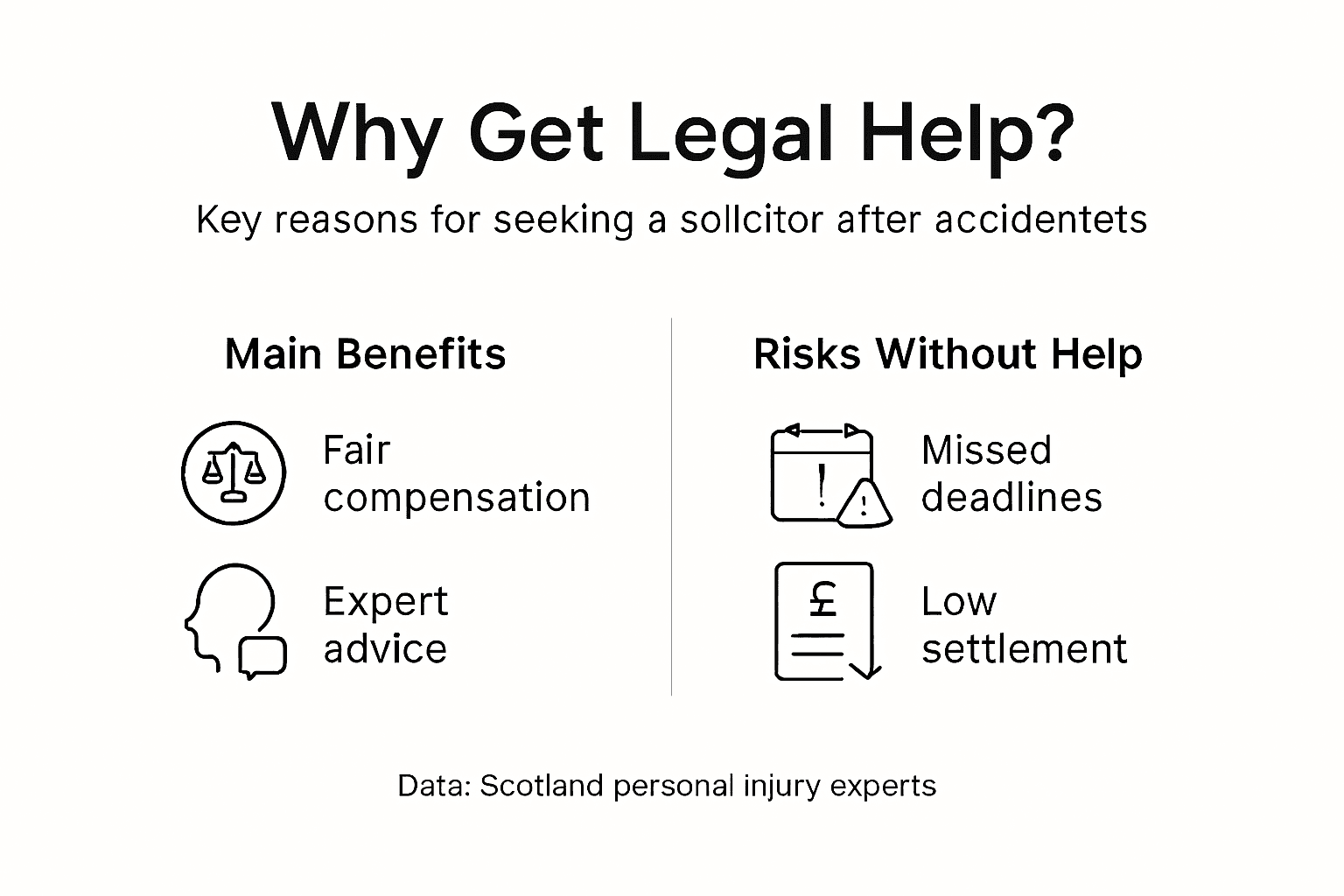
Choosing not to pursue legal help after an accident leaves you vulnerable to financial loss and missed compensation opportunities. Without professional representation, navigating the claims process becomes considerably more difficult and costly.
Here are the main risks you face:
- Missing the deadline – The three-year time limit passes quickly; delay too long and you lose your right to claim entirely
- Accepting lowball offers – Insurers exploit unrepresented claimants by offering settlements far below what claims are actually worth
- Inadequate evidence – Without proper investigation, crucial evidence gets lost, weakening your case significantly
- Procedural errors – Missing filing deadlines, incorrect paperwork, or procedural mistakes can result in claim rejection
- Financial hardship – Medical bills, lost income, and rehabilitation costs accumulate whilst you remain uncompensated
- Psychological stress – Handling negotiations alone whilst recovering from injury creates unnecessary strain
The Cost Of Accepting Undervalued Settlements
Insurance companies know most injured people lack legal knowledge. They exploit this by offering settlements substantially lower than actual claim values. Without a solicitor to challenge their figures, you accept whatever they propose. The difference between a fair settlement and an inadequate one can reach tens of thousands of pounds.
Time Limits That Cannot Be Extended
Scotland’s three-year deadline is absolute. Once it expires, your right to compensation vanishes permanently. Many people don’t realise this deadline exists until it’s too late. Procrastination costs claims entirely—there are virtually no exceptions to this rule.
Evidence Deterioration
Without early legal involvement, crucial evidence disappears. Witnesses relocate or forget details. CCTV footage gets deleted after weeks. Medical records become harder to retrieve. Your solicitor acts immediately to preserve everything whilst memories remain sharp and documentation is accessible.
Proceeding alone without legal representation typically results in significantly lower compensation—often 30-50% less than what specialist solicitors achieve.
The false economy of “saving” solicitor costs usually backfires dramatically. Most injury claims settle through negotiation, and professional negotiators secure substantially better outcomes.
Pro tip: Contact a solicitor for a free initial consultation within days of your injury—this costs nothing and protects your claim without financial risk, whilst No Win No Fee arrangements ensure you pay nothing if unsuccessful.
How No Win No Fee Makes Claims Accessible
The No Win No Fee arrangement removes the primary barrier preventing injured people from pursuing compensation. This funding model means you access specialist legal representation without paying upfront costs, regardless of your financial circumstances.
Here’s how it works:
- No payment if unsuccessful – You pay nothing if your claim fails, protecting you from financial loss
- Costs come from compensation – If successful, your solicitor’s fees are deducted from your award
- You retain 100% of compensation – The settlement amount you receive remains yours after legal costs are covered
- Risk transfers to solicitor – Your lawyer assumes the financial risk, motivating them to build the strongest possible case
- Access regardless of income – No minimum earnings or savings required to qualify
Removing Financial Barriers
Traditionally, injured people faced impossible choices: pay substantial upfront legal fees or pursue claims alone. No Win No Fee claims eliminate this dilemma entirely. You work with experienced solicitors without financial risk, knowing you pay nothing unless your case succeeds.
This arrangement particularly benefits those facing medical bills and lost income. Rather than draining savings for legal representation, your funds focus on recovery and living expenses whilst your solicitor handles the claim.
How Solicitors Manage The Risk
Solicitors accepting No Win No Fee cases assess claims carefully. They only take cases with genuine prospects of success, meaning your solicitor believes in your claim’s viability before starting work. This filter actually benefits you—weak cases are rejected, protecting your time and energy.
The Success Incentive
When your solicitor’s income depends on winning your case, their motivation aligns perfectly with yours. They invest significant time and resources to maximise your compensation because higher awards mean higher fees. This creates genuine partnership rather than transactional service.
No Win No Fee arrangements mean your solicitor profits only when you win—their financial interest directly supports your success.
You benefit from a solicitor wholly committed to achieving the best possible outcome. There’s no conflict between your interests and theirs.
What “No Win No Fee” Actually Covers
This arrangement typically covers solicitor time and case preparation. Court costs and expert witness fees may be covered separately through insurance protection, meaning you’re shielded from unexpected expenses.
Pro tip: Ask your solicitor to explain exactly what’s covered under the No Win No Fee agreement before starting—clarifying insurance protection and any potential costs ensures you understand your financial position completely.
To help you understand No Win No Fee compared to legal aid, see this summary:
| Feature |
No Win No Fee |
Legal Aid Scheme |
| Upfront cost |
None |
Usually none |
| Eligibility |
Any financial situation |
Must meet means criteria |
| Who pays solicitor |
Paid from compensation |
State covers most legal costs |
| Risk to claimant |
No fee if unsuccessful |
Minimal if successful/eligible |
| Popularity |
Most common for accidents |
Used for complex or serious |
Secure the Compensation You Deserve with Expert Legal Support
After experiencing an accident in Scotland the challenges of navigating the legal system and meeting strict deadlines can feel overwhelming. You may be worried about managing complex paperwork negotiating with insurers or simply understanding your rights without facing upfront costs. The article highlights key concerns such as the risk of missing the three-year time limit low settlement offers and the importance of early evidence gathering. These are common pain points that Scotland Claims is designed to solve.
At Scotland Claims we connect you with specialist injury solicitors who work on a No Win No Fee basis ensuring you pay nothing unless you win your case. From road traffic accidents to workplace injuries and slip or trip claims our legal experts handle the entire process keeping you informed and protecting your interests. Don’t leave your compensation to chance when you can get free initial advice and let professionals navigate the complexities for you.
Take control of your claim today visit Scotland Claims to start your risk-free consultation or explore detailed guidance on workplace injury claims and slip or trip accidents. Act now to safeguard your rights and maximise your compensation before critical time limits pass.
Frequently Asked Questions
Seek medical attention right away and document everything related to the accident, including witness contact information and photographs of the scene. Reporting the incident to the necessary parties is also crucial.
How can legal representation help me after an accident?
A solicitor provides essential support by communicating with insurers, gathering evidence, negotiating settlements, and representing you in court if necessary, ensuring you receive appropriate compensation for your injuries.
What is a No Win No Fee arrangement?
A No Win No Fee arrangement means you don’t pay legal fees upfront. If your claim is unsuccessful, you pay nothing; if it’s successful, your solicitor’s fees are deducted from your compensation, allowing you to retain the majority of your award.
How long do I have to file a claim after my injury?
You generally have three years from the date of your injury to lodge a claim. Acting quickly is important to ensure you meet this deadline and to preserve evidence while details are fresh.
Recommended