
Could a scar that looks small still have a lasting effect on your confidence, work or daily life? When assessing scarring compensation Scotland claims, appearance is only one part of the picture. The accident circumstances, the scar’s location and development, its lasting effects and the evidence available can all matter.
A visible injury can affect more than how you look, but it can be hard to tell whether your accident and scar could support a claim, what evidence may help or how legal fees affect what you receive. This guide explains the factors that may shape an assessment, which records and photographs to keep, and how the general three-year time limit may apply. It also explains why exceptions can matter.
Injury compensation may be assessed alongside relevant financial losses, such as documented treatment expenses or lost earnings. Scotland Claims Injury Lawyers charges no success fee, makes no deduction from your settlement and recovers its legal fees from the at-fault party’s insurer. If a claim is unsuccessful, you owe nothing. These terms don’t guarantee a claim or a particular award, but they give you a clear basis for understanding the fee arrangement before deciding what to do next.
Key Takeaways
- Find out when an accident-related scar may support a claim, including why another party’s negligence or breach of duty matters.
- See how scarring compensation scotland claims are assessed through evidence of appearance, pain, treatment and the injury’s wider effects.
- Learn what to keep to help show how the accident happened, how the scar changed and how it affects everyday life.
- Compare fee arrangements by checking whether a success fee is deducted, who pays legal costs and what happens if a claim fails.
- Understand the usual time-limit considerations and why it can help to discuss your circumstances and evidence early.
Scarring compensation in Scotland: when might an accident claim be possible?
A scar may form part of a personal injury claim, but its presence alone doesn’t create an automatic right to compensation. In a successful claim, damages for the injury and its effects may include the scarring. The key questions are whether another party was legally responsible for the accident, whether the accident caused or worsened your injury, and what evidence supports your account.
Injury, responsibility and evidence are separate parts of a claim: a scar shows an injury, while the accident circumstances and supporting evidence help establish whether another party may be liable. The injury’s effects are assessed separately from the question of who caused it.
Which accident-related scars could be considered?
Examples could include a facial cut from a road collision, a burn caused by an unsafe work situation or a wound from a fall on a hazard in a public place. A scar may result from the original injury or, in some cases, from an injury made worse by the accident.
The cause and circumstances matter more than the mere presence of a scar. A scar alone doesn’t prove that another party was at fault, and not every accident-related scar will lead to a successful claim. Evidence needs to help connect the injury to the incident and explain why another party may be responsible.
If the scarring resulted from a violent crime rather than an accident, a different route may apply. The Criminal Injuries Compensation Authority (CICA) administers a compensation scheme for victims of violent crime, including in Scotland.
Who may be responsible for the injury?
Responsibility usually depends on whether someone failed to take reasonable care or meet a duty they owed, and whether that failure caused or contributed to the injury. For example, careless driving, an unsafe working practice or a hazard left unattended in a public place could be relevant. Each case depends on its own facts.
Establishing responsibility isn’t the same as assessing the scar. First, evidence must support a link between the other party’s conduct and the injury. Then the injury’s physical and wider effects can be considered. Photographs, accident records and medical information may each help explain a different part of the claim.
If you need broader guidance about the legal process, read the Scottish injury lawyers guide. Start by writing down what happened, where it happened and how you were injured. A clear account can help you understand whether an accident claim may be possible.
How is scarring compensation assessed in Scotland?
There’s no fixed amount for a particular scar. An assessment depends on the available evidence, the injury’s effects and the circumstances of the case. A small scar may have a considerable effect on one person’s life, while a more visible scar may have different consequences for someone else.
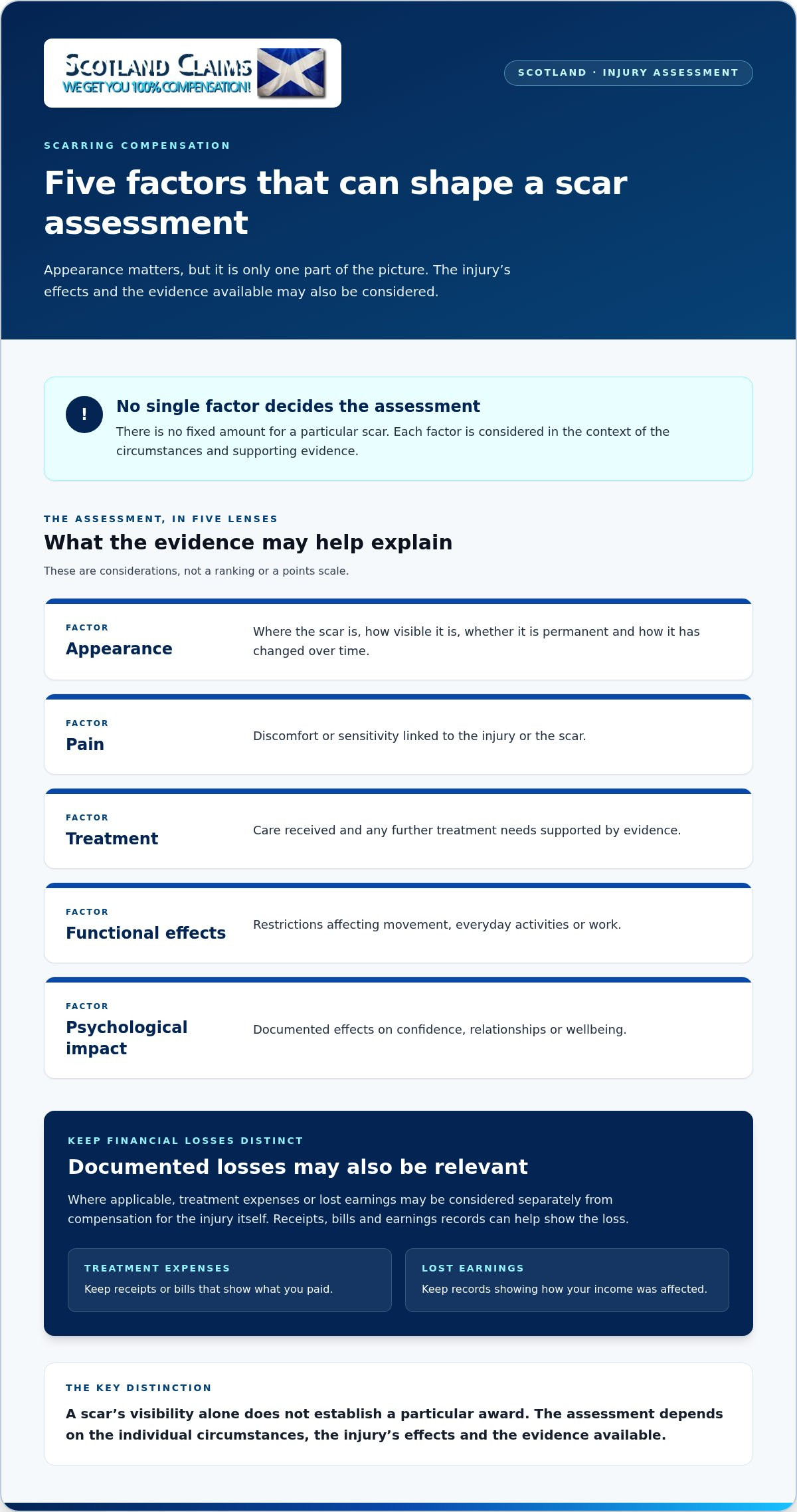
No single feature determines the assessment of a scarring injury. Location and appearance matter, but so can pain, treatment, practical limitations and psychological effects. The table summarises the types of impact that may be considered.
| Factor | What it may help explain |
|---|
| Appearance | The scar’s location, visibility, permanence and changes over time. |
| Pain | Discomfort or sensitivity linked to the injury or scar. |
| Treatment | Care received and any further treatment needs supported by evidence. |
| Functional effects | Restrictions affecting movement, daily activities or work. |
| Psychological impact | Documented effects on confidence, relationships or wellbeing. |
Does the scar’s appearance determine the outcome?
Appearance is one part of the picture. An assessment may consider where the scar is, how noticeable it is, whether it is permanent and how it has changed. Suitable evidence can help explain these details. A scar’s visibility alone doesn’t establish a particular award, and visible scars don’t automatically attract more compensation than less visible injuries.
Describe the practical changes as clearly as you can. Does the injury affect a task at work, make certain movements uncomfortable or change how you feel in social situations? The relevance of these effects depends on your circumstances and the evidence available.
What other losses may be relevant?
Compensation for the injury itself is distinct from financial losses. Where applicable, documented treatment expenses or lost earnings may also be considered as separate parts of a claim. Keep receipts, bills or earnings records that show what you paid or how your income was affected. A loss needs to be evidenced, not assumed.
The Scottish injury compensation calculator can provide an estimate to help you explore a potential claim. It isn’t a valuation guarantee: an individual assessment depends on the facts and supporting evidence. The Scottish Sentencing Council concerns criminal sentencing guidance, which is separate from assessing personal injury compensation.
For a clearer view of how your injury and documented losses may be considered, you can discuss your accident claim with Scotland Claims.
What evidence can support a scarring compensation claim?
Useful evidence helps build a clear account of four things: how the accident happened, what injury it caused, how the scar developed and how it affects you. You don’t need every item below for a scarring compensation Scotland claim. Keep what’s relevant and available, and continue to follow appropriate medical advice.
What should you record while the scar changes?
Photographs can help show how the scar looks over time. If you take them, use consistent lighting and distance, note the date and store the originals privately. Avoid filters, editing or retouching. Don’t delay seeking care or go against medical advice to take photographs.
Brief notes can capture details that may be hard to recall later. Record symptoms, treatment and practical effects on everyday activities, such as discomfort during a task or a change to your usual routine. Keep the entries factual and dated.
Your photographs and notes describe your experience, but they don’t replace a medical professional’s assessment of the injury, its development or its effects. A solicitor may arrange appropriate medical evidence as part of assessing the claim.
Which records can help explain the accident and its effects?
Use this checklist as a guide, not a list of requirements. Each item may help clarify a different part of your account, but none automatically proves who was responsible.
- Accident circumstances: incident reports, witness details and relevant correspondence may help record what happened and who was present.
- The injury and treatment: relevant medical records can document the injury, care received and symptoms reported.
- Progression: dated, unedited photographs and brief notes may show how the scar and symptoms changed over time.
- Practical impact and losses: notes about disrupted activities, along with receipts or lost earnings records where relevant, can help explain the effects and any financial loss.
Keep copies of records together, and note where you might obtain anything you don’t have. Don’t try to diagnose the injury or predict how the scar will develop. Medical evidence has a distinct role, while your records help describe what you experienced and when.
If your scar followed a road collision, Scotland Claims handles road traffic accident claims in Scotland. For any accident, an organised record makes it easier to explain the circumstances, injury and impact when discussing your claim with a solicitor.
How do scarring claim fees and compensation arrangements compare?
Before starting a scarring claim, separate three questions: whether the claim succeeds, who pays the legal fees and whether any fee is deducted from your settlement. “No win, no fee” arrangements can have different terms, so read the agreement rather than assuming they all work the same way.
| What to compare | What to establish |
|---|
| Who pays legal fees? | Find out how fees are dealt with if the claim succeeds. |
| Is a success fee deducted? | Check whether any fee comes out of your settlement. |
| What if the claim fails? | Confirm whether you would owe anything under the agreement. |
What does no win, no fee mean for a scarring claim?
In plain terms, a no-win, no-fee arrangement means legal fees depend on the outcome, subject to the agreement. Scotland Claims states that if your claim is unsuccessful, you owe nothing. The firm charges no success fee and makes no deduction from your settlement. Read the terms so you understand exactly what applies to your claim.
What does keeping 100% of compensation mean?
Scotland Claims’ 100% compensation model means retaining the settlement without a success-fee deduction. The firm recovers its legal fees from the at-fault party’s insurer instead. This is separate from your settlement and doesn’t mean a claim is guaranteed to succeed or that a particular amount will be awarded. The amount depends on the claim and its assessment.
This distinction matters when comparing scarring compensation Scotland arrangements. Focus on the written terms: who pays the legal fees, whether anything is taken from your settlement and what you owe if the claim is unsuccessful. Scotland Claims’ clients keep their full settlement, with no success fee or settlement deduction, and owe nothing if the claim fails.
For more detail on the firm’s fee terms, read Understand the firm’s no-win, no-fee approach.
How can you take the next step with a scarring claim in Scotland?
You don’t need to have every detail resolved before asking about a potential claim. Start with what you know, then use an assessment to understand what may need to happen next. This sequence can make scarring compensation Scotland feel easier to approach:
- Share what happened. Note when and where the accident occurred and how you were injured.
- Discuss the evidence. Mention any photographs, medical information, incident records or witnesses you know about.
- Assess the claim. A specialist solicitor can review the information and discuss whether a claim may be viable.
- Understand the next steps. Ask what further evidence may help, how fees work and what to expect from the claims process.
What information should you have ready?
If you can, write down the accident date and location, how the scar happened and who was involved. Gather any photographs, medical information and relevant incident details you already have. These can help explain your account, but you can still enquire if documents are missing. Don’t put off seeking advice just because you’re still gathering records.
What happens after an initial assessment?
Scotland Claims offers a free, no-obligation assessment through its 24-hour freephone helpline. A specialist solicitor reviews the information you provide and discusses whether a claim may be viable. If further steps are appropriate, you can ask what evidence may be needed and how the process and fee terms apply. An assessment doesn’t guarantee that a claim will succeed or determine the amount of any compensation.
Time limits matter. For most personal injury claims in Scotland, court proceedings must generally be started within three years. The period will usually run from the accident date, though in some cases it may run from the date of knowledge. Exceptions can apply, and the rules depend on the circumstances. Seek legal advice early rather than assuming you have the full period available.
Use the first conversation to get clear answers. Explain what you know about the accident and injury, then ask what information supports your account, what remains uncertain and what the next step would involve. This gives you a practical basis for deciding whether to proceed.
Take a clear next step with your scarring claim
A scar alone doesn’t determine whether a claim can succeed. The accident circumstances, who was responsible, the injury’s lasting effects and the evidence all matter. Keep relevant photographs and records, and seek advice promptly because most personal injury claims in Scotland are subject to a general three-year time limit, with exceptions that may apply.
Understanding scarring compensation scotland also means knowing what you would retain if a claim succeeds. Scotland Claims’ clients keep 100% of their settlement, with no success fee or deduction, and the firm recovers its legal fees from the at-fault party’s insurer. If a claim is unsuccessful, you owe nothing. This arrangement doesn’t guarantee a successful claim or a particular award. Scotland Claims is authorised and regulated by the Law Society of Scotland, and offers a free, no-obligation assessment through its 24-hour freephone helpline.
Start by explaining what happened and asking clear questions about evidence, fees and the process. Scotland Claims can provide a straightforward assessment to help you understand your options and decide what to do next.
Frequently Asked Questions
Can I claim scarring compensation in Scotland after an accident?
A claim may be possible if another party’s negligence or breach of duty caused or worsened your injury. The accident circumstances, available evidence and the scar’s effects all matter. A scar alone doesn’t prove responsibility or guarantee compensation. Scotland Claims offers a free, no-obligation assessment of accident-related claims. You can explain what happened and discuss whether a claim may be viable and what steps could follow.
How much compensation can I get for scarring in Scotland?
There’s no single amount that applies to every scar. An assessment may consider its appearance, location, permanence, symptoms, treatment and effect on daily life, alongside supporting evidence. Relevant financial losses, such as documented expenses or lost earnings, may also be considered separately. A calculator or general example can only offer an indication, not determine your award. An individual assessment is needed to consider your circumstances and evidence.
Does a scar have to be permanent to make a compensation claim?
Not necessarily. The injury and its effects need to be considered in context, including how the scar changes, any symptoms, treatment and lasting impact. Medical evidence may help explain these matters. A mark that remains doesn’t automatically mean a claim will succeed, and a changing scar doesn’t by itself rule one out. Whether another party was responsible and what the evidence shows are also important.
What evidence do I need for a scarring compensation claim?
Useful evidence may include medical records, dated photographs, accident details, incident reports and witness information, if available. Notes about treatment, symptoms and effects on everyday activities can help explain the impact. You don’t necessarily need every item: what’s relevant depends on your circumstances. Keep records you already have and follow appropriate medical advice. A solicitor can discuss which evidence may assist with assessing your particular claim.
How long do I have to claim scarring compensation in Scotland?
A three-year time limit generally applies to personal injury claims in Scotland, but the relevant start date and exceptions depend on the circumstances. Different rules may apply, for example, where the injured person is a child or lacks legal capacity. Don’t rely on a general summary to calculate your deadline. Seek qualified Scottish legal advice promptly so your situation and any applicable time-limit rules can be considered.
Will a no-win, no-fee scarring claim reduce my compensation?
It depends on the fee agreement, so check who pays legal costs, whether a success fee applies and whether anything is deducted from your settlement. Scotland Claims charges no success fee, makes no settlement deduction and recovers its fees from the at-fault party’s insurer. Clients owe nothing if a claim is unsuccessful. The firm explains the terms clearly before you proceed.
Can I claim for a scar caused by a workplace or public-place accident?
A claim may be possible if another party’s fault caused or worsened your injury in a workplace or public place. The circumstances and evidence need individual assessment; an accident or scar alone doesn’t establish responsibility. Scotland Claims handles workplace injury and slip-or-trip claims in Scotland. An assessment can help you understand whether a claim may be viable and what evidence may be relevant.