A fall alone doesn’t prove fault. To understand how to prove a slip and fall case in Scotland, you’ll need evidence that another party’s negligence caused the accident and your injury. According to UK legislation, a personal injury claim generally must be brought within three years of the accident date.
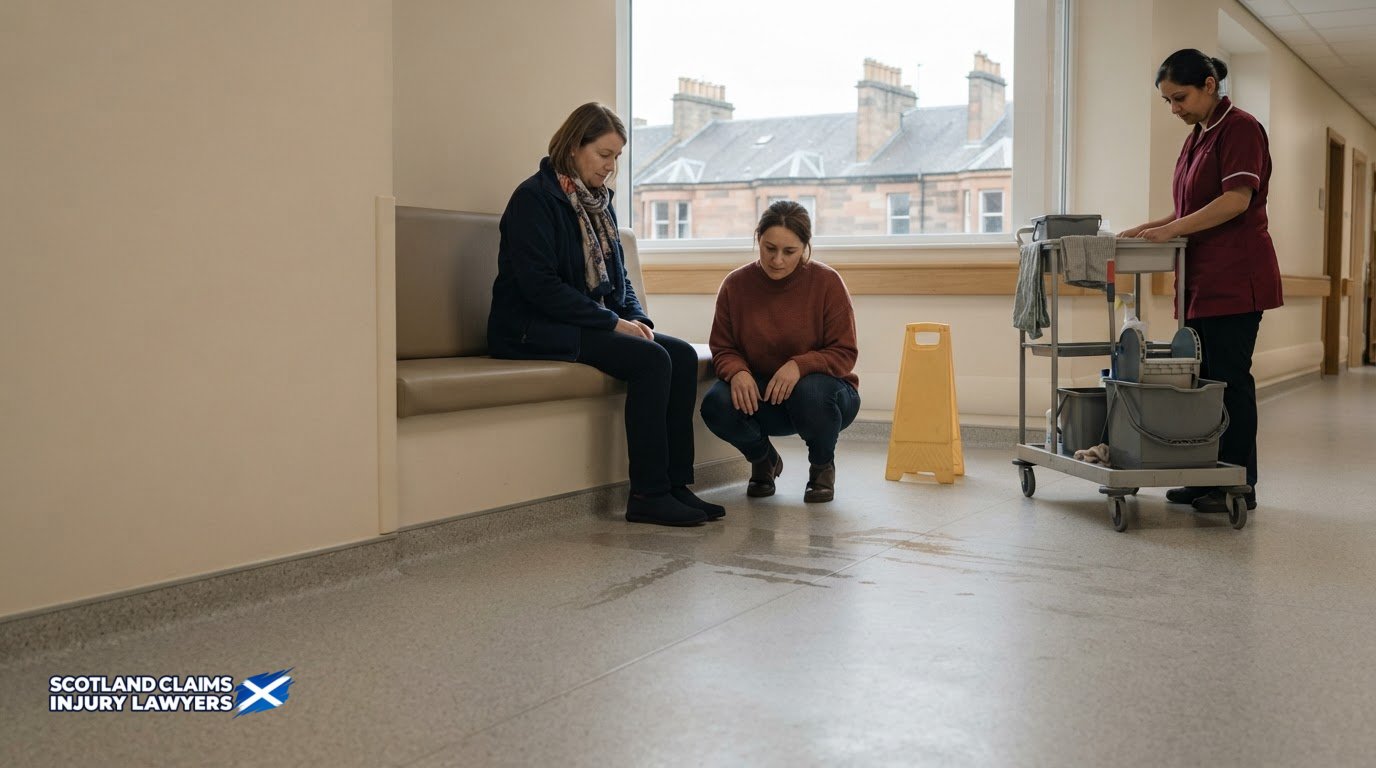
A hazard such as a wet floor may seem enough to prove responsibility, but the details matter: what caused the danger, who controlled the area and whether reasonable precautions were taken. A fall in a hospital corridor, for example, may raise questions about cleaning procedures, warning signs and what witnesses saw.
This guide explains how to prove a slip and fall case in Scotland, including evidence of fault, how your own actions may affect a claim, and what pain, expenses and lost earnings may be considered. It also covers how medical records and photographs can support your account.
Key Takeaways
- Build a clear account of what caused your fall, who controlled the area and what precautions were in place.
- Medical records and expense records can help show how the injury affected your health, income and day-to-day life.
- If your own actions contributed to the accident, your share of responsibility may reduce the compensation awarded.
- Photographs, witness details and available CCTV can preserve evidence that may otherwise be lost.
- In a workplace fall, cleaning routines, warning signs and the condition of the walkway can all help explain how the hazard arose.
What Evidence Do You Need for Slip and Trip Claims?
To establish a Scottish slip, trip or fall compensation claim, you need to show that another party’s negligence caused the accident and your injury. Evidence should connect the hazard, the person or organisation responsible, the fall and its consequences. A photograph of a broken paving slab, for example, is more useful when supported by an account of where and when you fell.
The cost depends on the funding agreement and the work needed for the claim. A no-win-no-fee agreement should explain any success fee, deductions and what happens if the claim fails. In Scotland, success fees are capped by law. A speculative fee arrangement may still leave a claimant responsible for the other party’s costs if the case is lost.
Gather records that help establish both fault and injury. Useful evidence can include:
- Photographs or video showing the hazard and the surrounding area.
- Witness names and contact details, with a note of what each person saw.
- An incident report, complaint correspondence or records of when the hazard was reported.
- Medical records showing the injury, treatment and its effect on your health.
- Receipts and wage records supporting expenses or lost earnings.
Responsibility depends on where the fall happened. The local council may be responsible for uneven paving on a public road or path; a fall inside a shop or other premises may involve the occupier. Council inspection, repair and complaint records can help show whether a defect was known, how long it existed and what action followed. The defect’s size may also matter when assessing whether reasonable precautions were taken.
According to UK legislation, a personal injury claim generally must be brought within three years of the accident date under the Prescription and Limitation (Scotland) Act 1973. Keep evidence promptly, as photographs, CCTV and witness recollections can become harder to obtain over time. Simple Scottish slip and fall cases with admitted liability are estimated to take 6 to 12 months; disputes and serious injuries can take longer.
A claims management company must register with the Financial Conduct Authority (FCA), but it isn’t usually a solicitor and may not be able to pursue compensation through the courts. A personal injury solicitor can assess evidence and advise on the legal route. Scotland-specific guidance is available through personal injury lawyers in Scotland.
Compensation for pain, suffering and financial losses
A Scottish slip or fall claim can include compensation for physical pain, emotional distress and financial losses caused by the accident. Compensation for pain and distress is known as solatium. The amount depends on the injury’s severity, treatment, recovery period and continuing effects. A sprained ankle that heals fully presents a different claim from a fracture requiring surgery or an injury that limits mobility.
Illustrative figures show how the injury and recovery can affect compensation. These are examples, not fixed tariffs for every accident claim.
Assess each loss separately and link it to the accident. Medical records can establish the injury and treatment; wage slips or employer records can show lost earnings. Keep receipts for medical expenses and travel, and records of any care needed because of the injury. A clear timeline can show how the accident affected work, daily tasks and recovery.
Financial losses may include medical expenses, lost wages and care costs. Reduced mobility can also affect the support or assistance you need. The circumstances matter: a short absence from work differs from lasting restrictions that affect future earnings. Travel costs may be included when supported by records. Expected recovery and continuing symptoms can also influence negotiations.
Many personal injury claims in Scotland are settled through negotiation without a court hearing. The parties consider evidence about fault, injury and losses before agreeing a settlement. A medical report can help assess the injury’s severity and likely recovery, while receipts and earnings records support financial losses. Weigh any early offer against the documented effects, not just immediate pain or missed work.
Benefits can affect compensation. Certain state benefits paid because of the injury may need to be repaid through the Compensation Recovery Unit. DWP benefits may also reduce compensation for corresponding losses, such as lost earnings, care costs or loss of mobility. This avoids paying twice for the same injury-related loss. The calculation should distinguish each type of loss and any relevant benefit.
For an initial estimate based on your injury and losses, use the personal injury compensation calculator. It can help organise the figures, while medical evidence and the circumstances of the fall remain central to a full assessment.
Contributory negligence
In a Scottish slip or fall claim, you must establish that someone’s negligence caused your injury. Liability depends on the hazard, who controlled the area and what reasonable precautions were taken. The Occupiers’ Liability (Scotland) Act 1960 sets out responsibilities for people in control of public places, according to UK legislation. Occupiers don’t have to remove every risk, but must take reasonable steps to protect lawful visitors.
Evidence should show how an organisation’s actions or omissions created a foreseeable hazard or failed to address one. A spill left on a walkway, for example, may prompt questions about inspections, cleaning and warning signs. For a defect in the ground, its size may matter when assessing whether the responsible party should have acted. The key is connecting the hazard, the failure to take reasonable precautions and the accident.
Contributory negligence concerns your own conduct. If it contributed to the accident or injury, compensation may be reduced to reflect your share of responsibility. That does not automatically mean you lose the whole claim. Any reduction depends on the evidence about what happened and how each party’s actions contributed.
For example, if someone is found 30% to blame for a car crash, their compensation is reduced by 30%. This example illustrates how a share of responsibility can affect an award; it isn’t a fixed percentage for a Scottish fall. In a slip claim, the relevant facts might include whether a hazard was visible, whether a warning sign was present and how the accident occurred.
The organisation may dispute negligence or argue that your actions contributed. It may challenge whether the hazard existed as described, whether it caused the fall, or whether reasonable precautions were taken. Your account, witness evidence, photographs and relevant inspection or incident records can help address those points. Consider the evidence together: no single photograph or statement is necessarily conclusive.
Assess the issues in sequence. First, identify who controlled the location. Next, establish what hazard caused the fall and what precautions were taken. Then consider whether your own actions affected the accident or injury. For example, evidence of a wet floor and a nearby warning sign may raise questions about the sign’s visibility and position, and whether another route was available.
Keep your account precise. Record what you noticed before falling, where you stepped and what happened immediately afterwards. If your recollection differs from an incident report, explain why and provide supporting details. This helps assess negligence, liability and contributory negligence based on the circumstances, rather than assumptions about how someone should have behaved.
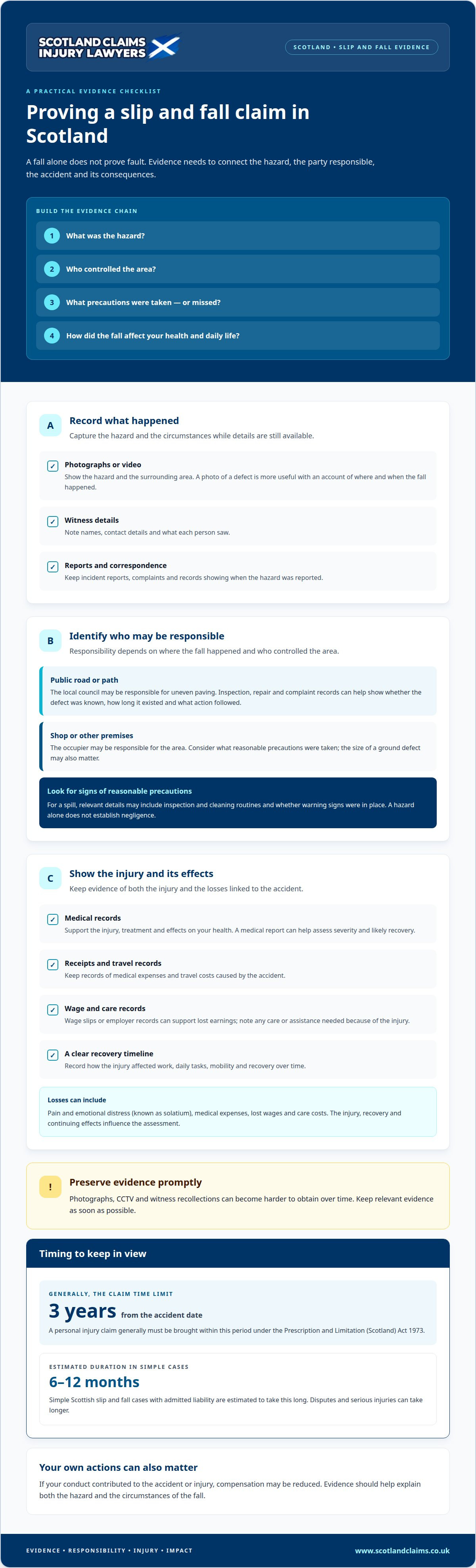
Photographs, witness details and other evidence to gather
Evidence is strongest when it shows the hazard, the circumstances of the fall and the resulting injury. Photographs, witness accounts, CCTV and medical records can each add a different part of the picture.
Photographs, CCTV and Witness Evidence
Photograph the hazard from several angles, including a wider view that shows its location and the route around it. If you fell on ice, include an object such as a coin or shoe for scale. Note the time and place, and preserve any phone footage. Record witnesses’ names and contact details, then note what each person saw while their recollection is fresh.
CCTV may show the hazard before the fall, how long it was present and whether staff responded. Note nearby cameras and the approximate time of the incident so relevant footage can be identified. Footage may be overwritten, so tell your solicitor about it promptly. A&E reports and later medical records can also support your account of when symptoms began.
Evidence Needed to Establish Liability
To establish liability, evidence needs to connect the hazard to the fall and identify who controlled the area. An incident report, photographs, witness details and medical records can help show what happened and the injury suffered. For example, footage showing a spill before a fall may help establish the sequence, while a medical record documents the injury afterwards.
Keep records showing how the injury affected daily life. Receipts for related expenses and documents showing missed work can support financial losses. A specialist solicitor can organise the evidence, identify gaps and assess how it supports negligence. Evidence is more persuasive when dates, locations and descriptions are consistent across records.
Showing Awareness of a Slipping Hazard
How can you show a business knew or should have known about a hazard? Evidence may include earlier complaints, incident reports, inspection or cleaning records, and CCTV showing how long the hazard remained. A witness who saw staff pass the spill can add context. Taken together, these details may indicate whether the risk was noticed or could have been found through reasonable checks.
Making a claim usually involves preserving evidence, obtaining medical records, identifying the responsible party and presenting the claim for negotiation. Most Scottish personal injury claims settle without a court hearing; complex or disputed cases may proceed to the Sheriff Court. Legal advice helps assess the evidence and explain the next steps. The slip or trip claim process focuses on establishing responsibility and injury.
Workplace slip and fall in a hospital corridor
A Glasgow hospital employee’s fall shows why workplace claims depend on specific site evidence. She fell in July 2020 at a hospital operated by NHS Greater Glasgow and Clyde. Although she had passed areas with wet-floor signs, there were no warning signs where she fell. The location and position of signs therefore mattered to the account of the accident.
The hospital’s usual procedure was to mop one side of the corridor and leave the other dry. The employee said both sides were wet when she fell. That difference makes cleaning records, staff statements and witness accounts important. They can help establish whether the floor’s actual condition matched the procedure and whether anyone identified or marked the hazard.
In Scotland, employers must take reasonable care for workers’ safety. Workplace floors should be suitable for their use, and employers should keep them clear of spills or other substances likely to cause a fall. Walkways should be clearly designated where needed, lighting should be proper, and temporary hazards that cannot be cleared should be clearly marked.
For a corridor accident, useful lines of enquiry include:
- Which areas were wet, and where were warning signs placed?
- What cleaning procedure applied, and what did staff do that day?
- Were the floor, lighting and walkway suitable for hospital use?
- What did witnesses see before and immediately after the fall?
These details help assess how the accident happened and whether reasonable precautions were taken. A sign elsewhere in the corridor does not establish whether the wet area where the employee fell was clearly marked. Staff and witness statements can clarify the sequence, while relevant cleaning or incident records may show how the floor was managed.
Medical evidence connects the workplace fall to its effects. The employee attended a knee fracture clinic two days after the accident. Her injury was diagnosed as an overstretched medial ligament, with fluid behind the knee and bone bruising. A medical report estimated recovery would take 2-3 years, illustrating why the impact on health and work needs careful assessment.
That outcome relates to her particular evidence and injury, not to hospital falls generally. The practical lesson is to preserve workplace accounts, cleaning details, witness statements and medical records together. Their combined evidence can explain how the hazard arose and the seriousness of the resulting injury.
Scotland Claims Injury Lawyers: Slip or Trip Claims
Scotland Claims Injury Lawyers can assess whether the evidence supports a slip or trip claim and help you pursue compensation for your injury and losses. Its Slip or Trip Claims service is for falls in Scotland that may have resulted from another party’s negligence. The firm is regulated by the Law Society of Scotland.
The firm works on a no-win-no-fee basis and promises 100% compensation. This means it recovers its fees from the at-fault party and passes the entire settlement to you. Your records of the accident, medical treatment and financial losses can help build a clear picture of the claim.
If you’d like support assessing a slip or trip claim, contact Scotland Claims Injury Lawyers.
Take the next step with confidence
To prove a slip and fall case in Scotland, turn the available evidence into a clear account of responsibility and impact. A specialist assessment can help identify what needs to be established, which records matter and how to address any dispute about your actions or the hazard.
Scotland Claims Injury Lawyers handles slip or trip claims, as well as road traffic accident and work injury claims across Scotland. If your fall happened at work, its work injury service may also be relevant. A review of the circumstances, evidence and losses connected to the accident is a practical next step.
Taking advice can help you move forward with a clearer understanding of your options.
Frequently Asked Questions
What Must You Prove to Win Your Claim?
To win, establish that another party’s negligence caused both the fall and your injury. Build a clear chain: identify the unsafe condition, show who controlled the area, then connect the fall to medical evidence. A dated incident report may establish the location and timing, while a clinical record documents the injury. A claim is harder to establish if the evidence does not connect the hazard to the accident.
How Much Compensation Can You Get?
Compensation depends on the injury, recovery and losses supported by evidence. These examples are not fixed amounts for every claim. A medical report describing symptoms and prognosis helps assess the injury, while evidence of specific financial losses supports the separate calculation of expenses and earnings.
Navigating Personal Injury Claims in Scotland: What Factors Affect Your Compensation?
Compensation reflects how the injury affected you, not just its name. Relevant factors include ongoing symptoms, treatment, effects on usual activities and documented financial loss. A medical report, for example, can explain why a knee injury prevents particular tasks, while a care record can describe assistance needed at home. Keep expense records separate so each cost can be linked to the accident and supported.
Are there different kinds of liability?
Yes. A fall in a shop or other premises may involve the occupier, while an uneven public pavement often involves the local council. A workplace fall may involve an employer’s responsibilities for workers’ safety. Responsibility for uneven paving in a private car park may depend on who controlled and maintained the area. The location helps identify who controlled the area, but the evidence must still connect their negligence to the injury.
Can I Claim Compensation for Slipping on Ice in Glasgow?
You may have grounds for a claim if the person responsible for the area failed to take reasonable precautions and that failure caused your injury. In Glasgow, establish whether the fall happened on a public pavement, inside private premises or at work, as responsibility may differ. Photographs from multiple angles can preserve the condition of ice. Include a coin or shoe for scale, and record the precise location and circumstances.
Can I make a claim if I was at fault?
You may still have a claim if your actions contributed to the fall. The evidence must establish what the responsible party did wrong and how your own conduct affected the accident or injury. For example, an assessment may consider both an unmarked spill and whether it was visible to you. If responsibility is shared, compensation can be reduced to reflect your contribution; being partly at fault does not automatically end the claim.
How Do You Show The Other Party Is Liable?
Show who controlled the location, what unsafe condition caused the fall and how a failure to take reasonable precautions contributed. Set out a timeline: when the hazard appeared, whether anyone reported it, what inspections or responses followed, and when you fell. Compare that timeline with witness statements, incident records and any available footage. Together, these details can help establish what the responsible party knew or should have identified.
What must be proved to win a slip and fall claim in Scotland?
To understand how to prove a slip and fall case in Scotland, establish negligence, causation and injury: another party failed to take reasonable care, that failure caused your fall, and you suffered harm. According to UK legislation, a personal injury claim generally must be brought within three years of the accident date under the Prescription and Limitation (Scotland) Act 1973. Evidence should therefore support both the circumstances and the injury.