Personal injury in Scotland: what to do next

TL;DR:
- If injured in Scotland due to someone else’s fault, you should act quickly to preserve evidence and contact a specialist solicitor. The three-year limit from the date of injury or knowledge applies, and missing it will forfeit your right to compensation. Most claims involve road traffic, workplace, slips, or product defects, with evidence and expert testimony being crucial to success.
If you were injured through someone else’s fault in Scotland, you can almost certainly pursue a personal injury claim. The single most important thing you can do right now is preserve your evidence and contact a specialist Scottish solicitor. Time is not on your side.

Under sections 17 and 18 of the Prescription and Limitation (Scotland) Act 1973, most claims must be raised within three years of the date of injury (or the date you first knew your injury was linked to someone else’s act or omission). A compulsory pre-action protocol applies to many of those claims, and the All-Scotland Sheriff Personal Injury Court (ASSPIC) offers an accessible route for cases that do not reach the Court of Session. Miss the three-year window and your right to compensation is almost certainly gone.
Your immediate checklist:
- Photograph the scene, your injuries, and any hazards before anything changes
- Note the names and contact details of witnesses
- Seek medical attention and ask for a copy of your records
- Report the accident formally (to your employer, the police, or the property owner)
- Contact a specialist Scottish personal injury solicitor without delay
Acting quickly after an accident protects both your evidence and your legal rights.
Table of Contents
What counts as a personal injury claim in Scotland?
Personal injury means harm to a person, whether physical or psychological, rather than damage to property. In Scottish law (and under the Court of Session rules), “personal injuries” expressly includes any disease or impairment, whether physical or mental.
The most common claim types are:
- Road traffic collisions — drivers, passengers, cyclists, and pedestrians injured by a negligent driver
- Accidents at work — injuries caused by unsafe systems, defective equipment, or inadequate training
- Slips, trips, and falls — on public pavements, in shops, or on poorly maintained premises
- Defective products — injuries caused by faulty goods
- Disease claims — including asbestos-related conditions where exposure is linked to an employer’s negligence
Personal injury law in Scotland covers a wide spectrum, from a soft-tissue whiplash injury after a low-speed collision to a life-changing spinal fracture sustained at work. The legal test is the same in both cases, but the financial stakes and the evidence required differ enormously. A minor whiplash claim may resolve quickly under a tariffed approach; a serious injury affecting future earnings and care needs will require detailed expert evidence and a much longer process.
Scotland Claims Injury Lawyers handles road traffic accidents, workplace injuries, and slips and trips. Criminal injuries compensation and medical negligence fall outside the firm’s scope.
Who can claim, and what are the time limits in Scotland?
The legal test for liability
A successful personal injury claim in Scotland must prove three elements of delict (the Scottish equivalent of negligence in English law): that a duty of care was owed to you, that the duty was breached, and that the breach directly caused your injury. All three must be established. Proving you were hurt is not enough on its own; you must show the other party was at fault and that their fault caused the harm.
Time limits: Scotland vs England and Wales
| Scenario |
Time limit |
Clock starts |
Interrupted by |
| Standard adult claim (Scotland) |
3 years |
Date of injury |
Service of proceedings |
| Latent injury / disease (Scotland) |
3 years |
Date of knowledge |
Service of proceedings |
| Child claimant (Scotland) |
3 years |
— |
Service of proceedings |
| Standard adult claim (England & Wales) |
3 years |
Date of injury or knowledge |
Issue of proceedings |
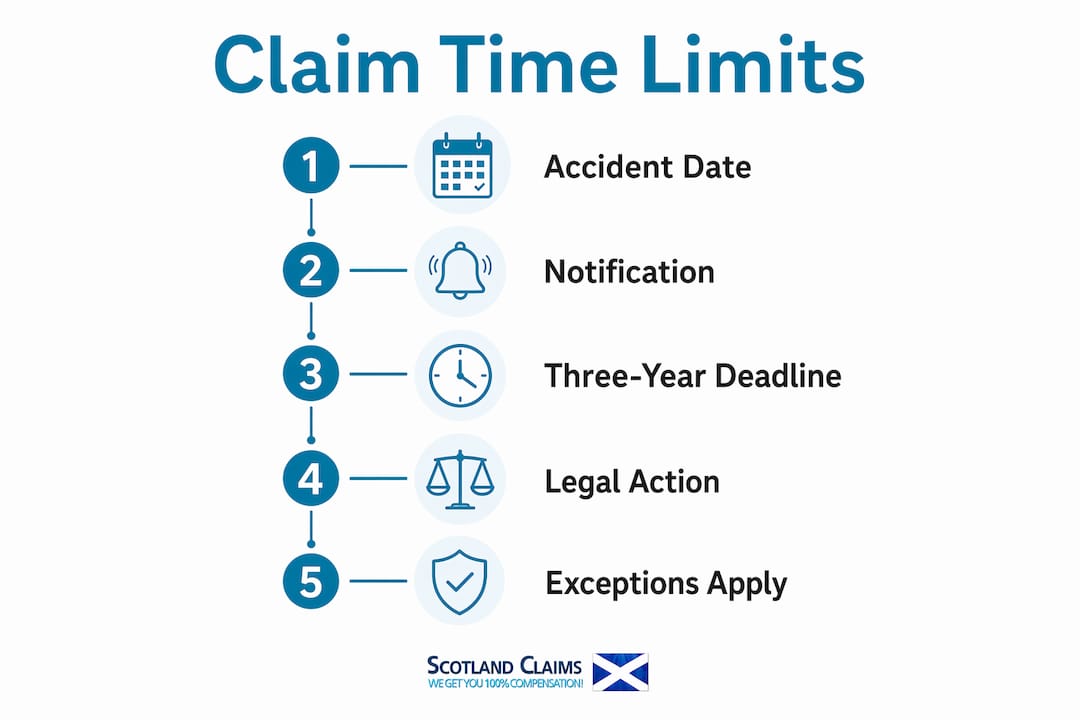
One critical point that catches many claimants out: in Scotland, notifying an insurer does not stop the three-year clock. Only the formal service of court proceedings interrupts the limitation period. Sending a letter of claim or registering a complaint with an insurer buys you nothing legally. Your solicitor must raise and serve proceedings before the deadline expires.
For low-value whiplash claims arising from road traffic accidents, separate reforms introduced tariffed damages and a specific portal process. If your claim falls into that category, early legal advice is particularly important to ensure the right route is taken.
What evidence do you need to support your claim?
Evidence quality is the single biggest factor separating claims that settle quickly from those that drag on or fail. Insurers defending claims look for gaps in the evidence trail; a well-documented claim gives them far less room to dispute liability or causation.
Core evidence to gather as soon as possible:
- Contemporaneous photographs of the scene, hazard, and your injuries (taken the same day where possible)
- Medical records and GP or hospital notes confirming the injury and its cause
- Witness names, addresses, and phone numbers (and written statements if you can get them)
- The accident report (employer’s accident book, police report, or incident log from the property owner)
- Receipts for all out-of-pocket expenses: travel, medication, physiotherapy, care costs
- CCTV or dashcam footage (request it immediately — many systems overwrite within 14–31 days)
The documents that support a settlement claim are often straightforward, but they must be gathered before memories fade and footage is deleted. Practitioners consistently stress that early, accurate documentation is the foundation of a successful claim; legal strategy alone rarely compensates for weak evidence.
Pro Tip: Back up every photo and message to a cloud service immediately and note the date and time each was taken. Screenshot the metadata if your phone allows it. A timestamped photo taken at the scene is far harder for a defender to challenge than one uploaded days later.
How does a Scottish personal injury claim progress?
Most claims follow a broadly predictable sequence, though the pace varies considerably depending on the complexity of the injuries and the defender’s approach.
- Initial enquiry and evidence review — your solicitor assesses your prospects, reviews the evidence you have gathered, and advises on funding and likely timescales.
- Letter of claim — a formal letter is sent to the defender (or their insurer) setting out the basis of liability and the nature of your injuries, as required by the pre-action protocol that applies to most personal injury cases in Scotland.
- Admission or denial of liability — the defender has a specified period to respond. An early admission can accelerate settlement; a denial means the claim moves towards litigation.
- Medical evidence and expert reports — an independent medical expert examines you and prepares a report. In complex cases, multiple experts (orthopaedic surgeons, neurologists, care experts) may be required.
- Negotiation and offers — once medical evidence is complete, offers are exchanged. Many claims settle at this stage without ever reaching court.
- Raising court proceedings — if no agreement is reached, your solicitor raises an action in the sheriff court or ASSPIC (or the Court of Session for high-value claims).
- Pre-Trial Meeting (PTM) — typically fixed about one month before the proof (trial) diet. The PTM is a frequently overlooked opportunity to resolve claims; many cases that appear destined for trial settle here.
- Proof (trial) — if the PTM does not produce agreement, the case proceeds to a hearing before a sheriff or judge who decides liability and quantum.
Resolution typically falls in a 12–18 month range for many claims, though expert availability, court timetables, and the defender’s strategy can extend that considerably. Straightforward road traffic claims with clear liability sometimes settle in months; serious injury cases with disputed causation can run for several years.
How are legal costs handled in Scotland?
No Win No Fee explained
Under a No Win No Fee arrangement (formally a conditional fee agreement), you pay nothing upfront and nothing if your claim fails. Legal fees are recovered from the at-fault party’s insurer when you win. Scotland Claims Injury Lawyers goes further: there is no success fee deducted from your compensation. You keep 100% of what is awarded. Many solicitors across Scotland charge a success fee of up to 20% (including VAT) from the claimant’s settlement. Scotland Claims takes nothing.
QOCS protection
Qualified One-Way Costs Shifting (QOCS) provides an important safety net for pursuers in Scotland. Under QOCS rules, an unsuccessful claimant is generally protected from having to pay the defender’s legal costs, unless the court finds the pursuer acted fraudulently or otherwise inappropriately. This significantly reduces the financial risk of bringing a claim.
Other funding routes
Some claimants have legal expenses insurance attached to their home or motor policy, which can cover solicitor fees. Private funding (paying a solicitor by the hour) is also possible but rarely the most practical route for personal injury claims. Whichever route you use, ask your solicitor at the outset exactly what expenses will be recovered from the insurer and whether any deductions will be made from your compensation.
Pro Tip: Ask your solicitor two specific questions before signing anything: “Will any amount be deducted from my compensation?” and “What happens to my disbursements if the claim fails?” The answers tell you everything about the real cost of the arrangement.
Citizens Advice Scotland notes that claims management companies are not the same as solicitors and may lack the right to take formal court action on your behalf. For any claim that might reach litigation, you need a qualified solicitor.
How do you choose the right solicitor in Scotland?
Not every solicitor who handles personal injury claims has meaningful experience in Scottish courts. The distinction matters because Scottish procedure, including the pre-action protocol, ASSPIC, and the PTM process, differs from practice in England and Wales.
What to check before instructing anyone:
- Demonstrable experience in Scottish sheriff courts and ASSPIC, not just general personal injury work
- Membership of the Association of Personal Injury Lawyers (APIL) or accreditation through the Law Society of Scotland’s personal injury specialist panel
- A clear explanation of the fee structure before you sign anything
- Named solicitor handling your file (not a call centre passing your case between handlers)
Questions to ask in your first call:
- What is the likely timescale for a claim like mine?
- Who will handle my file day-to-day and how will you update me?
- Will any amount be deducted from my compensation at settlement?
- Have you litigated cases in ASSPIC or the Court of Session?
Red flags to watch for:
- Vague or evasive answers about costs and deductions
- Inability to explain the pre-action protocol or what happens if liability is denied
- Pressure to sign paperwork immediately without time to read it
- No clear answer on who specifically will run your case
What compensation might you receive?
General damages (solatium) and special damages
Scottish personal injury compensation divides into two broad categories. General damages, known in Scotland as solatium, cover pain, suffering, and loss of amenity. Special damages cover financial losses: lost earnings, care costs, travel expenses, rehabilitation, and future losses where the injury affects your long-term earning capacity or care needs.
The Judicial College Guidelines (JC Guidelines) provide the framework solicitors and courts use to assess solatium. Awards vary significantly with injury severity, age, and the impact on daily life and employment. A soft-tissue neck injury resolving within a few months sits at the lower end of the scale; a serious spinal injury with permanent disability can attract solatium running into six figures, with special damages potentially far exceeding that.
Whiplash and low-value road traffic claims may follow a tariffed approach under the whiplash reforms, which cap solatium for minor soft-tissue injuries at fixed bands depending on recovery time. More serious injuries are assessed individually.
Use the compensation calculator at Scotland Claims Injury Lawyers to get an initial estimate, and read the detailed guide on how compensation is calculated in Scotland for a fuller picture of how awards are assessed. Every claim is fact-specific; a free assessment with a specialist solicitor is the only reliable way to understand what your particular case is worth.
This article is general information, not legal advice. Confirm the current rules and how they apply to your situation with a qualified Scottish solicitor.
What do claimants actually experience in Scotland?
Timeline realities
Resolution often falls in a 12–18 month range for many claims, but that figure masks considerable variation. Expert availability is one of the biggest practical constraints: a specialist orthopaedic or neurological report can take months to obtain, and court diets in busy sheriff courts are not always available quickly. Defenders sometimes use delay as a tactic, particularly where liability is disputed. Understanding from the outset that timelines are unpredictable helps claimants manage expectations without losing confidence in the process.
The PTM opportunity
The Pre-Trial Meeting deserves more attention than most claimants give it. Fixed roughly one month before the proof diet, it brings both sides’ solicitors together to discuss the case candidly. Many claims that looked certain to go to trial resolve at this stage, often because the defender’s solicitor reassesses the strength of the pursuer’s evidence when it is all laid out. An experienced litigation solicitor who knows how to present your case compellingly at PTM can make a material difference to the outcome.
Pro Tip: Ask your solicitor well in advance of the PTM what their strategy is for that meeting and what settlement figure they consider reasonable. Going into a PTM without a clear bottom line is one of the most common reasons claimants accept less than they should.
Insurers often settle rather than risk an adverse court judgment, particularly where liability is clear and evidence is strong. Building that strong evidence base from day one is what makes the PTM and any pre-PTM negotiations work in your favour.
When are claims barred or restricted?
Several scenarios can prevent or limit a personal injury claim in Scotland, and it is worth knowing them before you start.
Absolute time-bar: If the three-year limitation period under the Prescription and Limitation (Scotland) Act 1973 expires before proceedings are served, the claim is almost certainly gone. Courts have a discretion under section 19A of the Act to allow a late action to proceed where it is equitable to do so, but this discretion is exercised sparingly and is not a reliable safety net.
Contributory negligence: Where you were partly at fault for your own injury, your compensation is reduced proportionately. A pedestrian who crossed on a red light and was struck by a speeding driver might be found 25% contributorily negligent, reducing their award by that proportion. Contributory negligence does not bar a claim entirely; it adjusts the outcome.
Statutory compensation schemes: Certain work-related conditions, particularly industrial diseases covered by statutory benefit schemes, may be subject to recoupment rules where state benefits paid during the claim period are deducted from the settlement. This does not bar the claim but affects the net amount received.
Fraud and QOCS: A pursuer who is found to have acted fraudulently or to have provided fundamentally dishonest evidence loses QOCS protection and may face an adverse costs order. This is a serious consequence that underlines why accuracy in presenting your claim matters.
Excluded categories: Criminal injuries compensation and medical negligence fall outside the scope of Scotland Claims Injury Lawyers’ practice. If your injury arose from a criminal act, the Criminal Injuries Compensation Authority (CICA) operates a separate scheme; if it arose from clinical treatment, a specialist medical negligence solicitor is the appropriate route.
Alternative Dispute Resolution (ADR), including mediation, is available in Scottish personal injury cases and is increasingly encouraged by the courts. In mediation, an independent mediator facilitates negotiation between the parties without imposing a decision. Both sides retain control of the outcome, which is one reason insurers sometimes prefer it for mid-value claims where the cost of litigation is disproportionate.
ADR is not compulsory in most personal injury cases, but courts can take a dim view of a party who unreasonably refuses to engage with it. A solicitor who dismisses ADR out of hand without good reason may expose their client to a costs sanction. In practice, many personal injury claims in Scotland settle through direct negotiation between solicitors rather than formal mediation, but where liability is disputed and quantum is complex, a structured mediation session can break a deadlock that would otherwise cost both sides significantly more in court.
The PTM itself functions as a form of structured negotiation and is often more effective than formal mediation for personal injury cases, because both solicitors are already familiar with the evidence and the court timetable concentrates minds.
How do you handle claims with multiple liable parties?
Some accidents involve more than one party at fault: a road collision where two drivers share blame, a workplace accident where both an employer and a contractor are negligent, or a public liability claim where a property owner and a maintenance company are both responsible. These multi-defender claims are more complex but not unusual.
In Scotland, defenders can be sued jointly and severally, meaning you can pursue all of them together and each is liable for the full award. In practice, the defenders’ insurers negotiate between themselves about how to apportion liability; that is their problem, not yours. Your solicitor names all potentially liable parties in the initial letter of claim and, if proceedings are raised, in the court writ.
Where one defender is uninsured or cannot be traced (common in some road traffic cases), the Motor Insurers’ Bureau (MIB) provides a route to compensation for road accident victims. Your solicitor will advise whether the MIB scheme applies to your situation and handle the notification requirements, which have strict deadlines of their own.
The key practical point is to identify all potentially liable parties early. Attempting to add a new defender late in proceedings is procedurally difficult and can jeopardise the claim.
Key takeaways
In Scotland, most people injured by another party’s negligence can pursue a personal injury claim, but the three-year limitation rule under the Prescription and Limitation (Scotland) Act 1973 means acting quickly is not optional.
| Point |
Details |
| Three-year time limit |
The clock runs from the date of injury or knowledge; only service of proceedings stops it. |
| Evidence is decisive |
Contemporaneous photos, medical records, and witness details are the foundation of every successful claim. |
| No success fee with Scotland Claims |
Scotland Claims Injury Lawyers deducts nothing from your compensation; you keep 100% of your award. |
| PTM often settles cases |
The Pre-Trial Meeting, held roughly one month before proof, resolves many claims before trial. |
| Scotland Claims Injury Lawyers |
Specialist Scottish personal injury solicitors offering No Win No Fee with zero success fee deduction. |
Your immediate next steps:
- Preserve all evidence now (photos, CCTV requests, medical records)
- Note every witness’s contact details
- Check the three-year limitation clock for your specific date of injury
- Contact a specialist Scottish solicitor to protect your position
Start with a free case assessment from Scotland Claims Injury Lawyers.
Why Scotland-only focus changes the outcome
There is a version of personal injury practice that treats Scottish claims as a variant of English ones, applying broadly similar processes with minor adjustments. That approach costs claimants money and time. Scottish procedure has its own pre-action protocol, its own court structure (ASSPIC, the sheriff courts, the Court of Session), its own rules on service and time-bar, and its own approach to precognitions and witness evidence. A solicitor who litigates regularly in those courts knows how sheriffs approach credibility, how defenders’ solicitors behave at PTM, and which arguments land. That knowledge is not transferable from a different jurisdiction.
The no success fee model matters for a different reason. When a solicitor takes 20% of your compensation as a success fee, a £10,000 award becomes £8,000 in your hands. On a £50,000 settlement, that deduction is £10,000. Scotland Claims Injury Lawyers takes nothing from your award. The firm’s fees are recovered from the at-fault party’s insurer. That is the arrangement, and it is straightforward.
Transparent fees, a Scotland-only caseload, and litigation experience in the courts where your claim will actually be heard: those are the things that matter when you are choosing who to trust with a claim that may take 12–18 months to resolve.
Scotland Claims Injury Lawyers: no success fee, 100% compensation
Most solicitors handling personal injury claims in Scotland charge a success fee of up to 20% (including VAT) from your compensation when they win. Scotland Claims Injury Lawyers charges no success fee at all. Every pound of your settlement stays with you.
The firm handles road traffic accidents (drivers, passengers, pedestrians), workplace injuries, and slips and trips across Scotland, on a No Win No Fee basis. There are no upfront costs and nothing to pay if the claim does not succeed. A free case assessment is available online or by phone, with a specialist solicitor reviewing your situation and advising on prospects and next steps.
Use the compensation calculator to get an initial estimate, then contact Scotland Claims Injury Lawyers via the No Win No Fee claims page to start your free assessment today.
Useful sources and further reading
- Prescription and Limitation (Scotland) Act 1973, section 17 — primary statutory authority for the three-year time limit
- Scottish Law Commission Report on Personal Injury Actions: Limitation and Prescribed Claims (SLC 207) — background on limitation reform proposals
- Brodies: Handy guide to Scottish claims and court procedure — practical guide to pre-action protocol, QOCS, and court procedure
- Mondaq: 10 things to know about personal injury claims in Scotland — practitioner insights including PTM guidance
- Legal Clarity: How to make a personal injury claim in Scotland — plain-language explanation of the negligence test and evidence requirements
- Citizens Advice Scotland: Personal injuries — independent guidance on rights and the role of solicitors
- Lexology: How long does it take to make a personal injury claim? — timeline expectations and factors affecting resolution
- Scotland Claims compensation calculator — estimate your potential award
- Step-by-step guide to starting a claim in Scotland — detailed procedural walkthrough from Scotland Claims Injury Lawyers
- Preparing injury evidence for Scottish claims — practical checklist for gathering and preserving evidence
FAQ
What is classed as a personal injury in Scotland?
Personal injury covers any physical or psychological harm caused by another party’s negligence, including road traffic collisions, workplace accidents, slips and trips, and certain disease claims. It does not include damage to property, criminal injuries (which have a separate compensation scheme), or medical negligence.
What evidence do you need for a personal injury claim?
The core evidence is contemporaneous photographs of the scene and your injuries, medical records confirming the injury and its cause, witness contact details and statements, a formal accident report, and receipts for any out-of-pocket expenses. CCTV or dashcam footage should be requested immediately, as it is often overwritten within days.
How long do you have to make a personal injury claim in Scotland?
Under the Prescription and Limitation (Scotland) Act 1973, most claims must be raised within three years of the date of injury or the date you first knew the injury was linked to another’s fault. Notifying an insurer does not stop the clock; only formal service of court proceedings interrupts the limitation period.
Is it worth making a personal injury claim?
If another party’s negligence caused your injury, a claim can recover compensation for pain and suffering, lost earnings, care costs, and other financial losses. With a No Win No Fee arrangement through Scotland Claims Injury Lawyers, there is no financial risk in pursuing a claim, and no success fee is deducted from your award.
What does No Win No Fee mean in practice?
No Win No Fee means you pay nothing upfront and nothing if your claim fails. Scotland Claims Injury Lawyers also charges no success fee on a successful claim, so 100% of your compensation comes to you. Legal fees are recovered from the at-fault party’s insurer when the claim succeeds.
Recommended