An injury label alone does not determine compensation. To understand how personal injury compensation is calculated in Scotland, separate general damages for pain and suffering from special damages for financial losses caused by the injury. The injury’s severity, treatment, duration of symptoms and long-term prognosis all help shape the general damages assessment.
It’s understandable to want a clear estimate, especially when an injury has affected your income or daily life. This article explains how injury-related factors and financial losses may influence compensation, and what an online calculator can and cannot estimate.
You’ll also learn why past and future losses matter, how evidence supports a valuation, and why an online figure is only a starting point. The aim is to help you understand what a claim may include and consider your next steps with a clearer picture of the calculation.
Key Takeaways
- Compensation can include damages for pain and suffering, plus financial losses linked to your injury.
- Your prognosis, treatment and recovery time help shape the assessment of injury severity.
- A calculator can offer an initial estimate, but it cannot fully assess future earnings, care needs or other individual losses.
- The Scottish personal injury discount rate affects how future losses are converted into a lump sum.
- Guideline figures can help with context, but they do not determine the value of a Scottish claim on their own.
Can You Make Personal Injury Claims In Scotland?
You may be able to claim if another party’s negligence caused an accident and you suffered an injury or related financial loss. A Scottish claim can include general damages and special damages, each assessed using different evidence.
How general and special damages are calculated
General damages reflect the effects of the injury, while special damages cover financial losses it caused. The assessment considers both what you suffered and the costs or lost income linked to the injury. Medical evidence can explain the injury and prognosis; receipts, wage records and details of care can support financial losses.
General damages address pain, suffering and loss of amenity, meaning the effect on daily activities and quality of life. The injury’s nature, treatment, duration of pain and long-term prognosis all shape the assessment. A suitably qualified medical expert comments on the injury and its effects, helping establish how it has affected you.
Scottish awards are assessed under Scotland’s legal approach. Judicial College Guidelines figures used for England and Wales do not apply directly to Scottish claims, although previous cases and guidelines can provide context. The injury evidence and its impact remain central to the valuation.
Special damages cover financial losses caused by the injury. These may include lost earnings and injury-related travel, prescriptions, treatment, property adaptations or daily living aids. You may also claim for services you could not provide to your family, such as cooking, gardening or DIY. Keep records showing each loss and its connection to the accident.
Future losses can also affect the total. The Damages (Investment Returns and Periodical Payments) (Scotland) Act 2019 sets out the methodology for calculating Scotland’s personal injury discount rate. That rate is relevant when a court calculates compensation for future losses as a lump sum.
Claims process and time limits
The Scottish claims process involves setting out how the accident happened, the injury suffered and the losses claimed, then supporting those points with evidence. Compulsory pre-action protocols apply to qualifying claims valued at £25,000 or under for accidents on or after 28th November 2016. The relevant process matters because it sets a framework before court proceedings.
A personal injury claim generally must be made within 3 years from the injury date, or from when you became aware of the injury. If a loved one died because of negligence, a claim made on their behalf must generally be brought within 3 years of their death. You can find information about personal injury claims in Scotland.
Tax and benefit treatment is separate from the damages calculation. Its effect depends on the payment and benefits involved, so take those circumstances into account when assessing how a settlement may affect you.
Settlement offers should be assessed against the injury evidence and claimed losses. The Civil Litigation (Expenses and Group Proceedings) (Scotland) Act 2018 is cited in connection with No Win No Fee claims in Scotland. The agreement should explain how legal fees and any success fee are handled before you accept an offer.
Can a compensation calculator tell me my loss of earnings?
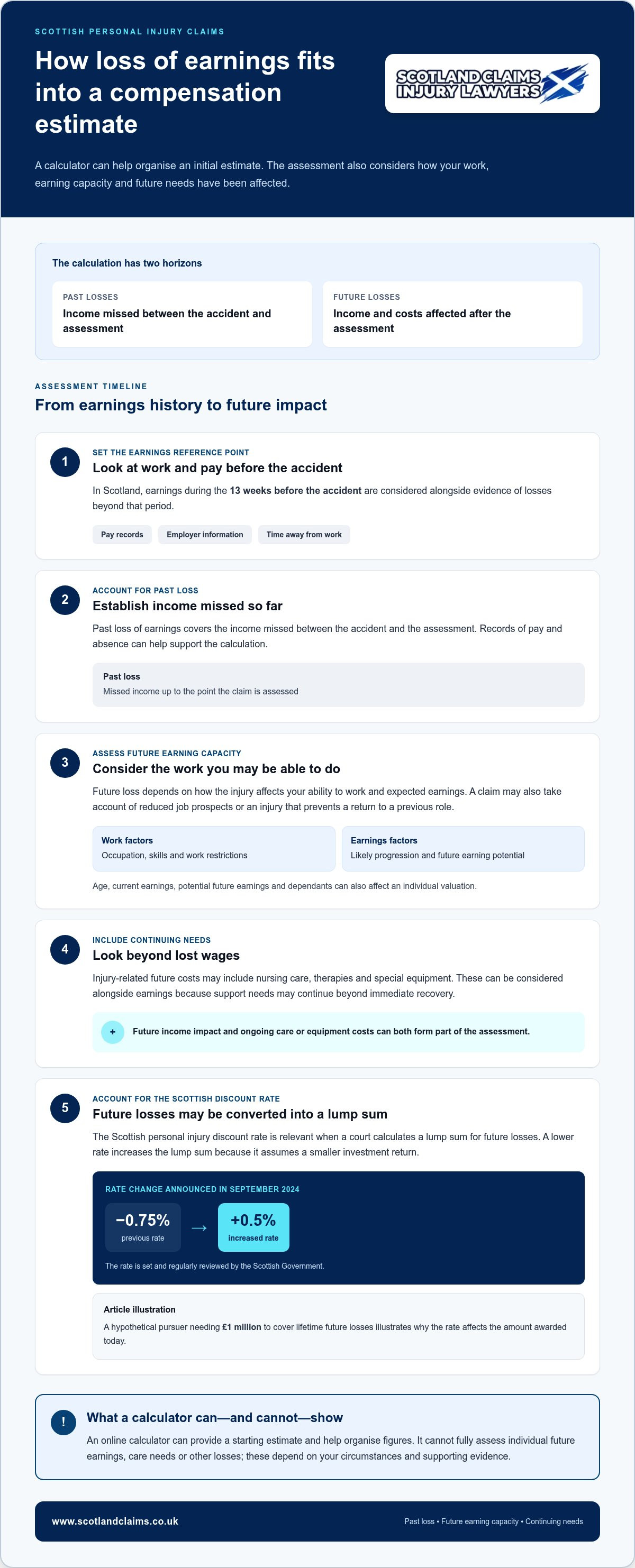
A calculator can help organise an estimate, but loss of earnings depends on your work history, recovery and future prospects. In Scotland, earnings during the thirteen weeks before the accident are considered alongside evidence of losses beyond that period.
Past and future loss of earnings
Past loss of earnings covers income missed between the accident and assessment; future loss covers income affected afterwards. Both matter because a serious injury can interrupt work during recovery and continue to affect earnings later. Pay records, employer information and records of time away from work can help show past losses and support the calculation.
Future losses depend on how the injury affects your ability to work and expected earnings. A successful claim may include both past and future loss of earnings. The estimate considers how long the effects are expected to last, rather than treating missed pay as the full financial impact.
Future earning capacity and job prospects
Future earning capacity is the income you may lose if an injury limits the work you can do. A claim may also account for reduced job prospects if your injuries affect your future career. Your occupation, skills, likely progression and injury-related restrictions help show the difference between expected earnings and what remains achievable.
For example, an injury that prevents someone from returning to their previous role may affect more than immediate wages. Evidence about their work duties and future opportunities helps define that loss. Age, current earnings, potential future earnings and dependants can also affect an individual valuation.
Future costs can extend beyond income. A personal injury claim may include costs for nursing care, therapies and special equipment. These needs are considered alongside earnings because an injury can create continuing support costs beyond the immediate recovery period.
The Scottish personal injury discount rate adjusts the lump sum for losses expected in the future. The Scottish Government sets and regularly reviews the rate, using expected returns on low-risk investments; the calculation also uses assumptions about low-risk asset yields and inflation. A lower rate increases the lump sum because it assumes a smaller investment return.
In September 2024, the Scottish Government announced that the rate had increased from -0.75% to +0.5%. For illustration, a hypothetical pursuer needing £1 million to cover lifetime future losses shows why the rate matters: it changes the amount awarded today to meet those future needs.
A calculator can provide a starting estimate from the figures entered, but it cannot fully assess future earnings, career prospects, care or equipment needs. A more complete estimate depends on evidence about your work and the injury’s lasting effects. Use a personal injury compensation calculator to explore an initial figure, then consider the losses it cannot capture.
How injury severity and prognosis affect compensation
In a Scottish injury claim, severity is assessed through the injury’s effects, not its name alone. Medical evidence explains the treatment required, the period of pain and the likely prognosis. These details help show how the injury affected your daily life and what lasting consequences it may have.
A suitably qualified medical expert comments on the nature and effects of your injury. Their assessment can consider symptoms, treatment and recovery, including whether further care is expected. For example, an injury that causes lasting difficulty with everyday activities has a different impact from one that resolves after treatment. The prognosis helps distinguish temporary effects from continuing restrictions.
Duration matters as well as severity. Pain that continues or returns during recovery can affect work, family responsibilities and leisure. A lasting restriction may change which activities you can manage, even after treatment ends. Evidence of these effects helps explain loss of amenity, which concerns changes to your ability to enjoy ordinary life.
APIL’s illustrative case study shows how general damages form part of a wider assessment. The example separates injury-related damages from the other losses included in the total.
Prognosis can also influence future losses. If medical evidence indicates continuing symptoms, the assessment can consider how they may affect your ability to work or manage daily tasks. The injury’s effects on earnings, care needs and support are considered alongside its physical and psychological impact. This is why a clear account of recovery matters.
Treatment records help establish what care the injury required and how symptoms changed over time. Evidence may include appointment records, prescriptions and descriptions of difficulties with specific tasks. For instance, someone unable to return to a usual activity during recovery can explain what changed and when. Such details give context to the medical assessment.
Scottish solicitors use medical prognosis and evidence of day-to-day impact to evaluate a claim. The same diagnosis can affect two people differently, depending on their symptoms, treatment and recovery. Describe concrete changes, such as disrupted sleep, reduced mobility or difficulty completing work duties, rather than relying only on an injury label.
Judicial College Guidelines injury valuation ranges
The Judicial College Guidelines, 17th edition, published in 2024, give injury valuation ranges for England and Wales. Those figures do not apply to personal injury claims in Scotland. They can provide context, but Scottish awards are assessed within Scotland’s legal system, using the injury evidence and relevant cases.
For example, the Guidelines give a range of £1,880 to £10,890 for a minor brain or head injury, and £36,740 to £186,890 for moderate brain damage. For very serious brain damage, the range is £240,590 to £344,640. These figures concern general damages, not a complete claim total including financial losses.
Other examples show how duration and lasting effects distinguish injury categories. The Judicial College Guidelines indicate general damages of up to £2,090 for whiplash recovering within three months. A back injury causing permanent symptoms has a listed range of £11,730 to £26,050. These England and Wales figures are not Scottish award tariffs.
Severity matters across injury types. The Guidelines give £12,650 to £22,340 for knee injuries with mild ongoing problems, and £33,450 to £46,780 for serious leg injuries leaving permanent problems. They list £51,070 to £85,880 for severe PTSD. Treatment, prognosis and the effects on daily life help distinguish the circumstances behind each category.
For a Scottish claim, previous cases and guidelines can indicate what a court may award, but a range cannot determine the right valuation by itself. A road traffic injury, for example, may involve several injuries, different recovery periods and financial losses. The assessment must reflect the evidence for the individual, rather than simply selecting a figure from an England and Wales table.
General damages address pain, suffering and loss of amenity. Special damages cover injury-related financial losses, such as earnings, treatment or property adaptations. Adding a guideline figure to those losses without assessing the evidence risks overlooking how each loss arose and whether it belongs in the claim.
Personal injury solicitors can use relevant Scottish cases and medical evidence to assess an injury’s nature, treatment and prognosis. Confusing English guideline figures with Scottish valuations can give a misleading impression. Use ranges as context only, and focus on documented effects and the losses connected to the injury.
Calculating personal injury compensation
In Scotland, a personal injury claim is calculated by combining general damages for pain, suffering and loss of amenity with special damages for injury-related financial losses. Evidence establishes the injury’s impact and the losses caused; any share of responsibility for the accident can then reduce the amount awarded.
The calculation starts with the injury itself. Medical evidence describes its nature, treatment and effects, while records and personal accounts show how it changed your daily life. General damages reflect those effects. Special damages cover financial consequences, such as lost earnings, travel, prescriptions, treatment, property adaptations and daily living aids.
Keep each financial loss distinct and connect it to the injury. For example, support treatment travel costs with records of the journeys and expenses. If you needed help with cooking, gardening or DIY, explain which tasks you could no longer manage and who provided the assistance. Family members’ services may be relevant, as may paid care.
A Scottish court may reduce compensation to reflect the claimant’s share of responsibility. If the claimant is found 30% to blame, the compensation may be reduced by 30%. The amount of compensation therefore depends not only on the injury and losses, but also on how responsibility for the accident is assessed.
Some Scottish claims include other categories of loss. After a death caused by negligence, eligible relatives may claim loss of society for effects such as grief, distress, guidance and support. A partner, parent, child, sibling, grandparent or grandchild may qualify, as may someone accepted and treated as one of these relatives. A judge or jury decides the award and which relatives receive it.
Published case studies illustrate why a settlement total is not a standard tariff. Different injuries and losses produce different valuations. These examples show outcomes, not automatic figures for another person’s claim.
Courts assess the evidence and the legal basis for each claimed loss. A clear calculation separates injury effects, documented costs and any reduction for shared responsibility, rather than relying on one headline figure. This helps you see what the settlement represents and which parts relate to pain and suffering or financial consequences.
Estimate your personal injury compensation
Scotland Claims Injury Lawyers: Road Traffic Accident Claims
Scotland Claims Injury Lawyers handles road traffic accident claims in Scotland, helping you assess injury evidence, financial losses and potential compensation. The firm also handles slip or trip claims and work injury claims, and offers a personal injury compensation calculator for an initial estimate.
The firm works on a no-win-no-fee basis and promises 100% compensation: it recovers its fees from the at-fault party and passes your entire settlement to you. This can help you understand how fees are handled before deciding how to proceed with a claim.
If your injury followed a road accident, workplace incident or slip or trip in Scotland, contact Scotland Claims Injury Lawyers to discuss your claim.
Take the next step with a clearer picture
Understanding how personal injury compensation is calculated in Scotland gives you a useful starting point, but your records can help make the impact clearer. Note how your injury affects daily tasks, work and responsibilities, and keep evidence of expenses connected to your recovery. These details can help you explain what has changed and what support you may need.
Before deciding whether to accept a settlement, consider whether the information you have reflects the full effect of your injury. A clear account of symptoms, work restrictions and practical costs gives your claim a stronger foundation. Scotland Claims Injury Lawyers handles road traffic accident, slip or trip, and work injury claims in Scotland, and is regulated by the Law Society of Scotland.
If you want to discuss your circumstances and possible next steps, contact Scotland Claims Injury Lawyers.
A considered next step can help you approach your claim with greater confidence.
Frequently Asked Questions
How is personal injury compensation calculated?
In Scotland, compensation is assessed by valuing the injury’s effects and the losses linked to it. To understand how personal injury compensation is calculated in Scotland, separate the valuation into general damages and special damages, then account for any shared responsibility. For example, organise wage records, treatment information and receipts by date. This makes it easier to connect each claimed loss to the accident and identify any evidence still to gather.
What else can you claim for?
You can include reasonable injury-related losses beyond missed wages. For example, keep travel receipts for appointments and record each journey’s date, purpose and cost. If you paid for help with a task you previously managed yourself, note the task, who helped and when. A clear record shows how the injury changed your practical needs, rather than relying on a broad estimate made later.
Can I make a claim if I was at fault?
Yes, being partly responsible does not automatically prevent a Scottish personal injury claim. The court can reduce damages to reflect your share of responsibility. For example, evidence about road position, warning signs, accident photographs or witness accounts can help establish how the incident happened. Since responsibility affects the final award, give a clear account of your own actions as well as the other party’s.
How accurate are online compensation calculators?
An online calculator provides an estimate based on the information entered, not a full valuation of every part of your claim. The result may change if you later provide medical evidence, accurate earnings records or details of future care needs. Treat the output as a starting point for organising your information. A calculator cannot independently assess disputed responsibility, the long-term effects of symptoms or whether each loss is supported.
How much compensation will I get?
Your award is calculated from evidence of the injury, its effect on your life and the financial losses connected to it. For example, a record of reduced hours at work should show the relevant dates and impact on earnings. Any reduction for shared responsibility also changes the final amount. A strong estimate separates each loss clearly, rather than relying on one overall figure or the injury’s name alone.
What are typical payouts for personal injury in the UK?
There is no single typical payout for every personal injury claim across the UK. The injury, prognosis, financial effects and legal jurisdiction all matter. Scotland’s awards are assessed under its own legal approach, so England and Wales guideline figures are not Scottish payout tariffs. Two claims involving the same broad injury can still differ because treatment, recovery and documented losses vary.
What do I do next?
Write down how the accident happened while the details are fresh, and keep relevant photographs, witness details and correspondence together. Save payslips, absence records and receipts in a separate folder, with a note explaining each item. This creates a useful timeline for discussing your circumstances with a Scottish personal injury solicitor. If symptoms or work restrictions change, update your records to reflect their continuing effects.
What are the Judicial College Guidelines for personal injury awards in Scotland?
The Judicial College Guidelines are injury valuation ranges for England and Wales, not award tariffs for Scotland. The 17th edition was published in 2024. Scottish courts can consider previous cases and guidelines as context, but the figures do not apply directly to Scottish claims. For a Scottish valuation, focus on the medical evidence, the injury’s effects and the relevant Scottish legal approach.