
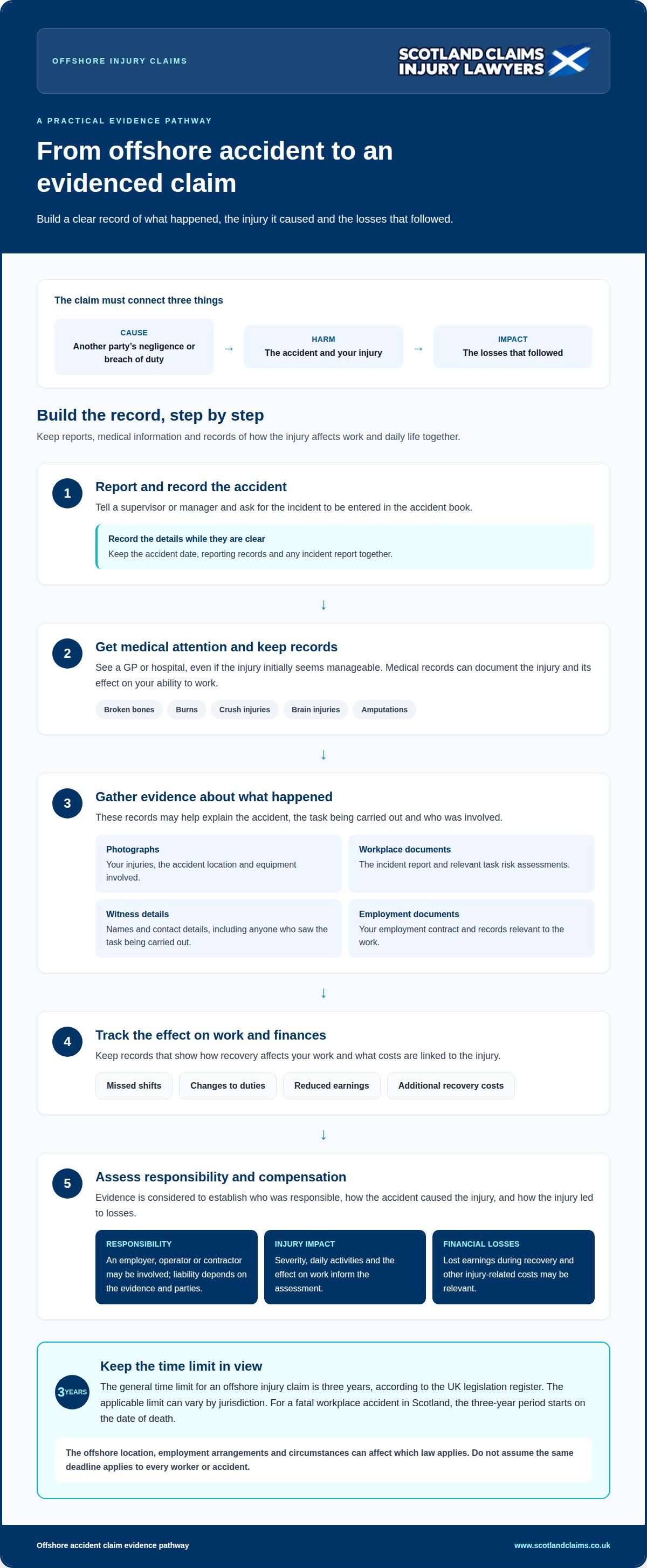
For most offshore injury claims, the time limit is three years, according to the UK legislation register, although the applicable limit can vary by jurisdiction. To make a claim, you must show that another party’s negligence or breach of duty caused the accident, your injury and the resulting losses. An oil rig accident lawyer in Scotland can assess how these requirements apply to your circumstances.
An offshore accident can leave you coping with an injury, lost income and uncertainty about who was responsible. The claims process can feel complicated, particularly when an employer, operator or contractor is involved.
This guide explains how to make an offshore accident claim, what evidence may help establish responsibility, how compensation is assessed and what can affect the time needed to resolve a claim. Acting promptly matters when a time limit applies.
Key Takeaways
- Keep evidence such as incident reports, witness details and medical records together to help explain what happened and how it affected you.
- Offshore injuries can range from burns and crush injuries to broken bones, brain injuries and amputations.
- According to the UK legislation register, the Health and Safety at Work etc. Act 1974 extends to offshore operations on the UK continental shelf.
- Liability and compensation depend on who was responsible, how the accident caused your injury and the losses that followed.
- Risk assessments, training and equipment maintenance can be central to examining an employer’s safety responsibilities.
How long do I have to make an offshore compensation claim?
For an offshore injury claim, the general time limit is three years, according to the UK legislation register. The applicable limit can vary by jurisdiction, so an accident on a North Sea installation may need careful assessment. Don’t assume the deadline is the same for every offshore worker or every accident. The location, employment arrangements and circumstances of the injury can all matter.
You can claim compensation for an oil rig injury in Scotland if another party’s negligence or breach of duty caused the accident and your injury. The claim must also connect the injury to losses, such as reduced earnings or additional costs. An employer may be responsible if a health and safety failure caused harm, but liability depends on the evidence and the parties involved.
UK and Scottish laws apply according to the jurisdiction and circumstances of the accident. For a North Sea incident, the offshore location and your employment contract can affect which law applies. If you work for a Scottish or UK-based company but were injured abroad, those details may also affect whether you can bring a claim in Scotland.
Act promptly after an accident. A clear record can help establish what happened and preserve details while they are easier to gather. Useful evidence may include:
- Photographs of your injuries, the accident location and the equipment involved.
- The incident report and relevant task risk assessments.
- Names and contact details for witnesses, including anyone who saw the task being carried out.
- Medical records and your employment contract.
Report the accident to a supervisor or manager and ask for it to be recorded in the accident book. Seek medical attention from a GP or hospital, even if the injury initially seems manageable. Medical records can document the injury and its effect on your ability to work. Keep records of missed shifts, changes to your duties and expenses linked to your recovery.
For a fatal workplace accident in Scotland, the three-year claim time limit starts on the date of death. That differs from an injured worker’s circumstances, so identifying the correct starting point matters. Claims can also become harder to evidence as records and witness recollections fade. A Scottish assessment of your circumstances can clarify the issues involved; the Scotland injury lawyers page explains the relevant support. Keep the accident date, reporting records and employment documents together for that assessment.
How Common Are Offshore Rig Accidents?
Offshore installation figures show that workplace accidents are not limited to minor injuries. In 2019, installations recorded no fatal injuries, but they reported 25 specified injuries and 73 over-seven-day injuries. These figures describe different recorded injury categories; they don’t show that every incident had the same severity. They do show why a workplace accident involving machinery, hazardous substances or other offshore work needs careful attention.
Offshore workers may suffer broken bones, burns or chemical burns, crush injuries, brain injuries and amputations. A hand caught in machinery, for example, can affect grip and fine movement. A brain injury may affect concentration and memory. The injury, its treatment and the work involved all shape how recovery affects daily life.
The effects can extend beyond time away from the installation. A worker with reduced movement after a crush injury may struggle with tasks requiring strength or precision. Someone recovering from a brain injury may find demanding shifts harder to manage. If an injury affects the ability to return to a previous role, lost earnings and future work prospects may be relevant to a personal injury claim.
Compensation depends on more than the name of the injury. Its severity, effects on daily activities and impact on work all inform the assessment. Financial losses may include earnings lost during recovery and other injury-related costs. Evidence linking those losses to the accident helps show its full effect.
Published oil rig claim examples give a sense of how widely injury compensation figures may vary. Head injury amounts range from £1,760 to £322,060, while back injury amounts range from £1,950 to £128,320. These ranges reflect different injury circumstances and levels of harm, not a fixed amount for every worker. The most useful comparison is the actual effect on your health, work and everyday activities.
Severity also matters when looking at offshore safety records. Installations recorded six deaths in the ten years preceding 2019, while the 2019 figures included 73 injuries lasting over seven days. Neither figure predicts the outcome of an individual claim. Instead, the nature of the accident and its consequences help explain why two workers involved in similar incidents may face different recoveries and financial losses. Solicitors assessing a workplace accident examine those details alongside the injury evidence, work impact and losses claimed.
Types of offshore accidents
Offshore accidents can involve machinery, flammable substances, severe weather or helicopter transfers. A moving component may trap a worker’s hand, while a fall or impact in rough conditions can cause serious injury. Chemical exposure may also cause burns or longer-term ill health. The cause matters because a claim must link the accident or exposure to the harm and resulting losses.
Families may claim compensation after a fatal offshore accident in Scotland if the death resulted from another party’s negligence or breach of duty. The accident, responsible parties and available evidence all matter. For a fatal workplace accident in Scotland, the three-year claim time limit starts on the date of death.
Yes, an offshore accident claim in Scotland can be pursued through a no-win, no-fee agreement. The agreement sets out how the claim is funded and what happens if it succeeds or ends without compensation. Understand those terms before proceeding, including any provisions about fees or cancellation.
Offshore safety regulations set the framework for preventing and responding to workplace harm. According to the UK legislation register, regulations extend the Health and Safety at Work etc. Act 1974 to offshore operations on the UK continental shelf. The UK legislation register also identifies the Offshore Installations (Safety Case) Regulations 2005 as imposing safety responsibilities on employers in Scotland. RIDDOR 2013 sets reporting duties relevant to offshore employers in Scotland, according to the UK legislation register.
The available safety figures show why reporting and follow-up matter. Offshore installations recorded 218 dangerous occurrences in 2019. In that year, the Health and Safety Executive assessed 84 safety cases, raised 1,382 non-compliance issues with offshore operators and issued 22 enforcement notices. These figures describe recorded activity, not the likelihood of an individual worker’s accident. They show how inspections and reports can identify hazards requiring attention.
Reporting an accident creates a record of what happened, where it happened and who was involved. A report may document machinery failure, hazardous substance exposure or a helicopter-transfer incident. Preserve relevant task records, witness accounts and medical evidence. Together, these can help show whether a safety failure caused the injury or ill health and how it affected work and daily life.
A solicitor handling an offshore accident claim should assess the installation, how the accident happened and the parties involved. For example, a helicopter-transfer injury may raise different questions about responsibility from a machinery accident on a platform. The assessment should also consider whether the evidence supports negligence, the injury’s effects and the financial losses. These factors help establish whether a claim is viable and what compensation may cover.
Establishing liability and negotiating compensation
A successful offshore accident claim must link another party’s negligence or breach of duty to the incident, injury and resulting losses. Responsibility may involve an employer, installation operator, contractor or helicopter-transfer provider. An investigation identifies who controlled the work, equipment or transfer when the accident happened, then examines how a failure contributed to the harm. An oil rig accident lawyer in Scotland can assess how the evidence supports liability and compensation.
Records help establish what happened. A solicitor can examine incident reports, task documents, maintenance records, witness statements and medical evidence. For example, a machinery injury raises questions about the equipment’s condition, instructions and task being performed. A hazardous transfer incident calls for scrutiny of who arranged the journey and what caused the accident. One account alone rarely resolves every disputed issue.
Offshore claims are often handled by insurers acting for employers, operators or contractors. Negotiations focus on evidence of responsibility and the resulting losses, not simply the fact that an accident occurred. The claim should set out the injury, treatment, work restrictions and financial consequences. A clear timeline shows how the incident led to medical care, time off work and ongoing effects. An oil rig accident lawyer in Scotland can organise these details into a coherent claim.
Compensation can address the injury and its practical consequences. Medical treatment and rehabilitation needs are relevant, as are lost earnings and other financial losses caused by the accident. A serious hand injury, for example, can affect grip, everyday tasks and the ability to return to previous duties. Medical records and evidence about work help show the impact.
Scottish courts use the Judicial College Guidelines and may refer to other cases when assessing personal injury compensation. They also apply the personal injury discount rate when calculating financial losses. These factors are considered alongside evidence about the injury’s severity, recovery and future impact. A settlement should reflect the full claim supported by evidence, rather than assume one figure suits every worker.
That example illustrates an outcome, not a tariff for every amputation. The extent of the injury, its effects on work and daily life, and the evidence for financial losses all shape an individual assessment. Another worker’s claim cannot replace a careful review of your medical and employment evidence.
Negotiations may progress when the responsible party accepts fault and the evidence supports the losses claimed. If responsibility or the injury’s effects are disputed, further evidence and discussion may be needed. Keep treatment records, earnings information and rehabilitation details organised as the claim develops. These documents help explain both the immediate consequences and the longer-term impact of the offshore accident.
Employer duties and risk assessments
Employers operating offshore installations on the UK continental shelf have safety responsibilities covering risk assessment, training and equipment maintenance. The UK legislation register lists the Management of Health and Safety at Work Regulations 1999 and their Approved Code of Practice and guidance L21 as approved. These requirements matter when an incident involves machinery, hazardous substances or a task with known risks.
A risk assessment identifies what could cause harm during a particular job. For example, a lifting task may involve heavy equipment, restricted space and workers moving nearby. The assessment should address these hazards and the steps taken to manage them. Training and equipment maintenance matter too: a claim may examine whether workers understood the task and machinery was maintained.
To assess a compensation claim, the evidence needs to connect a failure with the injury. Relevant material may include the task risk assessment, training records, equipment maintenance documents and incident reports. A witness account may help show how the task was carried out. Medical records establish the injury and its effects, while employment information can explain the impact on work.
Questions an investigation may consider include:
- Did the risk assessment address the hazard that caused the incident?
- Did the task require training or instructions that were missing or inadequate?
- Was the equipment involved maintained, and did records identify a problem?
- Do the incident account and medical evidence connect the event to the injury?
These questions help distinguish an accident from one caused by negligence or a breach of duty. For instance, if a worker was injured by a machine, the evidence may need to clarify its condition, the work instructions and what happened before the incident. An employer’s responsibility depends on the circumstances and whether a failure caused the harm. An injury at work does not automatically entitle someone to compensation.
Preserve documents as soon as possible. Risk assessments, training records and maintenance logs can show what was known before the accident. Incident reports and witness accounts can help establish the sequence of events. Alongside medical evidence, these records support a clearer assessment of liability, injury and financial losses.
If you suffered an injury at work, a work injury claim can address the evidence and responsibility involved.
Scotland Claims Injury Lawyers: Road Traffic Accident Claims
Scotland Claims Injury Lawyers helps people across Scotland pursue Work Injury Claims after workplace accidents, including injuries sustained offshore. The firm can assess how the accident happened, who may be responsible and how the injury has affected your work and finances.
Its 100% compensation promise means the firm recovers its fees from the at-fault party and passes your entire settlement to you. The Personal Injury Compensation Calculator can also help you explore how compensation may be assessed. A claim needs evidence linking the accident to your injury and losses, so details such as medical records and employment information can help explain your circumstances.
If you’d like to discuss a workplace injury claim, contact Scotland Claims Injury Lawyers.
Take a clear next step with your claim
The next decision is not simply whether to pursue a claim. It is how to understand the evidence and practical impact of your injury. A focused conversation can turn scattered records and unanswered questions into a clear next step. Consider what feels least clear: responsibility, recovery, changes to your work or the losses you need to explain.
If you are considering an oil rig accident lawyer in Scotland, explain what happened and how the injury affects your work. Scotland Claims Injury Lawyers handles Work Injury Claims, as well as Road Traffic Accident Claims and Slip or Trip Claims. A free, no-obligation assessment can help you understand how the firm’s personal injury services relate to your circumstances.
A clear first conversation can help you approach the next decision with greater confidence.
Frequently Asked Questions
How Do I Make a Claim for an Oil Rig Accident?
Start by recording the accident details and identifying the people or organisations involved. A claim needs evidence that another party’s negligence or breach of duty caused the accident, injury and resulting losses. Alongside medical records, details such as your shift pattern, job duties and changes to your work can show the practical effects. A solicitor can assess whether the evidence supports a claim and explain the next steps.
Is there a time limit for making a claim relating to a personal injury claim in Scotland?
The general time limit for an offshore injury claim is three years, according to the UK legislation register, but the applicable limit can vary by jurisdiction. Record the accident date and any later medical findings, as these details may matter when assessing the deadline. For a fatal workplace accident in Scotland, the three-year claim time limit starts on the date of death.
What should I do if I have sustained an accident on an oil rig in Scotland?
Tell your supervisor or manager promptly and ask for the accident to be recorded. Seek medical attention from a GP or hospital, even if symptoms initially seem manageable. Keep copies of work rota or pay records showing missed shifts or altered duties. Alongside clinical records of your symptoms and treatment, these can show how the incident affected your working life.
Will making a claim affect my job or employment rights?
A personal injury claim concerns responsibility for an injury and its consequences; it does not itself determine your offshore role or rota. The effect on your employment depends on your circumstances and arrangements. Keep a dated record of relevant conversations with managers, changes to duties and work restrictions linked to your injury. This provides a clear account if employment concerns arise during recovery.
How Long Will It Take to Receive Compensation?
If the other party admits fault, compensation may be paid in a couple of months. Payment can take longer if liability is disputed, medical evidence is incomplete or the injury’s effects need further assessment. Settlement discussions must also account for losses linked to the accident. The timing of compensation therefore depends on how quickly responsibility and the claim’s value can be agreed.
How long will the oil rig claims process take?
In very rare cases, the full claims process can take several years. It involves establishing responsibility, gathering evidence about your injury and losses, and negotiating a settlement. A dispute about who controlled the task or equipment can add complexity, as can uncertainty about how an injury affects future work. The time needed to resolve each issue shapes the overall duration, not just the date the claim begins.
What Does My Oil Rig Compensation Cover?
Compensation can address the injury and financial losses caused by the accident. Depending on your circumstances, these may include earnings lost during recovery, treatment or rehabilitation needs, and other injury-related costs. If symptoms prevent you from performing your usual duties, for example, evidence about changes to your work and income helps explain the financial impact. Medical evidence links those consequences to the injury.
What should I do after an oil rig accident in Scotland?
After reporting the incident and seeking medical care, preserve records that may be difficult to obtain later. Keep copies of communications about the accident, your duties and any equipment involved. Note who witnessed the event and what task was underway. If the incident happened outside Scotland, retain your employment contract and details of the accident location, as these may matter when assessing whether a Scottish claim can proceed.