A minor head injury settlement in Scotland can vary with the injury’s effects and the losses it causes. For concussion with minimal or no brain damage, the Scottish Judicial College Guidelines’ 18th edition (April 2026) gives a solatium range of £3,000 to £17,000. That covers injury-related pain and suffering, not financial losses that may also form part of a claim.
A head injury may seem minor at first, but post-concussion symptoms can continue for weeks or, in some cases, months. Headaches, memory problems and difficulty concentrating can affect work and daily life, so the injury’s full impact matters when compensation is assessed.
This guide explains how a settlement is assessed, what it may include and how persistent concussion symptoms can affect a claim. It also covers evidence that can show the injury’s consequences and how the accident circumstances shape the next steps.
Key Takeaways
- Settlement value depends on the injury’s effects, recovery outlook and impact on everyday life, not just the initial diagnosis.
- A claim may include financial losses such as lost earnings, treatment costs and travel to appointments, as well as compensation for pain and suffering.
- Post-concussion symptoms can affect how an injury is assessed when they continue to disrupt concentration, memory, work or daily activities.
- Medical evidence and clear records of symptoms, expenses and their effects can help show the full consequences of the injury.
- The circumstances of the accident and who was responsible are central to whether a claim can proceed.
Head injury claims in Scotland
A head injury claim in Scotland may seek compensation if another party’s fault caused the accident and your injury. The process depends on responsibility, medical evidence, your circumstances and the applicable time limit.
Eligibility to Make a Claim
You may be eligible to claim if an accident caused a head injury and someone else was legally responsible. Examples include a road collision, workplace accident or fall on unsafe premises. Evidence connecting the accident, fault and injury is central to a personal injury compensation claim.
Children can claim through a parent or another appropriate adult until they can act for themselves. A guardian appointed under the Adults with Incapacity (Scotland) Act 2000 can make a claim for an adult who lacks capacity to manage their affairs. The claimant’s age and ability to make decisions affect who takes the necessary steps.
Time Limits for Personal Injury Claims
In most Scottish cases, the time limit is three years from the accident date, according to The National Archives (legislation.gov.uk). A personal injury that develops gradually has a different starting point: the three-year period runs from when the claimant knew, or ought reasonably to have known, the injury was caused by someone else’s fault.
For a child, the limitation period generally does not begin until age 16, so a claim can usually be brought until age 19. These rules make it important to identify the accident date or, for gradual injuries, when the link to another party’s fault became known.
Symptoms That Appear Later
Yes. You may still be able to claim if symptoms emerge after the accident, provided someone else’s fault caused the injury and you are within the applicable time limit. Symptoms appearing later do not, by themselves, rule out compensation.
Medical records can help connect your symptoms to the incident. Note when problems began and how they affect work or daily activities. This gives a clearer account for medical assessment and rehabilitation planning. The National Archives (legislation.gov.uk) states that, in Scotland, the three-year claim period for a personal injury that develops gradually runs from when the claimant knew or ought reasonably to have known that the injury was caused by someone else's fault.
Making a Compensation Claim
To claim, establish how the accident happened, identify the party whose fault may have caused it, and gather available medical evidence. Witness details, photographs and symptom records can help explain what happened and its effects. Road accidents, workplace incidents and slips or trips are assessed in light of their specific circumstances.
If an insurer disputes responsibility or the extent of your injury, the disagreement will turn on the evidence. Medical records, witness accounts and accident details can help address disputed points. If the claim remains unresolved, it may need to proceed through the Scottish courts. Most head injury claims settle out of court.
Legal fees depend on the funding agreement. A no-win, no-fee arrangement can fund a personal injury claim; under the firm’s 100% Compensation approach, fees are recovered from the at-fault party and the full settlement is passed to you. Scotland-specific personal injury claim support can help clarify the process and evidence relevant to your circumstances.
How head injury compensation is calculated
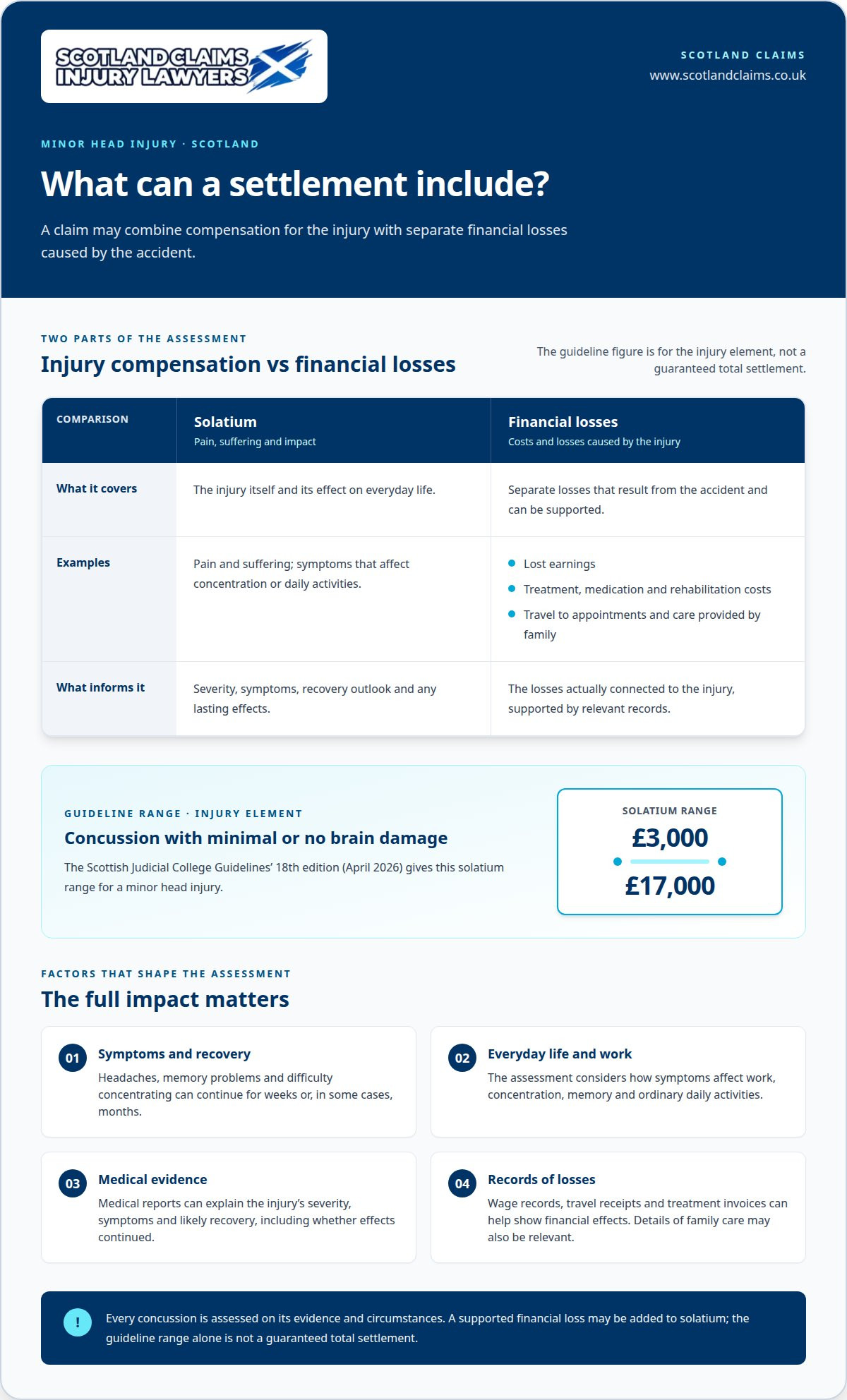
A Scottish award can include compensation for the injury itself and separate financial losses. For a minor head injury with concussion and minimal or no brain damage, the Judicial College Guidelines’ 18th edition (April 2026) gives a solatium range of £3,000 to £17,000.
Pain and Suffering Compensation
Solatium compensates for pain, suffering and the injury’s impact on everyday life. Its assessment considers severity, symptoms, recovery and any lasting effects. A short-lived headache may have a different impact from symptoms that affect concentration or daily activities over a longer period.
The £3,000 to £17,000 guideline range is for the injury element, not a guaranteed total settlement. Medical evidence helps explain the symptoms and recovery outlook. The assessment also considers how the injury affected ordinary activities, rather than relying only on the initial diagnosis.
Expenses and Financial Losses
Separate financial losses may be claimed alongside solatium where they result from the accident. These can include lost earnings, treatment and medication costs, travel to appointments, rehabilitation expenses and care provided by family. The amount depends on the losses actually connected to the injury.
For example, if headaches prevent you from working, evidence of missed work and reduced earnings can help show the financial impact. Keep wage records, travel receipts for appointments and treatment invoices together. If a family member provides care, the nature and extent of that support may also be relevant.
Minor Head Injury and Concussion
For a minor head injury with concussion and minimal or no brain damage, the Scottish guideline range is £3,000 to £17,000 for solatium. A settlement may be higher when supported financial losses are added. It may differ where symptoms persist or affect work, memory or concentration.
Medical reports help assess the injury’s severity and likely recovery. They can explain whether symptoms resolved or continued to interfere with daily life. The assessment considers that evidence alongside earnings and other documented costs, rather than treating every concussion as having the same value.
Skull and Facial Fractures
A skull or facial fracture can change the assessment because the injury and its consequences may be more serious than concussion alone. For example, Scottish guidance gives a solatium range of £9,000 to £40,000 for a fractured jaw. Facial scarring described as less significant to significant has a range of £5,000 to £40,000.
These are injury guidelines, not automatic awards. The fracture’s effects, including scarring and any impact on daily life, matter. Separate financial losses may also be included when evidence connects them to the accident.
To explore the factors that may shape a claim, use the personal injury compensation calculator.
General damages for minor brain and head injuries
General damages compensate for the injury itself, including pain, suffering and its effect on ordinary life. In Scotland, the Judicial College Guidelines’ 18th edition (April 2026) provides different solatium brackets for brain injuries. The symptoms, recovery and lasting effects help distinguish a minor injury from one with continuing consequences.
A head injury can affect the scalp, skull or brain. Concussion is a traumatic brain injury that temporarily disrupts mental function after a blow. Some injuries involve no brain damage, while others lead to concentration or memory problems. Medical evidence and the recovery outlook help clarify which description fits the injury.
For minor brain injuries, the Scottish guideline range is £3,000 to £17,000 for concussion with minimal or no brain damage. This is solatium for the injury, not a combined total including financial losses. The same diagnosis can affect people differently, so the assessment considers the symptoms and their effect, rather than relying on the word “concussion” alone.
Less severe brain injuries with good recovery but some persisting concentration or memory problems have a Scottish solatium range of £20,000 to £57,000. Moderate brain injuries affecting concentration and memory, and reducing the ability to work, fall within a range of £57,000 to £120,000. Those distinctions show why ongoing effects can alter the injury assessment.
For the most severe brain injuries requiring lifelong care, Scottish awards range from £198,000 to over £530,000. This bracket reflects a very different level of impact from a concussion with minimal or no brain damage. It also concerns general damages for the injury, rather than the separate value of care, lost earnings or other financial losses.
The NHS says most people recover from a mild traumatic brain injury within a week to three months. That recovery period can help explain whether symptoms were temporary or continued, but it does not set a payout by itself. For example, medical evidence of persistent memory problems may support a different severity assessment from evidence of a full recovery.
Guideline brackets are reference points, not automatic awards. A medical report can describe the brain injury, symptoms and prognosis, while evidence about work and daily life helps explain the consequences. If the head injury also caused facial or skull fractures, those injuries may need separate consideration alongside the brain injury.
What are Post Concussion Syndrome and other effects of mild head injury?
Concussion can temporarily affect mental function after a sudden blow to the head. Some people continue to experience symptoms after the initial injury, including headaches, nausea, confusion, poor concentration or memory problems. These lingering effects are often called post-concussion symptoms. Their duration and impact help show how the injury affected the person after the accident.
Symptoms may persist for weeks and, in some cases, months. The NHS says headaches, nausea and some confusion can be normal for up to two weeks after a head injury. If problems continue, worsen or interfere with work and daily activities, record when they occur and discuss them with a healthcare professional.
Post-concussion effects vary depending on the injury and the person’s recovery. For example, someone may struggle to follow conversations, forget appointments or find a usual working day difficult. A symptom record can show frequency, severity and practical effects. This detail helps distinguish a brief recovery from continuing problems that need further assessment.
Medical evidence is important in head injury claims involving ongoing symptoms. A doctor’s records can document reported problems, examination findings and treatment. Further reports may address prognosis and effects on daily life. Solicitors use this evidence to explain how symptoms relate to the accident and support the claimed injury. The other party’s obligation to compensate depends on establishing responsibility and injury.
It is an estimate, not a fixed Scottish award. The assessment considers the injury evidence, recovery and any ongoing symptoms. If concentration or memory problems remain, their effect on work and ordinary activities can be important to the valuation. Supported financial losses are assessed separately from compensation for the injury itself.
Lawyers can use medical evidence and symptom records to present the effects clearly. Useful details include when headaches began, how often confusion occurs and whether memory problems disrupted a particular task. For example, evidence that concentration difficulties affected work can help explain the injury’s consequences. Keep records factual and consistent to give the medical assessment and claim a clear account of recovery.
Minor head injury settlement amounts
The latest Scottish guideline figure for minor concussion with minimal or no brain damage is £3,000 to £17,000 in solatium, under the Judicial College Guidelines’ 18th edition (April 2026). This is compensation for the injury itself, not necessarily the total head injury compensation claim.
These figures describe different things: a guideline range for solatium and an estimate that may include financial losses. Do not add them together. The total claim depends on the injury evidence and losses caused by the accident.
Recovery is a key factor. A concussion that resolves without lasting effects may be assessed differently from an injury followed by persistent headaches, memory problems or reduced concentration. Medical evidence can describe the symptoms, how long they lasted and their effect on work or daily activities. These details show the injury’s actual consequences, beyond the label “minor”.
Financial losses are considered separately from compensation for pain and suffering. For example, lost earnings during recovery, treatment expenses or travel to appointments may be included when evidence connects them to the injury. Keep relevant wage records and receipts together. If symptoms affect future work or care needs, those consequences also require evidence and assessment.
Guidelines provide reference points, not a guaranteed settlement amount. The Scottish solatium range for concussion is not interchangeable with brackets for less severe or moderate brain injuries. Ongoing memory or concentration problems may lead to a different injury assessment from a full recovery. The medical report, prognosis and day-to-day effects help explain the distinction.
Responsibility for the accident matters too. A claim must connect the injury and losses to an accident caused by someone else’s fault. If responsibility is disputed, evidence about how the accident happened is important alongside medical records. If the claimant was partly responsible, compensation may be reduced to reflect their share of responsibility.
For a clearer estimate, organise the claim around three elements: medical evidence of the injury, evidence of its impact and proof of related financial losses. For example, a medical report can document ongoing headaches while wage records show time away from work. This helps distinguish a modest injury claim from one involving longer-lasting effects or substantial losses.
Scotland Claims Injury Lawyers
Scotland Claims Injury Lawyers can help you pursue a claim if a head injury was caused by a road accident, workplace incident, slip or trip in Scotland. The firm handles personal injury claims and can help you understand the evidence, injury assessment and losses involved, including symptoms that continue after concussion.
The firm’s 100% Compensation approach means it recovers its fees from the at-fault party and passes the full settlement to you. Its Personal Injury Compensation Calculator can also help you explore the factors that may affect an estimate. This support may be relevant if you’re unsure how to present your injury and losses or what to do next.
Take a clear next step
A minor head injury settlement in Scotland should reflect the evidence and the injury’s real effects. Before taking the next step, write a concise timeline of the accident, how your symptoms developed and what remains difficult now. This provides a clear starting point for discussing your circumstances and the questions that matter to your claim.
Scotland Claims Injury Lawyers handles Road Traffic Accident Claims, Slip or Trip Claims and Work Injury Claims. If your head injury followed one of these accidents, the firm can help you understand how to proceed with a personal injury claim. You can contact the team to discuss your situation and decide what to do next.
A considered next step can help you move forward with greater clarity.
Frequently Asked Questions
Can I claim if I was partly at fault?
Yes. You may still claim in Scotland if another party was also responsible for the accident. Compensation can be reduced to reflect your share of responsibility. For example, if evidence shows both parties contributed to a collision, responsibility and injury evidence are considered together. Witness accounts, photographs and a clear description of the accident can help establish what each person did.
How much compensation for concussion?
For concussion with minimal or no brain damage, the Scottish Judicial College Guidelines’ 18th edition (April 2026) gives a solatium range of £3,000 to £17,000. This covers the injury itself, not necessarily the whole claim. For example, documented lost earnings or treatment expenses may be considered separately. Ongoing symptoms, recovery and the effects on daily activities help explain where an injury sits within the guideline bracket.
What if I didn’t go to hospital at the time?
Not going to hospital immediately does not automatically prevent a claim. Seek medical advice if symptoms continue or appear later, and explain when they started and how they affect you. Healthcare records made later can still document your condition. For example, notes about recurring headaches or difficulty concentrating may help connect symptoms to the accident, alongside witness accounts or photographs of what happened.
How is a minor head injury settlement calculated in Scotland?
A minor head injury settlement in Scotland considers compensation for the injury and financial losses connected to the accident. The injury assessment considers symptoms, recovery and effects on daily life. Evidence can also support losses such as missed earnings, treatment expenses or travel to appointments. The claim must establish that another party was responsible for causing the injury, so evidence of fault and medical evidence both matter.
What factors affect the value of a minor head injury claim in Scotland?
The main factors include the injury’s severity, how long symptoms last, the recovery outlook and their effect on work or daily activities. Persistent headaches, memory difficulties or reduced concentration can have different consequences from symptoms that resolve quickly. The assessment also considers financial losses caused by the injury and the evidence supporting them. Shared responsibility for the accident can affect the amount recovered.
What evidence is needed to claim for a minor head injury in Scotland?
Useful evidence can include medical reports, witness statements, photographs and symptom records. Financial documents may also support losses, such as wage information, treatment or rehabilitation receipts, and travel expenses. For example, a dated record of headaches alongside medical notes can show how symptoms developed. Evidence should explain both how the accident happened and how the injury affected your work or daily life.
What is the time limit for making a head injury claim in Scotland?
In most cases, the limit is three years from the accident date, according to The National Archives (legislation.gov.uk). For a personal injury that develops gradually, the period runs from when you knew, or ought reasonably to have known, that someone else’s fault caused the injury. A child’s claim follows different rules, so the child’s age and circumstances matter when working out the deadline.