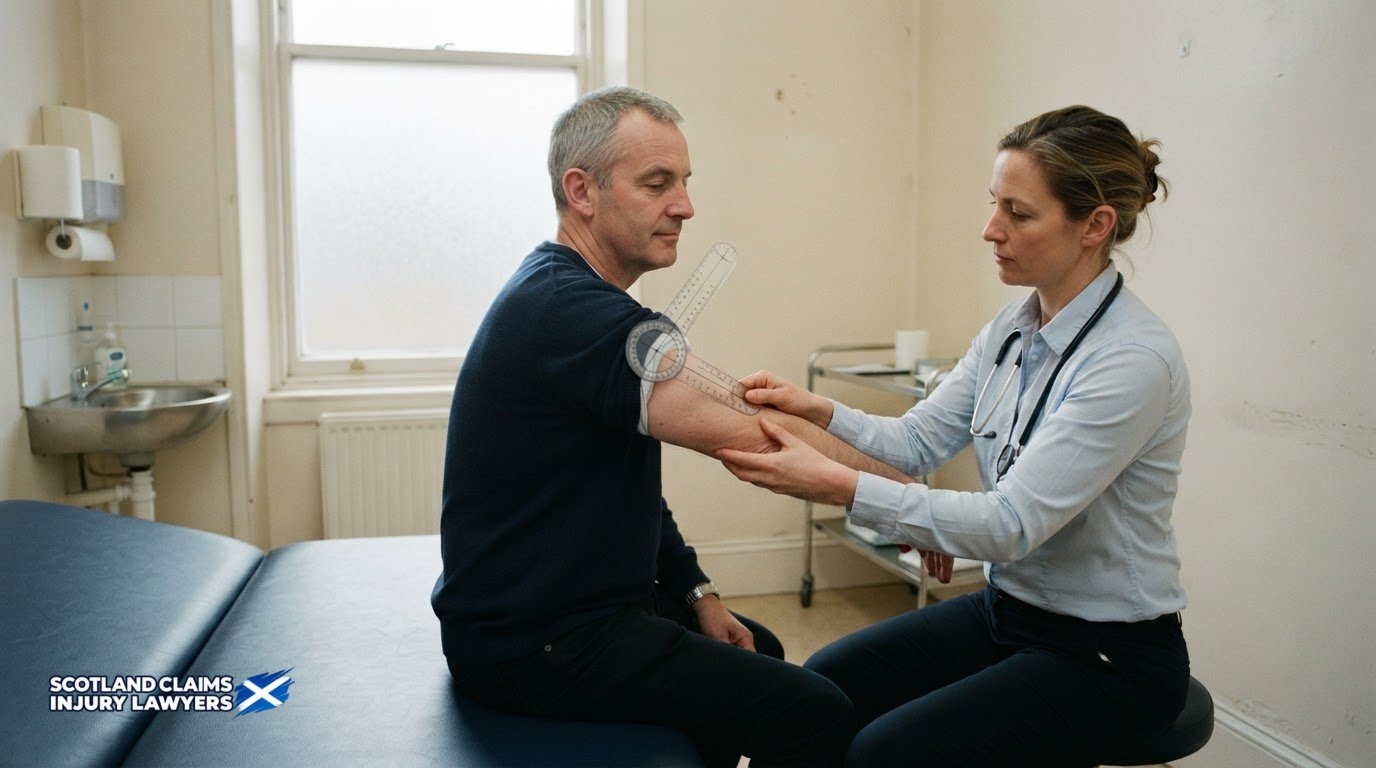
The answer depends on the examination’s purpose. For an adult protection medical examination under Section 9 in Scotland, doctors, nurses and midwives may conduct it. An independent medical examination in Scotland for a personal injury claim has a different purpose: it helps assess the reported injury and prepare a medical report.
It’s understandable to want clear answers about who will examine you, why the assessment is needed and what happens to the information you share. The term “independent” can also raise questions about the examiner’s relationship to you and the people involved in your claim.
This article explains who may conduct an examination, when one may be arranged and what it can involve. It also covers confidentiality and how findings are recorded, helping you understand the process before attending.
Key Takeaways
- Who conducts an examination depends on its purpose; adult protection examinations in Scotland may be carried out by doctors, nurses and midwives.
- An independent examiner has no prior relationship with the patient or other parties involved, helping provide an impartial assessment.
- The reason for an examination, the stage of an inquiry and the person’s circumstances all shape when it may take place.
- Learn what the assessment and report may involve, and how confidentiality is handled in different types of examination.
Healthcare professionals who conduct examinations
Who may conduct a medical examination in Scotland depends on its purpose. Under Section 9 of the Adult Support and Protection (Scotland) Act, an adult at risk of harm may be examined in private by an eligible health professional. The professionals listed for this purpose are doctors, nurses and midwives. Section 52(2) defines the relevant health professional for adult protection examinations.
The roles can differ. Doctors usually conduct medical examinations, while nurses and midwives assess a person’s current health. An adult protection examination may involve a physical, psychological or psychiatric assessment. This is different from an independent medical examination for a personal injury claim, which assesses reported injuries and symptoms and informs a medical report. An independent examiner has no prior relationship with the patient or the other parties involved.
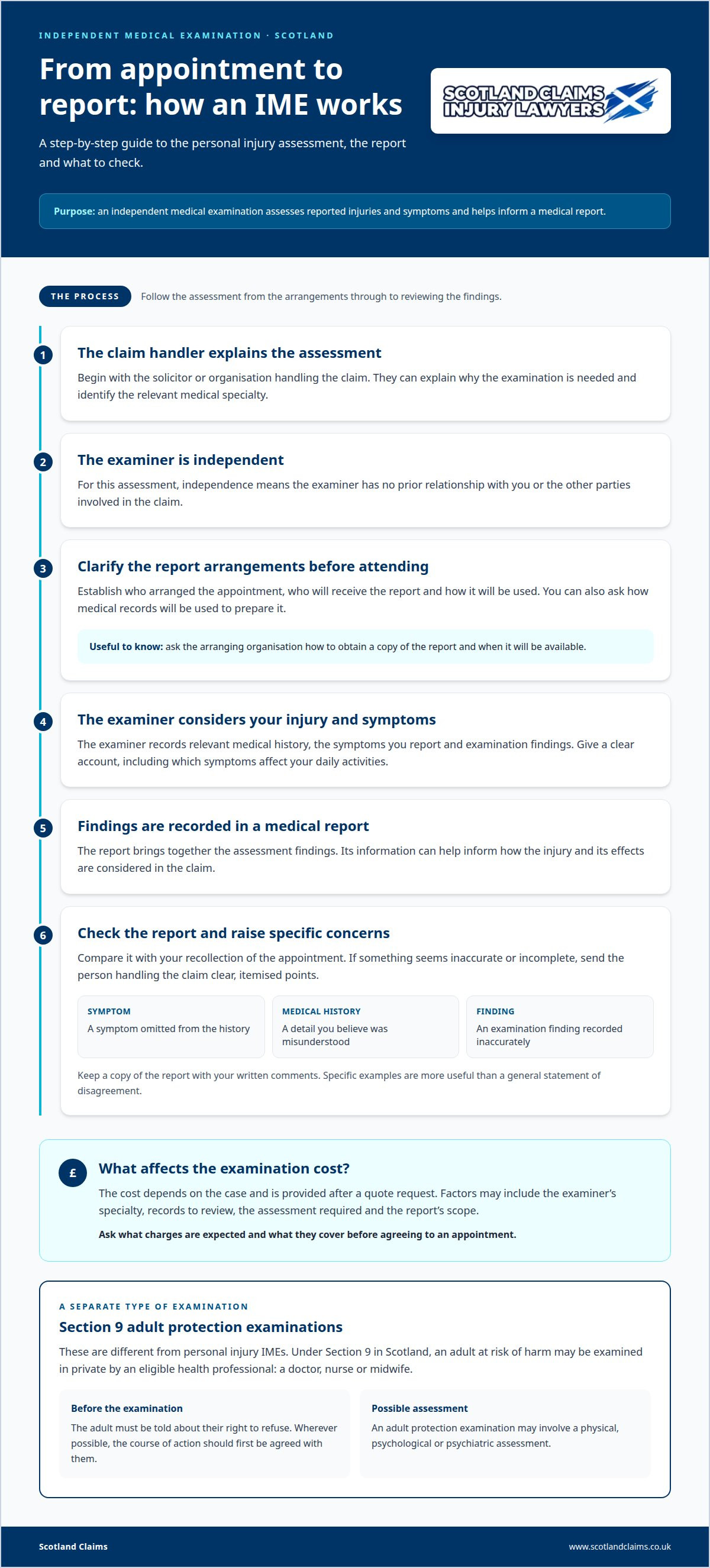
The cost of an independent medical examination depends on the case and is provided after a quote request. Factors may include the examiner’s specialty, the records to review, the assessment required and the report’s scope. Ask what charges are expected and what they cover before agreeing to an appointment.
To find an independent medical examiner in Scotland, begin with the solicitor or organisation handling the claim. They can explain the assessment’s purpose and identify the relevant medical specialty, such as a doctor assessing an injury. If you need legal support with a Scottish personal injury claim, injury lawyers in Scotland can help with the claim process. Independence means the examiner has no prior relationship with you or the other involved parties.
If you disagree with an examination report, identify the specific points you believe are inaccurate or incomplete. For example, note a symptom, medical history detail or examination finding that you believe has been misunderstood. Send your concerns to the person handling the claim and ask how they can be addressed. Clear, itemised points are more useful than a general statement of disagreement.
For an adult protection examination, the person must be told about their right to refuse before it takes place under Section 9(2). Wherever possible, the course of action should first be agreed with the adult concerned. These safeguards relate to adult protection examinations; the purpose and arrangements for a personal injury assessment depend on the claim process.
As of March 2021, Scottish Ministers had made no order describing additional types of health professionals for this purpose. The listed roles remain doctors, nurses and midwives.
Medical confidentiality and certification
Confidentiality depends partly on the type and purpose of the examination. A report records the assessment findings, but it is also important to understand who will receive it and who can access it.
Medical confidentiality
A personal injury IME is arranged to inform a claim. The examiner records relevant medical history, symptoms and examination findings, then prepares a report. Before attending, establish who arranged the appointment, who will receive the report and how it will be used. This helps you understand what information is being shared for the claim.
Forensic examinations have distinct confidentiality arrangements in Scotland. They are a confidential NHS service, and police are not informed unless the person chooses to report the crime. This applies to forensic examinations, not automatically to every independent medical examination. The appointment’s purpose determines which confidentiality arrangements are relevant.
Screening and assessment can mean different things in practice. Screening identifies information relevant to the examination, while assessment considers the reported symptoms and findings. For example, a doctor preparing an injury report may record a symptom you describe and consider it alongside the examination. Give a clear account and explain which symptoms affect your daily activities.
If you are unsure who will receive the report, ask the person arranging the examination to explain its intended recipients before the appointment. You can also ask how medical records will be used to prepare it. These questions help distinguish information needed for the assessment from details unrelated to its purpose.
Patient rights and report access
For an adult protection medical examination under Section 9, the adult must be told about the right to refuse before the examination takes place. This rule concerns adult protection examinations in Scotland. It should not be treated as a general statement about every IME arranged for a personal injury claim.
For an IME report, ask the organisation arranging the examination how to obtain a copy and when it will be available. Ask whether it includes your medical history, examination findings and recorded symptoms. Since the examiner prepares the report, directing access questions to the arranging organisation gives you a clear route to the information.
Compare the report with your recollection of the appointment. Note specific points, such as a symptom omitted from the history or a finding you believe is recorded inaccurately. Send your concerns to the person handling the claim and explain what needs clarification. Specific examples make your disagreement easier to understand.
Keep a copy of the report with your written comments. This creates a clear record of what you queried and why. If the assessment relates to a personal injury claim, its findings can inform how the injury and its effects are considered. Understanding confidentiality and report access helps you take an informed role in the process.
When an examination can be conducted
Timing depends on the examination’s purpose and legal context. Adult protection examinations and forensic medical examinations follow different arrangements in Scotland.
Timing an examination
For adult protection, a medical examination may take place at a location visited under Section 7 of the Act. It may also take place at premises where the adult has been taken under an assessment order granted under Section 11. These settings connect the examination to the relevant adult protection process.
Timing can be more urgent after sexual assault. In Scotland, the peak timeframe for a forensic medical examination is within 3 days of the assault. This is a distinct type of examination, not a general deadline for an IME arranged for a personal injury claim. The reason for the appointment determines the relevant timing.
Rules and requirements
There is no single rule in these circumstances that applies to every examination. For adult protection, Section 9 allows a health professional to examine an adult at risk of harm in private. Before that examination, Section 9(2) requires the person to be told about their right to refuse.
Wherever possible, the proposed course of action should first be agreed with the adult concerned. These provisions relate to adult protection examinations. They are not rules for every independent medical examination arranged as part of a personal injury claim. Identify the examination’s purpose and legal context before applying a particular requirement.
Refusing or rescheduling an examination
For an adult protection examination under Section 9, the person must be informed of their right to refuse before it proceeds. For a personal injury IME, Section 9(2) is not a general refusal rule. If you need to change an appointment, tell the person arranging it promptly and explain the reason, so the request can be considered in the context of the claim.
The distinction matters because an adult protection examination may be part of an inquiry into harm, while a personal injury IME assesses an injury. An adult protection examination may be considered from the start of an inquiry until it is determined that the adult is not at risk of harm. It may therefore be relevant at different stages, not only after an inquiry has concluded.
A medical examination may also be needed to provide evidence of harm for a criminal prosecution under police direction, or to support an application for an order to safeguard the adult. These purposes differ from a personal injury assessment. If you receive an appointment, establish whether it concerns adult protection, a forensic examination or a personal injury claim. This helps you understand which timing and consent arrangements apply.
Circumstances for considering an examination
An examination may be considered for different reasons in Scotland. Its purpose can range from assessing an injury for a claim to investigating suspected harm to an adult.
For an adult protection medical examination, it may be considered from the start of an inquiry until it is determined that the adult is not at risk of harm. It may provide evidence of harm for a criminal prosecution under police direction, or support an application for an order to safeguard the adult.
For a personal injury claim, an independent medical examination may help document reported symptoms and assess their effects. For example, a report may clarify how an injury affects movement or daily activities. The examination is relevant when medical information is needed to understand the reported injury and its consequences. Its purpose is assessment, not treatment.
Who can request an independent medical examination in Scotland? In a personal injury claim, the examination is arranged through the claims process. The person handling the claim can explain who made the referral and what questions it addresses. In an adult protection matter, an examination may be considered as part of an inquiry, while police direction may apply when evidence is sought for a criminal prosecution.
The reason for the referral matters. Before attending, establish whether the appointment concerns a personal injury claim, an adult protection inquiry or suspected criminality. Each has a different purpose. An IME report concerns the medical assessment, while an adult protection examination may contribute to safeguarding decisions or provide evidence of harm.
If a crime has been committed or criminality is suspected in Scotland, police should be contacted immediately to discuss how to proceed with an investigation. Police may arrange a forensic medical examination. If an adult has been injured, their immediate health and welfare come first. Urgent care takes priority over evidence-gathering arrangements.
For concerns about rape or sexual assault, a forensic medical examination is separate from a personal injury IME. It must take place in a suitable healthcare facility, such as a properly decontaminated forensic medical suite in a Sexual Assault Referral Centre. The setting supports the examination’s forensic purpose.
These distinctions help explain why an examination has been proposed. Ask the person arranging the appointment to clarify its purpose, the issues the report will address and how the referral relates to the claim or inquiry. For example, a referral about an injury’s effect on daily activities has a different role from an examination intended to document suspected harm for safeguarding or criminal proceedings.
IME examination process
An independent medical examination follows a clear sequence: the examiner reviews relevant information, discusses your health and records findings. The appointment produces a report for the claim; it is not treatment for the injury.
Before the appointment, prepare a concise account of the injury and its effects. Bring relevant medical records and identification, and note the symptoms you want to explain. For example, describe how pain affects walking, lifting or sleep. A clear summary helps you give an accurate account during the assessment.
- Medical history: The examiner discusses your health history and the circumstances of the reported injury.
- Symptoms: You describe what you experience, including how symptoms affect everyday activities.
- Examination: The examiner carries out a physical examination relevant to the reported injury.
- Report: The evaluator documents the information and prepares a medical report.
Each stage provides different information. Your medical history gives context, while your account describes the symptoms you experience. The physical examination records relevant findings at the appointment. The report brings these elements together, allowing the claim to be considered alongside your account and medical evidence.
Wear loose clothing to a face-to-face appointment, as it may be easier to remove if needed for the examination. Organise your records and keep your symptom notes brief and specific. For instance, describe which activity causes difficulty and what you can no longer do in the same way. These details help you give a clear account.
How are IME reports used in Scottish personal injury and insurance claims? The report records the examiner’s assessment of your medical history, symptoms and examination findings. In a personal injury claim, it provides medical evidence to help parties consider the reported injury and its effects.
The report is not a treatment plan. Its purpose is to document the examination for the claim. Read it carefully when it becomes available, and note any specific details you believe are inaccurate or incomplete. For example, you may want to flag an omitted symptom or relevant medical history detail. Clear, precise comments help explain your concern.
Keep your appointment information, symptom summary and relevant records together. This makes it easier to give a consistent account and refer to the same details later. If the examination concerns an injury from a road accident, work incident, or slip or trip, the report is one part of the wider claim assessment.
Scotland Claims Injury Lawyers
Scotland Claims Injury Lawyers can help if your examination relates to a personal injury claim in Scotland. The firm handles claims arising from road traffic accidents, workplace injuries, and slips or trips. It can help you understand how medical evidence fits into your claim and what steps come next.
The firm works on a no-win-no-fee basis and promises 100% compensation: it recovers its fees from the at-fault party and passes the entire settlement to you. Its personal injury compensation calculator can help you explore potential compensation. An IME does not itself decide your claim, so clear legal guidance can help you understand the report alongside the other evidence.
Contact Scotland Claims Injury Lawyers to discuss your personal injury claim.
Take the next step with confidence
An independent medical examination in Scotland can influence how a personal injury claim is understood, but the report is only one part of the wider picture. Consider how its findings relate to your symptoms, treatment and the injury’s effect on everyday life. If anything is unclear, note the specific point and raise it through the claim process.
Scotland Claims Injury Lawyers can guide you through the personal injury claims process and explain how medical evidence relates to your circumstances. Clear guidance can help you decide what to do next, whether you are at an early stage or reviewing a report that has already been prepared.
Take the process one step at a time, with a clearer understanding of the evidence and your options.
Frequently Asked Questions
Who may conduct a medical examination and what is its purpose?
For an adult protection examination in Scotland, eligible professionals include doctors, nurses and midwives. The examination can help assess an adult at risk of harm and provide information relevant to safeguarding or an inquiry. A doctor usually conducts the medical examination, while nurses and midwives may assess current health. The professional’s role depends on the examination’s purpose and the information required.
How do I prepare for a face-to-face examination?
Before attending, make sure you understand the appointment’s purpose and the issues the examiner will consider. Plan how you will describe the injury’s effect on everyday activities, such as getting dressed or travelling to work. Wear clothing that lets you move comfortably and makes any examination easier. If you need an adjustment to attend, raise it with the person arranging the appointment beforehand.
How do Independent Medical Opinions ensure impartiality?
Impartiality rests on the examiner having no prior relationship with you or the other parties involved. Their role is to assess medical information and record findings, not to act as your treating doctor or advocate. An independent opinion can inform the claim, but does not determine its outcome. Its value lies in providing a separate medical assessment of the issues referred.
What happens at the appointment?
The appointment gives the examiner a chance to understand the referral and hear your account. Explain what has changed since the injury and which activities are affected. The examiner may ask follow-up questions to clarify your answers. Be factual and distinguish current symptoms from those that have improved or changed over time.
What happens during an Independent Medical Examination (IME)?
An IME typically moves from discussion to examination and then a written report. The examiner considers relevant medical history, asks about symptoms and conducts an examination suited to the referral. They document the findings in a report for the claim. This is an assessment, not a treatment appointment, so raise immediate health concerns separately with an appropriate healthcare professional.
What happens during an independent medical examination?
You’ll be asked about your health and the injury, then examined in relation to the issues referred. The examiner records relevant findings and prepares a report. After the appointment, note anything you want to clarify while your recollection is fresh. If you later identify a factual error, explain the specific point to the person handling the claim.