
Table of Contents
Last Updated: July 21, 2026
Understanding Your Right to Free Legal Advice for Injury Claims
When you're injured through an accident or negligence, the path to compensation shouldn't be blocked by legal costs. At Scotland Claims Injury Lawyers, we help individuals understand how to get free legal advice for injury claims without paying upfront fees. In Scotland, specific legal protections ensure injured parties can access justice regardless of their financial circumstances. Free initial consultations early in your claim can significantly affect the outcome.
Most specialist injury solicitors across Scotland offer no-cost initial consultations where a qualified solicitor assesses your situation, explains your legal rights, and outlines potential claim value, all without charging you.
Key Takeaway
Free legal advice for injury claims is your right in Scotland. Most reputable solicitors offer no-cost initial consultations where they evaluate your case and discuss your options.
What constitutes a personal injury claim
A personal injury claim is a legal action seeking compensation for harm caused by someone else's negligence or breach of duty. This covers road traffic incidents, workplace injuries, slips and trips on someone else's property, medical negligence, and assaults. The key element is that another party's failure to take reasonable care caused your injury.
To establish a valid claim, three core elements must be present: the defendant owed you a duty of care, they breached that duty through negligent action or inaction, and their breach directly caused your injury and resulting losses. These losses include medical expenses, lost wages, pain and suffering, and reduced quality of life. Scottish courts apply consistent standards when evaluating these elements.
Why free initial consultation matters
The initial consultation is where your claim journey begins. A solicitor will listen to your accident circumstances, ask clarifying questions, and gather information about your injuries and losses. They'll explain whether Scottish law supports your claim and what compensation you might realistically expect, at no cost to you.
This free consultation removes a significant barrier to justice. Many injured people worry they cannot afford legal representation and either abandon valid claims or navigate the system alone, often making costly mistakes. Within an hour or two, you'll have professional clarity on your situation.
:::pro_tip
Use your free consultation to ask about the No Win No Fee basis. Understanding how your solicitor is paid removes uncertainty and helps you feel confident in their commitment to your case.
:::
How to Find Free Legal Advice Without Upfront Costs
Finding reliable free legal advice for injury claims in Scotland requires knowing where to look. The landscape includes specialist injury solicitors operating on a No Win No Fee basis, legal aid services for those who qualify, and pro bono organisations offering free support to vulnerable clients.
No Win No Fee solicitors in Scotland
No Win No Fee arrangements are the most common way injured people access free legal advice in Scotland. Under this model, your solicitor pursues your claim without charging upfront fees. If unsuccessful, you pay nothing. If successful, the solicitor's costs are typically recovered from the defendant or their insurance company, not from your compensation.
This arrangement aligns the solicitor's interests with yours: they only profit if you win. When selecting a No Win No Fee solicitor, verify they're regulated by the Law Society of Scotland. Check their track record with similar cases and ask about their success rate. A reputable firm will answer these questions transparently during your free consultation.
Watch Out
Some firms may pressure you to settle quickly to minimise their costs. A good solicitor prioritises your maximum recovery, even if it means investing more time in your case.
Legal aid and pro bono services
Legal aid in Scotland is means-tested support provided by the Scottish Legal Aid Board to individuals who cannot afford private solicitors. To qualify, your income and capital must fall below certain thresholds, and your case must meet specific criteria regarding merit and importance.
Pro bono services are free legal assistance provided by solicitors and barristers on a voluntary basis. Organisations like Law Works Scotland maintain referral lists of professionals willing to take cases for free when clients cannot afford representation.
For most people injured through accidents, No Win No Fee solicitors offer the most straightforward path to free legal advice. Legal aid and pro bono services remain important safety nets for those who don't qualify for No Win No Fee arrangements.
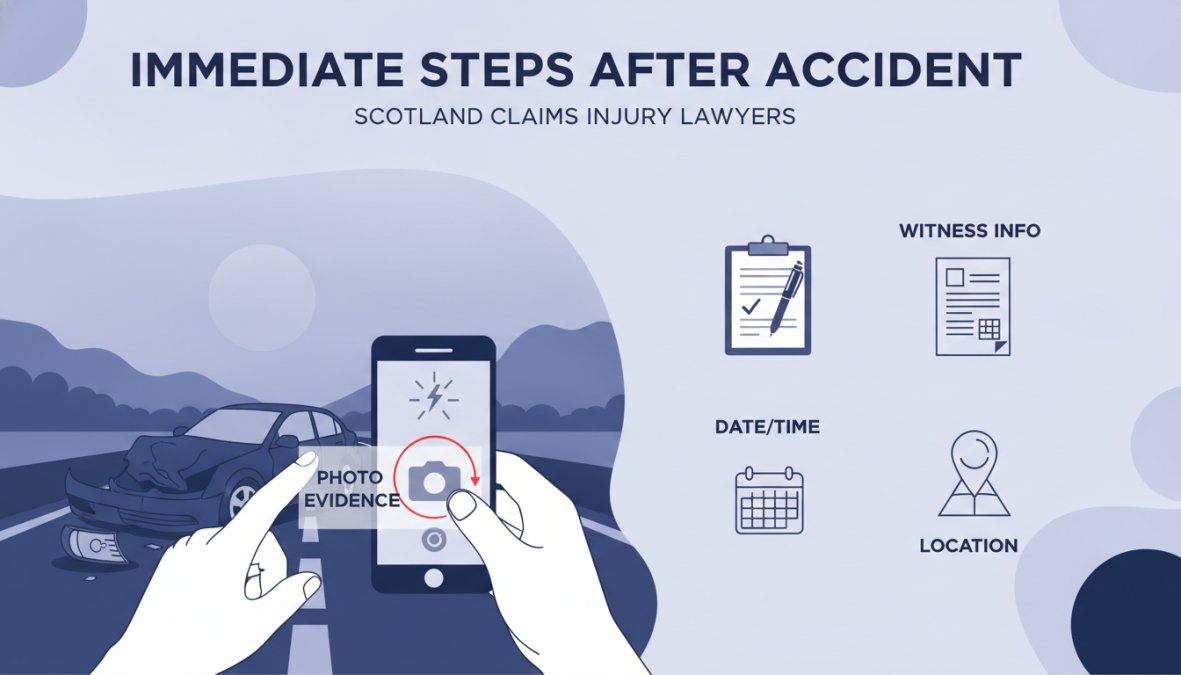 Person photographing damage to a vehicle at roadside accident scene with smartphone, documenting evidence in daylight
The hours and days immediately following your accident are critical for building a strong claim. Actions you take directly affect the evidence available to support your case.
Documenting evidence for free
Begin documenting immediately if you're physically able. Photograph the accident scene from multiple angles, capturing relevant details: road conditions, weather, traffic signs, vehicle positions, and visible injuries. For workplace accidents, photograph the hazard or unsafe condition. For slips or trips, document the surface, obstacles, and lighting conditions.
Gather contact information from witnesses. Ask them to provide a brief account of what they saw. Obtain an accident report if one was filed. For road traffic accidents, contact Police Scotland and request a report number. For workplace accidents, ensure your employer completes an accident book entry. For slips or trips on someone else's property, ask the property owner to document the incident in writing.
This documentation becomes invaluable when you later consult with a solicitor, who will use it to build your case.
:::pro_tip
Take photographs immediately after the accident. Memory of details fades quickly, and physical evidence can be cleaned up or altered within hours.
:::
Gathering witness statements and records
Contact witnesses within days of the accident while their recollection is sharp. Ask them to write a brief account of what they saw. Gather medical records from your GP, hospital, or physiotherapists. If you've missed work, obtain a letter from your employer confirming the dates and impact.
Collect financial records supporting your losses: payslips showing lost earnings, receipts for medical expenses, invoices for care or assistance. The more organised and complete your evidence, the faster your solicitor can assess your case.
Understanding Contingency Fee Agreements and No Win No Fee
The terms "contingency fee" and "No Win No Fee" are often used interchangeably, but understanding the distinction matters for your peace of mind.
How No Win No Fee protects you
A No Win No Fee agreement means your solicitor's fees depend entirely on the outcome of your case. You pay nothing upfront and nothing if the claim fails. In Scotland, No Win No Fee solicitors typically recover their fees from the defendant's insurance company or from the compensation awarded, rather than from your pocket.
When you get free legal advice, ask your solicitor to explain exactly how their fees work. A transparent solicitor will detail what happens if your case settles, what happens if it goes to court, and whether any costs could fall to you in unusual circumstances.
What happens if your claim is unsuccessful
If your claim is unsuccessful, you pay nothing to your solicitor under a No Win No Fee agreement. However, you might face the defendant's legal costs if they've incurred them in defending the claim.
This is where After the Event (ATE) insurance becomes relevant. Many No Win No Fee solicitors recommend ATE insurance, which covers the defendant's costs if your claim fails. The insurance premium is usually paid from your compensation if you win. If you lose, the insurance covers those costs, protecting you from financial liability.
Key Takeaway
No Win No Fee means you risk nothing financially. Your solicitor only profits if you win, aligning their incentive with yours.
Evaluating Your Case Worth and Claim Value
Understanding what your claim might be worth helps you assess whether pursuing it makes sense.
Factors affecting settlement amounts
Compensation in personal injury claims reflects the severity of your injury, the impact on your life, and the financial losses you've incurred. Scottish courts consider the nature and extent of your injury, your age at the time of injury, and the circumstances of the accident.
Financial losses are calculated precisely: lost wages, medical expenses, travel costs for treatment, and costs for care assistance. General damages, compensation for pain, suffering, and reduced quality of life, are assessed using judicial guidelines that categorise injuries and assign compensation ranges.
When you get free legal advice, your solicitor will discuss these factors in relation to your specific circumstances and explain realistic settlement ranges.
Many law firms offer online compensation calculators. These tools provide rough estimates based on injury type and circumstances. They're useful for gaining a general sense of potential value, but they're not precise predictions.
Calculators apply average compensation figures to your injury category. Your actual case is unique, with factors like your specific job, age, injury's exact nature, and evidence strength all influencing the final figure. Use calculators as a starting point, then discuss your specific situation with a solicitor during your free consultation for a more accurate assessment.
| Factor |
Impact on Claim Value |
Example |
| Injury severity |
High |
Spinal injury worth significantly more than minor fracture |
| Age at injury |
High |
30-year-old receives more than 65-year-old with same injury |
| Lost earnings |
Medium to High |
Professional earning £60,000 annually has higher losses than part-time worker |
| Clear liability |
High |
Obvious defendant negligence strengthens settlement position |
| Treatment costs |
Low to Medium |
Documented medical expenses add to claim total |
| Recovery time |
Medium |
Longer recovery period increases compensation for pain and suffering |
Self-Representation Risks and When You Need Professional Help
Some injured people consider handling their claim without legal representation to save money. Whilst legally possible, the risks often outweigh any savings.
Common mistakes people make without legal representation
Self-represented claimants frequently accept the first settlement offer without understanding whether it's fair. Insurance companies know unrepresented claimants often lack knowledge of typical compensation ranges and make lowball offers accordingly.
Another common mistake is missing procedural deadlines. Scottish civil procedure involves strict timelines for filing documents and taking steps in litigation. Missing a deadline can result in your case being dismissed entirely. Unrepresented claimants also often fail to gather sufficient evidence or present it effectively, and make damaging admissions when communicating with the other party's solicitor.
How solicitors protect your legal rights
A solicitor investigates your accident, gathers evidence, identifies all potentially liable parties, and assesses the full scope of your damages. They communicate with the other side's representatives, negotiate on your behalf, and protect you from pressure tactics.
Solicitors understand the law of negligence, causation, and damages. When dealing with insurance companies, a solicitor's involvement changes the dynamic immediately. Insurers know that represented claimants are more likely to pursue cases to court if necessary and are less likely to accept unreasonable offers.
Watch Out
Attempting to handle a complex injury claim alone risks accepting inadequate compensation or losing your case entirely on procedural grounds. The cost of a solicitor is typically recovered from your settlement.
Financial Assistance Beyond Legal Fees
Injury claims can take months or years to resolve. During this time, you might face financial hardship if your injury prevents you from working.
Interim payments and emergency support
If your injury is severe and your claim is strong, you may be eligible for an interim payment from the defendant's insurance company. This is a partial payment made before your case concludes, designed to help you cover immediate expenses.
Various support schemes exist for injured people in Scotland. If you've lost income due to your injury, you may qualify for Employment Support Allowance or Universal Credit. Charitable organisations across Scotland offer emergency grants to people facing hardship due to injury or illness.
Managing costs whilst your claim progresses
Create a budget reflecting your reduced income and increased expenses. Keep detailed records of all expenses related to your injury and recovery. Communicate openly with your solicitor about financial pressure you're experiencing; they may be able to expedite negotiations or apply for interim payments.
Your Next Steps: Getting Free Legal Advice in Scotland
Ready to pursue your injury claim? Understanding what to expect from your first consultation removes anxiety and helps you make the most of it.
What to expect during your first consultation
Your solicitor will ask detailed questions about how your accident occurred, what injuries you sustained, and what financial losses you've incurred. Bring any documentation you have: accident reports, medical records, witness details, photographs.
The solicitor will explain Scottish law as it applies to your situation, discuss whether you have a viable claim, and explain the No Win No Fee basis. You'll discuss next steps: what evidence needs gathering, whether expert reports are necessary, and what the timeline might look like.
Questions to ask your solicitor
Ask about their experience with cases similar to yours and their success rate. Ask specifically about costs and how fees are calculated. Ask about communication: how often will they update you, and what's their response time for queries?
Ask about alternatives to court. Most cases settle, but what's their approach to negotiation? When would court become necessary?
:::pro_tip
Trust your instinct about the solicitor. If you feel rushed, dismissed, or unclear after the consultation, it's fine to seek a second opinion elsewhere.
:::
Pursuing an injury claim whilst managing pain, recovery, and financial pressure is challenging. You shouldn't face this challenge alone. Scotland Claims Injury Lawyers specialises in helping injured people across Scotland access the compensation they deserve. Our solicitors operate on a No Win No Fee basis, meaning you pay nothing upfront and keep 100% of your compensation if successful. When you get free legal advice with our team, you'll speak with experienced solicitors who understand Scottish law and are committed to maximising your recovery. Contact Scotland Claims Injury Lawyers today to discuss your accident and learn what your claim might be worth.
Frequently Asked Questions
How can I get free legal advice for my injury claim without paying upfront?
Most Scottish solicitors offer free initial consultations where they assess your claim at no cost. Many operate on a No Win No Fee basis, meaning you pay nothing unless your claim succeeds. Legal aid may also be available depending on your circumstances. During your free consultation, solicitors will explain your legal rights, evaluate your case, and outline the next steps without any financial obligation to you.
What is a No Win No Fee agreement and how does it protect me?
A No Win No Fee arrangement means your solicitor only receives payment if your claim is successful. You retain 100% of your compensation when you win. This aligns your solicitor's interests with yours—they're motivated to pursue your claim vigorously. Unlike some firms charging success fees, Scotland Claims Injury Lawyers doesn't take a percentage of your settlement, ensuring you keep all compensation awarded to you.
What evidence should I document myself to support my injury claim?
Gather photographs of the accident scene, property damage, and your injuries at different stages of recovery. Keep all medical records, receipts for treatment, and a detailed diary of symptoms and impact on daily life. Collect contact information from witnesses. Document lost wages and expenses. This free documentation strengthens your case significantly and helps your solicitor during case evaluation and negotiations with insurance adjusters.
Can I represent myself in an injury claim, or do I need a solicitor?
Whilst self-representation is legally possible, it carries substantial risks. Without legal expertise, you may miss statute of limitations deadlines, undervalue your claim, or make statements damaging your case. Insurance adjusters exploit this. A solicitor understands tort law, negotiation tactics, and litigation procedures. Given free consultations are available, professional legal representation typically outweighs the risks of self-advocacy, especially for complex claims involving significant damages.