
Table of Contents
Last Updated: September 5, 2026
How Much Compensation for a Fractured Ankle in Scotland?
Understanding fractured ankle compensation in Scotland starts with knowing the legal benchmarks that guide personal injury awards. For a fractured ankle, compensation brackets typically range from £5,000 up to £85,000 depending on severity Accident Claim Expert payout guidance. Minor ankle injuries are valued up to £16,770, moderate injuries range from £16,770 to £32,450, and severe ankle injuries, including complex fractures, attract awards between £38,210 and £61,090 JMW Solicitors ankle injury compensation guide.
Scotland Claims Injury Lawyers, based in Glasgow, helps injured people across Scotland pursue these claims on a No Win No Fee basis. The firm tracks settlement data across Scottish courts to give claimants a realistic picture of what their case might be worth before they commit to legal action.
Below, this guide breaks down exactly how compensation is calculated, what affects the final figure, and the steps to start a claim under Scots law. The process matters more than most people realise, and getting it right early can add thousands to a settlement.
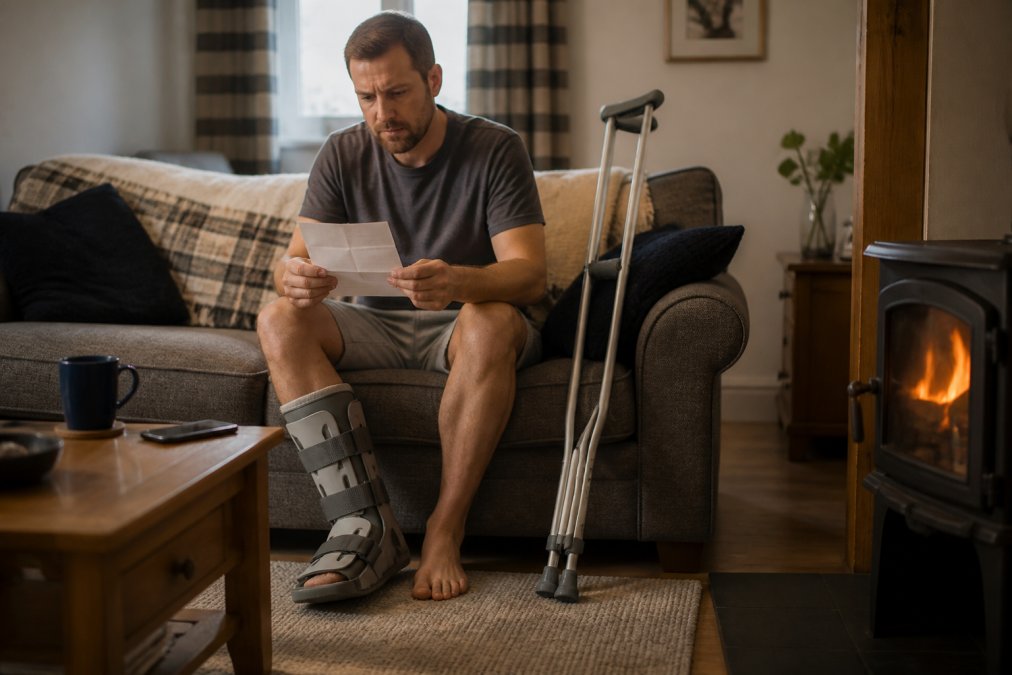 A person in a walking boot with crutches, sitting on a sofa at home in Scotland, looking at paperwork with a concerned expression
What Determines Your Fractured Ankle Compensation Value?
The amount awarded for a fractured ankle injury claim depends on two main categories of damages: general damages for pain and suffering, and special damages for financial losses. A claim for a fractured ankle in Scotland is assessed against the Judicial College Guidelines, which Scottish courts reference when determining appropriate payout brackets.
The clinical outcome does not always predict the financial settlement. While 52% to 87% of patients report good to excellent clinical outcomes following an ankle fracture NCBI study on ankle fracture life impact, compensation depends heavily on the specific severity and the long-term effect on the individual's ability to work and live normally.
Severity of the Fracture and Long-Term Impact
Fracture severity is the single biggest factor in valuation. A clean break that heals without complications sits at the lower end of the bracket. A comminuted fracture requiring surgery, metal fixation, or resulting in permanent stiffness or arthritis will push the value significantly higher.
Surgical intervention introduces its own risks. Research analysing 51 cases identified iatrogenic complications and patient-injury risks following ankle fracture surgery ScienceDirect study on ankle fracture surgery complications. These complications can extend recovery time, require further procedures, and increase the value of a claim because the long-term prognosis worsens.
Special Damages: Loss of Earnings and Out-of-Pocket Costs
Special damages cover the financial impact of the injury. The most significant of these is usually a loss of earnings claim in Scotland, which compensates for wages lost during recovery and any reduced earning capacity afterwards.
Other recoverable costs include:
- Medical treatment and prescription charges
- Physiotherapy and rehabilitation sessions
- Travel expenses to appointments
- Care and assistance provided by family members
- Adaptations to the home or vehicle
- Out-of-pocket expenses directly caused by the injury
A workplace accident resulting in a fractured ankle secured £120,000 in compensation in one Scottish case handled by RP Crawford Solicitors RP Crawford Solicitors case study. Another fractured ankle claim managed by Accident Claims UK secured £75,000 Accident Claims UK fractured ankle case example. These figures show how context and impact drive value beyond the base brackets.
Key Takeaway
Compensation is not just about the break itself. The financial consequences, ongoing care needs, and long-term prognosis all feed into the final settlement figure.
Fractured Ankle Recovery Time and Its Effect on Your Claim
Fractured ankle recovery time typically ranges from six weeks in a cast for a simple fracture to six months or longer for complex injuries requiring surgery. The recovery period directly influences the value of your claim because it determines how long you are off work and what level of care you need.
Claims adjusters and solicitors look at the prognosis carefully. A fracture that heals on schedule with no lasting effects will settle at the lower end of the bracket. One that develops complications, requires revision surgery, or leaves the claimant with chronic pain will command a higher settlement because the impact extends far beyond the initial healing phase.
The Psychological Impact of a Traumatic Fracture
The psychological effects of a serious fracture are often underestimated, both by claimants and by solicitors who fail to explore this head of damage. Reduced mobility, dependence on others, and the frustration of a long recovery can contribute to anxiety and depression. In some cases, the circumstances of the accident itself, a fall from height, a workplace machinery accident, or a road traffic collision, can trigger post-traumatic stress disorder (PTSD).
These psychological impacts can form part of a claim, particularly where they persist after physical healing is complete. Under Scots law, you can recover damages for psychiatric injury that arises as a consequence of a physical injury.
Recognising the Symptoms
Common psychological reactions following a fractured ankle include:
- Anxiety about walking on uneven surfaces, stairs, or in crowded places
- Avoidance behaviours, such as refusing to return to the location of the accident
- Sleep disturbance and nightmares, particularly if the fracture was sustained in a traumatic incident
- Hypervigilance, constantly checking the ground or feeling unsafe in situations that previously felt normal
- Low mood and irritability stemming from prolonged pain and restricted activity
- Social withdrawal due to embarrassment about mobility aids or inability to participate in usual activities
If you experience any of these symptoms for more than a few weeks after your injury, it is worth discussing them with your GP. A referral to a clinical psychologist or psychiatrist can provide both treatment and the medical evidence needed to support this element of your claim.
How Psychological Injury Affects Your Claim Value
A psychiatric assessment will determine the severity of your psychological condition and its prognosis. Mild anxiety that resolves within a few months may add a modest amount to your settlement. A diagnosable condition such as PTSD or clinical depression that requires ongoing therapy or medication can add thousands of pounds to your award.
The assessment will also consider whether your psychological condition delays your physical recovery. Research consistently shows that patients with significant anxiety or depression following orthopaedic trauma have poorer functional outcomes and longer recovery times. If your psychological state slows your return to work or extends your need for care, those additional losses are recoverable.
Proving the Psychological Impact
To claim for psychological injury, you will need:
- A GP record showing you reported symptoms during your recovery
- A referral letter to a mental health professional
- A psychiatric or psychological report prepared for your claim
- Evidence of any treatment you received, including counselling sessions or medication
Your solicitor can arrange an independent psychiatric assessment alongside the orthopaedic examination. Both reports are submitted to the defender as part of the evidence package. It is important to be honest and open with the psychiatrist about your symptoms, minimising your difficulties to appear strong can significantly undervalue your claim.
Watch Out
Psychological injuries are just as valid as physical ones in a personal injury claim. If you are struggling emotionally after your fracture, tell your GP and your solicitor. Failing to mention these difficulties means you cannot claim for them later.
The Interaction Between Physical and Psychological Recovery
The relationship between your physical and psychological recovery is not linear. A claimant who develops chronic pain or post-traumatic arthritis may experience worsening mood as their physical limitations persist. Conversely, a claimant who receives early psychological support may recover faster and return to work sooner, reducing their loss of earnings claim but improving their overall quality of life.
Get Started Today →
Your solicitor should instruct both an orthopaedic specialist and, where appropriate, a psychiatrist or psychologist to provide a coordinated prognosis. This ensures the claim reflects the full picture of your recovery and that no element of your suffering is overlooked.
Personal Injury Claim Time Limits Scotland: Act Now
The personal injury claim time limits in Scotland differ from the rest of the UK. Under the Prescription and Limitation (Scotland) Act 1973, you generally have three years from the date of the accident, or three years from the date you became aware of the injury, to raise a court action.
This three-year period is a hard deadline. Miss it, and your claim is time-barred, meaning you lose the right to pursue compensation entirely. There are limited exceptions for children and those lacking capacity, but adults should assume the three-year clock is running.
Acting quickly matters for reasons beyond the deadline. Evidence fades, witnesses move on, and medical records become harder to obtain. A solicitor in Glasgow can begin gathering the necessary documentation and arranging an independent medical assessment while the facts are still fresh.
The Claims Process Under Scots Law: Step by Step
Starting a fractured ankle claim in Scotland follows a structured process designed to resolve cases efficiently. Most claims settle before reaching court, but the court timetable shapes how the case progresses.
- Initial consultation: A solicitor assesses the merits of your case, confirms liability can be established, and explains the likely compensation range.
- Medical assessment: An independent orthopaedic specialist examines you and prepares a medical report detailing the fracture, treatment, and prognosis.
- Evidence gathering: Records of lost earnings, out-of-pocket expenses, and care needs are compiled to support the special damages element.
- Claim notification: The defender (the party at fault) is formally notified of the claim, often through the Scottish courts' pre-action protocols.
- Negotiation: Solicitors exchange evidence and negotiate a settlement figure. Around 95% of personal injury claims settle at this stage.
- Court action: If no agreement is reached, proceedings are raised in court. A judge determines liability and quantum if the case proceeds to a full hearing.
- Settlement: Once agreed, compensation is paid. Under a No Win No Fee arrangement, you keep the full amount.
No Win No Fee: Keeping 100% of Your Compensation
The fear of legal costs stops many people from pursuing a legitimate fractured ankle claim. No Win No Fee agreements remove that barrier entirely.
Under this arrangement, you pay nothing upfront and nothing if the case is unsuccessful. The solicitor recovers their fees from the defender only when you win. This structure means you can pursue a claim without financial risk.
Scotland Claims Injury Lawyers operates on a No Win No Fee basis with a 100% Compensation Guarantee. This means the firm takes no success fee from your settlement. Many other firms charge a success fee of around 20% of the compensation awarded, which can amount to thousands of pounds deducted from your final payout.
Watch Out
Before instructing any solicitor, ask directly whether a success fee will be deducted from your compensation. A 20% success fee on a £40,000 settlement removes £8,000 from your pocket.
Common Mistakes to Avoid When Claiming
Several avoidable errors can reduce the value of a fractured ankle claim or undermine it entirely.
Delaying medical treatment. Failing to seek prompt medical attention gives the defender grounds to argue the injury was not serious or was not caused by the accident.
Not documenting everything. Photographs of the injury, the accident scene, and the recovery process strengthen a claim. Keep receipts for every expense related to the injury.
Posting on social media. Insurance companies monitor claimants' social media activity. Photos showing you active and mobile can be used to argue your injury is less severe than claimed.
Accepting the first offer. Initial settlement offers are often lower than the claim's true value. Insurers expect negotiation. A solicitor will assess whether the offer fairly reflects the injury's impact.
Missing the time limit. The three-year prescription period in Scotland is unforgiving. Instructing a solicitor early protects your position.
Conclusion: Start Your Fractured Ankle Claim Today
A fractured ankle can disrupt your life for months, affecting your income, your mobility, and your wellbeing. The compensation system in Scotland exists to put you back in the position you were in before the injury, but only if you act within the time limits and present your case properly.
Scotland Claims Injury Lawyers, with a team covering Glasgow and all of Scotland, offers risk-free impartial advice on whether your claim is worth pursuing. Every case is handled on a No Win No Fee basis, and the 100% Compensation Guarantee ensures you retain every penny of your settlement.
Get started with Scotland Claims Injury Lawyers and find out what your fractured ankle claim could be worth.