
Could making a compensation claim after a workplace injury put your job or future opportunities at risk? The fear of claiming against employer is understandable, especially if you value your working relationships or worry colleagues will find out. But a personal injury claim is a route to compensation, not a demand to confront your employer personally. Claims are generally dealt with through the employer’s liability insurer, although making a claim can’t guarantee that workplace relationships will remain unchanged.
You may also wonder whether claiming is disloyal, or whether it’s the same as making a formal complaint at work. They’re different processes, and understanding that distinction can help you decide what feels right. This article explains the protections that may apply in Scotland, what can happen after a claim begins, and practical ways to protect evidence and your position at work. It also covers who may pay legal costs and what a No Win, No Fee arrangement means. You’ll get a clearer picture of your options, so you can seek specialist Scottish advice without feeling pressured to make a commitment.
Key Takeaways
- The fear of claiming against employer can involve job security, workplace relationships and reputation. Learn how to assess these concerns without assuming either that retaliation is inevitable or that a claim has no workplace impact.
- Understand how a personal injury claim differs from an internal workplace complaint, and why whether you have a claim depends on the evidence and circumstances.
- Find out who may need information about a claim, including the employer and its insurer, and what this means for privacy.
- Use practical steps to prioritise your health, record what happened and preserve useful evidence before deciding what to do next.
- See how Scotland Claims’ stated No Win, No Fee approach works: legal costs are recovered from the at-fault party’s insurer, and you keep your compensation, subject to the agreement’s terms.
Fear of claiming against your employer: why so many workers hesitate
Deciding whether to pursue a workplace injury claim can feel complicated when your employer is also the person or organisation you rely on for your income, references and day-to-day support. The fear of claiming against employer may involve more than the legal process. You might worry about losing your job, missing out on a promotion, being treated differently or gaining a reputation as someone who causes trouble.
Those concerns deserve to be taken seriously. A claim does not automatically mean dismissal or hostility, but no one can promise that working relationships will feel exactly the same throughout the process. Thinking about your options is not the same as accusing a manager face to face. A solicitor can explain how a claim might proceed and what information could be shared, before you decide whether to take any further step.
A workplace injury claim seeks compensation for an injury; it is not, by itself, a personal dispute with your employer. That distinction can help separate the question of responsibility for an injury from how you feel about the people you work with.
What are employees in Scotland most worried about?
Job security is often the first concern: you may wonder whether raising a claim could affect your role, shifts, promotion prospects or future references. You might also anticipate pressure from a manager or feel awkward working alongside colleagues who know what happened. These are understandable worries, but they are not proof that a negative reaction will follow.
Privacy matters too. You may not want colleagues to know about your injury, treatment or finances. Who needs to know depends on the circumstances and the information required to deal with a claim. It is sensible to ask a solicitor what may need to be shared and with whom, rather than assume either that every detail will remain private or that everyone at work will be told.
A compensation claim is not the same as a workplace grievance
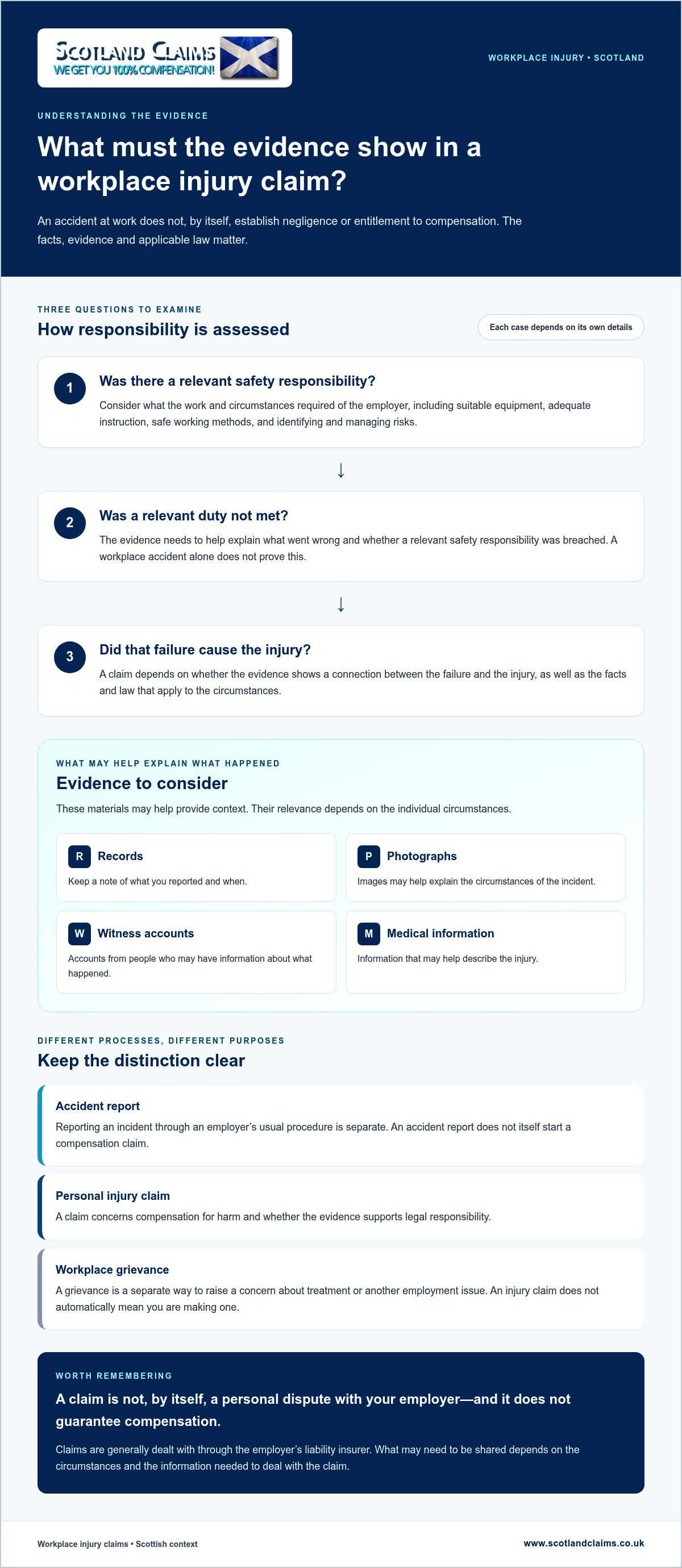
A personal injury claim concerns compensation for harm and whether the evidence supports legal responsibility. A workplace grievance is a separate way of raising a concern about your treatment or another employment issue. You may have one, both or neither; pursuing an injury claim does not automatically mean you are making a grievance.
Reporting an accident at work can also be a separate process. For example, if you slip on a wet floor, you might report the incident through your employer’s usual procedure, seek medical attention and later ask a solicitor whether the circumstances support a compensation claim. The steps and records involved can vary. Keep a note of what you reported and when, and avoid assuming that an accident report itself starts a claim.
Scotland has its own court system and routes for personal injury cases. For general background, you can read about the Sheriff Personal Injury Court. The court route is a legal process, not a requirement to personally confront your manager. You can also explore what is involved in work injury claims before deciding what questions to ask about your own situation.
What protections may apply if you claim against an employer in Scotland?
It helps to separate two questions: did the employer fail to meet a relevant safety responsibility, and does the evidence show that this failure caused your injury? Workplace safety duties and a compensation claim are connected, but one doesn’t automatically prove the other. The answer depends on the facts, the evidence and the law that applies to your circumstances.
Employer’s liability is the legal responsibility an employer may have where a failure to meet a relevant duty of care causes an employee’s injury, subject to the evidence and applicable law. An employer’s safety responsibilities are not the same as a finding that it is legally liable in your particular case. Nor does a claim guarantee compensation.
What does an employer’s duty of care mean in practice?
In practical terms, workplace safety can involve suitable equipment, adequate instruction, safe working methods and steps to identify and manage risks. What is reasonable depends on the work and the circumstances. For example, a risk assessment might identify a need to keep a walkway clear, whilst a task involving machinery could require appropriate training and safeguards.
If an accident happens, that fact alone doesn’t establish negligence or entitlement to compensation. The evidence may need to show what went wrong, whether a relevant duty was breached and whether that breach caused the injury. Records, photographs, witness accounts and medical information may help explain what happened, but each case is assessed on its own details.
Employers may also have separate reporting responsibilities for certain workplace incidents. Those reporting rules don’t decide whether an individual compensation claim will succeed. A solicitor can assess how the facts relate to the applicable Scottish law and the evidence available.
Can an employer dismiss or treat you unfairly for claiming?
Your concern about workplace consequences is real, but the legal position depends on why an employer acted and the circumstances. A personal injury claim does not mean every later disagreement, change in duties or negative decision automatically breaks the law. At the same time, an employer should not treat a legitimate claim as a reason to dismiss or penalise you. The details matter, and employment protections can depend on the facts and the legal basis involved.
Keep a clear record if something changes after you raise an issue or pursue a claim. Note dates, what was said, decisions affecting your work and any relevant messages. Don’t assume that a difficult interaction proves unlawful treatment, but don’t dismiss a pattern that concerns you either. Seek prompt, situation-specific legal advice if you face a threat to your job or believe you’re being treated differently. Acas (Advisory, Conciliation and Arbitration Service) also provides workplace guidance for employees in Scotland.
The fear of claiming against employer can make it hard to weigh up these separate issues. A confidential initial enquiry with a solicitor can help you understand the evidence and distinguish a possible injury claim from an employment concern, without obliging you to proceed. You can find out more about work injury claims in Scotland, or speak with Scotland Claims to discuss your options.
Who finds out about a workplace injury claim, and who pays?
It helps to separate three things that can feel tangled: who communicates about a claim, how compensation may be funded, and what your employer records or reports about an accident. The people involved can include you as the claimant, your solicitor, your employer and an insurer. Their roles are different, and information is shared for different reasons.
Will your employer know you have made a claim?
Your employer may be notified or asked to provide relevant records or information so the claim can be investigated and answered. For example, this could involve details about an accident, workplace procedures or what was recorded at the time. Your solicitor can explain what information is needed and how it may be used in your particular case.
That doesn’t mean every colleague will be told. Necessary communication about a claim is not the same as wider disclosure across the workplace. However, complete secrecy can’t be promised: who receives information depends on the circumstances and the steps needed to deal with the claim. If privacy is a concern, raise it with your solicitor before sharing details.
Does your employer pay compensation personally?
A claim may be brought against an employer, while an employer’s liability insurer may handle the response and meet compensation or legal costs where the relevant insurance applies. The insurer’s involvement doesn’t change the identity of the party the claim is against. The arrangements and outcome depend on the facts, applicable cover and whether the claim succeeds.
Scotland Claims’ stated approach is to recover legal costs from the at-fault party’s insurer, rather than deduct them from your compensation. Under its No Win, No Fee terms, you pay nothing if your claim is unsuccessful. Make sure you understand the terms that apply to your own case before proceeding. The insurer’s role in a claim is separate from workplace accident reporting, which may involve the employer and, where relevant, the Health and Safety Executive (HSE).
The table below separates these processes. It’s a guide to the usual roles, not a guarantee that every case follows the same steps.
| Process | Who may be involved | What it means |
|---|
| Claim communication | You, your solicitor, employer and insurer | Relevant information may be requested or shared to investigate and respond to the claim. |
| Insurance and compensation | Employer and insurer | An insurer may handle the claim and meet costs where the applicable cover and circumstances allow. |
| Workplace reporting | You, employer and potentially the HSE | Accident records or formal reports serve a safety and reporting purpose, distinct from deciding compensation. |
A workplace report does not itself establish liability, and an insurer handling a claim does not mean your manager is personally paying a settlement. If uncertainty about information sharing or funding is adding to your fear of claiming against employer, get advice before deciding what to do. You can explore work injury claims in Scotland and the steps involved.
What to do if afraid to make a workplace injury claim
You don’t have to decide straight away whether to make a claim. Start with practical steps that support your health and keep a clear record of what happened. You can report an accident through the appropriate workplace process without committing to a compensation claim. Don’t conceal an incident or alter records. The aim is to understand your options with reliable information, not to rush into a decision.
- Prioritise your health. Seek medical help if you need it, and explain how the injury happened so your symptoms and treatment are accurately recorded.
- Make a note of the incident. Record the date, time, location and what you remember, including any equipment, conditions or events that may have contributed.
- Preserve relevant evidence. Keep copies of records you can lawfully access, such as messages or accident-report details. Take photographs where appropriate, and note potential witnesses without pressuring them to give a particular account.
- Get advice before choosing what to do. A preliminary discussion can help you understand whether the circumstances and evidence may support a claim, what information may be needed and what the next steps could involve.
Keep your notes factual. If you’re unsure of a detail, say so rather than guessing. Don’t edit original records or ask colleagues to change their recollection. A clear timeline can help a solicitor assess the situation, even if you later decide not to proceed.
Which details and evidence should you keep?
Write down what happened while your memory is fresh, including where you were, what you were doing and who was present. Record when you told someone at work and any response you received. Save relevant photographs and medical documents where they’re available to you. Follow workplace reporting procedures, and keep a copy of any report you’re entitled to retain. Don’t access records without permission.
For broader information about rights and claim considerations, read this guide to accidents at work in Scotland. It can help you prepare questions, but it can’t determine whether your own circumstances meet the legal test.
How can you seek advice without committing to a claim?
An initial enquiry is a chance to explain what happened and ask about evidence, eligibility, timing and possible next steps. It doesn’t oblige you to start a claim, and not every enquiry will lead to one. A solicitor can also explain what information may need to be shared if a claim proceeds, so you can make an informed choice rather than relying on assumptions.
Timing matters. In Scotland, the standard personal injury time limit is generally three years, although exceptions may apply. Court proceedings must be raised to meet the deadline; simply contacting a solicitor or insurer doesn’t stop the clock. If you’re uncertain about dates, seek advice promptly. You can explore work injury claim support to understand the specialist advice available in Scotland.
If fear of claiming against employer is holding you back, an initial conversation can help you clarify your options without deciding to proceed.
How Scotland Claims can help you take the next step
You don’t need to have decided to claim before asking what your options might be. Scotland Claims Injury Lawyers handles workplace injury claims across Scotland. An initial enquiry is a chance to explain what happened, ask questions and understand whether the available evidence may support a claim. It doesn’t commit you to proceeding, and not every workplace injury will lead to a claim.
Scotland Claims Injury Lawyers is a specialist personal injury firm and a trading style of Kerr Brown Solicitors, authorised and regulated by the Law Society of Scotland. Its team can discuss the circumstances of your injury and explain what information may be relevant. You can also explore the firm’s work injury claim service to understand the type of support available.
How the No Win, No Fee and 100% compensation model works
Scotland Claims Injury Lawyers’ stated approach is to recover legal costs from the at-fault party’s insurer, rather than deduct them from your compensation. The firm describes this as 100% compensation: it refers to what happens to a successful settlement under this model, not a promise that your claim will succeed or that compensation is guaranteed.
The firm also offers No Win, No Fee terms. It says that if an eligible claim is unsuccessful, you pay nothing, subject to the terms of your agreement. Ask for those terms to be explained clearly before deciding whether to proceed, including what happens if your circumstances change. This helps you understand the financial arrangements rather than relying on the label alone.
Fee arrangements can differ between firms, so avoid assuming that every solicitor uses the same model or makes the same deductions. What matters is knowing how costs are handled in your own agreement and what you could owe in different circumstances. Scotland Claims Injury Lawyers’ approach is designed so that legal costs are recovered from the insurer, not taken from your compensation.
What happens when you ask Scotland Claims Injury Lawyers for an assessment?
You can explain the injury, when and where it happened, and what concerns you about making a claim. If you have notes or records, you can mention what is available, but you don’t need to have every document ready to make an initial enquiry. The discussion can clarify what further information may be useful, whether a claim appears worth exploring and what the possible next steps are.
The fear of claiming against employer can make even an initial conversation feel like a major decision. Treat it instead as a way to get clear information. You can ask about communication with your employer, the evidence needed and the fee terms, then consider your options without pressure to proceed. An enquiry does not itself guarantee that a claim will be accepted or succeed.
If you’d like to talk through your circumstances, Scotland Claims Injury Lawyers offers free initial enquiries through its 24-hour helpline. You can use the conversation to get guidance about your options before deciding what to do next.
Take the next step at your own pace
You don’t need to resolve every worry before asking what your options are. Start by identifying the question that matters most to you. It might be what information could be shared, how the evidence would be assessed or what the first step involves. A focused conversation can help you make a decision based on your circumstances, rather than on the fear of claiming against employer alone.
Speaking to Scotland Claims doesn’t mean you’ve agreed to pursue a claim. It gives you the opportunity to discuss your workplace injury and understand possible next steps. If you decide to go ahead, you can do so with a clearer idea of the process and the terms involved. If you choose not to, you’ll have explored your options and can consider what feels right for you.
You deserve clear information before making a decision. Take the next step when you feel ready.
Frequently Asked Questions
Can my employer dismiss me for making a workplace injury claim in Scotland?
An employer must not dismiss or penalise you for making a legitimate personal injury claim. If you’re worried a work decision is connected to your claim, keep a record of what happened and when, and seek advice about your individual circumstances. Not every disagreement or workplace change automatically amounts to unlawful treatment. The reason for the employer’s action and the surrounding evidence matter.
Will my employer find out if I make a workplace injury claim?
Your employer will usually need to know enough to respond to a claim, so you should not assume the process can remain completely confidential from them. For example, the employer may be asked for relevant incident records or information about your work. That doesn’t mean every colleague will be told. If you’re concerned about particular details being shared, ask your solicitor how information may be used in your case.
Can I claim against my employer and keep working for them?
Yes, making a workplace injury claim does not automatically mean you must leave your job. You may be able to continue working whilst the claim is considered, depending on your health, duties and circumstances. If your injury affects what tasks you can safely do, discuss this with your healthcare professional and employer through the appropriate workplace process. A claim cannot guarantee that working relationships or day-to-day arrangements will stay unchanged.
Does my employer have to pay my compensation personally?
Not necessarily. An employer’s liability insurer may handle a claim and pay compensation where the circumstances and insurance arrangements allow. The claim may still be made against the employer, even if an insurer manages the response. The outcome depends on the facts and applicable cover. Your solicitor can explain who is involved in your particular case and how any settlement would be handled.
What happens if my workplace injury claim is unsuccessful?
If you claim through Scotland Claims, the firm says you pay nothing if your claim is unsuccessful, subject to its No Win, No Fee terms. Ask for the agreement to be explained before deciding to proceed, including what it covers and whether any circumstances could affect the terms. An unsuccessful claim means compensation is not recovered, so it’s useful to understand the evidence and risks before taking that step.
Can I make a claim if I did not report my accident straight away?
A delay in reporting an accident does not automatically prevent you from asking whether you have a claim. It may make evidence harder to obtain, so write down why you reported it later, what you remember and who you told. Keep any relevant messages or medical records you can lawfully access. A solicitor can assess how the delay affects the evidence and what other information may help explain events.
How long do I have to make a workplace injury claim in Scotland?
The standard time limit for a personal injury claim in Scotland is three years from the accident date. For an injury or disease that becomes apparent later, the relevant period may run from the date of knowledge. Court proceedings must be started to meet the deadline; contacting a solicitor or insurer alone does not stop the clock. Exceptions can apply, so seek advice promptly if you’re unsure of the dates.