
A workplace injury does not automatically mean your employer was negligent, but safety is not optional. The employer duty of care in Scotland means taking reasonable steps to protect employees’ health, safety and wellbeing. The Health and Safety at Work etc. Act 1974 applies in Scotland, and the Management of Health and Safety at Work Regulations 1999 require a competent person to carry out a suitable and sufficient risk assessment, according to legislation.gov.uk.
If you’ve been hurt at work, it’s understandable to ask whether the hazard could have been prevented, whether your training or equipment was adequate, and what happens if your employer failed to act. The key question is not simply whether an accident occurred. It’s whether your employer breached a duty and that breach caused your injury or illness.
This guide explains how workplace safety duties apply in practice, including to physical and mental health, and what records or other evidence may help show negligence. It also outlines how the legal test works in Scotland, so you can see what matters before deciding what to do next.
Key Takeaways
- Understand what employers must do to reduce workplace risks and protect staff health and safety.
- See how reasonable risk reduction applies to everyday work and the equipment employees use.
- Learn which records and other evidence may help show that an employer’s failure caused an injury.
- Know the legal points a workplace injury claim must establish, and how Scots and UK law relate.
- If you’ve been injured at work in Scotland, find out how Work Injury Claims may help you pursue compensation.
Employer responsibilities for workplace health, safety and wellbeing
The Health and Safety at Work etc. Act 1974 applies in Scotland and underpins employers’ workplace duty of care, according to legislation.gov.uk. Employers must take reasonable steps to protect employees’ health, safety and wellbeing while they work.
Safe and Healthy Working Conditions
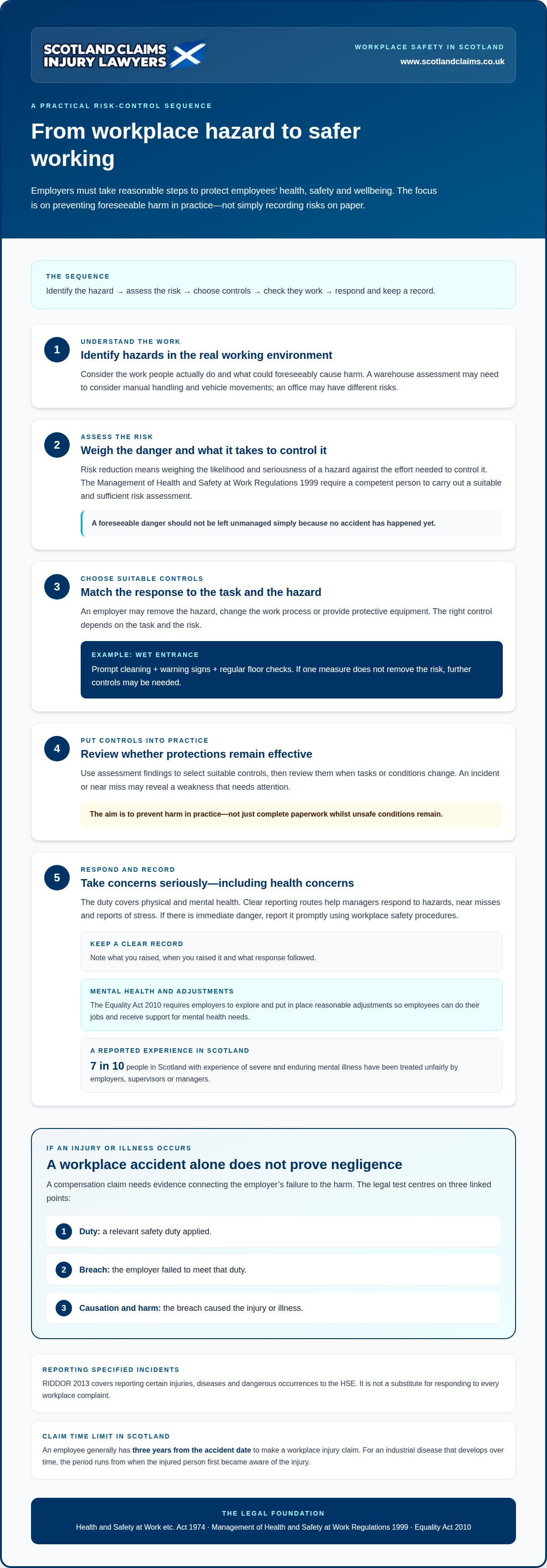
Safe and healthy working conditions mean identifying workplace hazards and taking reasonable steps to prevent harm. This matters because an avoidable risk, such as an unsafe walkway or unsuitable work process, can lead to injury or illness. The Management of Health and Safety at Work Regulations 1999 require a competent person to carry out a suitable and sufficient risk assessment, according to legislation.gov.uk.
A risk assessment should reflect the work people actually do. A warehouse assessment, for example, may need to consider manual handling and vehicle movements, while an office assessment may identify different risks. Employers should use their findings to choose suitable controls and review whether those controls remain effective as tasks or conditions change.
Physical and Mental Health Duties
An employer’s duty covers risks to both physical and mental health. The Equality Act 2010 requires employers to explore and put in place reasonable adjustments so employees can do their jobs and receive support for mental health needs, according to legislation.gov.uk. This matters if a health condition or disability makes a workplace task difficult or increases its risks.
Stigma can also affect how safely someone can work. Seven in 10 people in Scotland with experience of severe and enduring mental illness have been treated unfairly by employers, supervisors or managers. A worker who reports stress or asks for support should be taken seriously. Clear reporting routes help managers respond to concerns rather than dismissing them as weakness or poor performance.
Employers should respond to reported hazards and health concerns, including near misses that reveal a risk before anyone is injured. Keep a clear record of what you raised, when you raised it and what response followed. If there is immediate danger, report it promptly using your workplace’s safety procedures so the risk can be addressed.
RIDDOR 2013 covers the reporting of certain injuries, diseases and dangerous occurrences to the HSE, according to the Health and Safety Executive. This is a reporting duty for specified incidents, not a substitute for responding to every workplace complaint. For an injury at work in Scotland, injury lawyers in Scotland can assess how the circumstances relate to an injury claim.
What Is the Duty of Care?
An employer’s duty of care means taking reasonable steps to prevent foreseeable harm at work. A breach may lead to enforcement action, but a compensation claim also needs evidence that the breach caused injury or illness.
Practicable Workplace Risk Reduction
Reducing risk so far as is reasonably practicable means weighing the likelihood and seriousness of a hazard against the effort needed to control it. A foreseeable danger should not be left unmanaged just because no accident has happened yet. An employer may remove the hazard, change the work process or provide protective equipment. The right control depends on the task and the risk.
A wet entrance, for example, may require prompt cleaning, warning signs and regular floor checks. If one measure does not remove the risk, further controls may be needed. Employers should review their arrangements when work changes or an incident reveals a weakness. The aim is to prevent harm in practice, not simply complete paperwork while unsafe conditions remain.
Breach Consequences and Compensation
A breach occurs when an employer fails to meet a relevant safety duty, and the failure causes harm. This distinction matters: an unsafe practice may prompt enforcement, but a personal injury claim also needs evidence linking the breach to the claimant’s injury or illness. In the Sheriff Court’s summary jurisdiction in Scotland, the maximum fine for breaches of general duties under the Health and Safety at Work Act is £20,000.
Compensation addresses losses caused by an injury; it does not punish the employer. A claim must establish the duty, the breach and the resulting harm. Workplace stress can also have financial consequences for an organisation, such as absence, disrupted work and staff turnover. Those costs are separate from damages awarded to an injured employee.
Smoking restrictions are another workplace safety measure. Smoking is prohibited in enclosed workplaces and shared vehicles, and businesses must display no-smoking signs. Employers must take steps to ensure people do not smoke in these places. Separate workplace rules may apply to vaping, so a vape policy should not be confused with smoking restrictions.
Wellbeing support can help address stress before it develops into illness. Clear ways to raise concerns, a timely response from managers and access to appropriate psychological support can make it easier for employees to seek help. If a worker reports an excessive workload, for example, the employer should consider the work-related risk rather than dismiss or stigmatise the concern.
Time limits matter if an injury leads to a claim. In Scotland, an employee generally has three years from the accident date to make a workplace injury claim, according to legislation.gov.uk. For an industrial disease that develops over time, the period runs from when the injured person first became aware of the injury. Records of symptoms, treatment and workplace events can help clarify the relevant timeline.
Employee safety when using equipment
Equipment safety means managing risks from tools, machinery and screens used for work. Employers must minimise equipment-related risks, including when staff work remotely.
Common Safety Breaches
A safety breach may occur when an employer fails to control a workplace risk, such as defective machinery or unsafe equipment. A preventable failure can cause serious injury, even during routine work.
Examples include using machinery that has not been maintained, leaving guards or other safety features ineffective, and allowing workers to use equipment without suitable instruction. A damaged cable or poorly positioned screen can also create risks. The Health and Safety Executive may become involved in workplace safety matters. Details of the incident can help establish what equipment was involved and how it was used.
Remote work does not remove equipment risks. The Health and Safety (Display Screen Equipment) Regulations 1992 require workstation assessments for employees who use screens, including at home. An unsuitable chair, screen height or desk arrangement can contribute to discomfort or injury. Employers should address risks identified by the assessment, rather than treating a home workstation as outside workplace safety responsibilities.
Duties Across Worker Types
A worker’s employment status affects the working relationship, but a job title alone does not show who controls each safety risk. This is important when employees, agency workers and contractors share a site or use the same equipment.
For employees, the employer should assess risks related to their tasks and equipment. An agency worker may have both an agency and a host organisation involved in their placement, while a contractor may work under a separate contract. The organisations involved should be clear about practical responsibilities for site induction, equipment, instruction and supervision. Workers should know whom to tell if a tool is unsafe or a safety procedure is missing.
Training and Protective Equipment
Training and protective equipment help workers carry out tasks safely. Without suitable instruction or protective gear, even an ordinary task involving unfamiliar machinery can become hazardous.
Training should match the equipment and the worker’s role. Someone using a machine needs instruction on safe operation and what to do if it develops a fault. Employers should provide and require appropriate personal protective equipment when the task’s risks call for it. A worker handling a substance, for example, may need equipment suited to that exposure and instruction on how to use it correctly.
Workers also have a role: follow training, use protective equipment as instructed and report faults promptly. An employer’s responsibility does not end when equipment is handed over. Clear instruction, suitable supervision and action on reported defects can help prevent harm. If a machine guard is broken, stop using the machine and report the fault through your workplace’s safety process.
Evidence for proving employer negligence
A Scottish workplace injury claim needs evidence linking an employer’s failure to your injury. The key questions are whether your employer owed you a duty, breached it and caused your injury or illness. An accident at work alone does not establish negligence. Evidence should help explain what happened, which safety measures were missing and how the harm followed.
Different records can help establish different parts of an incident. Useful evidence may include:
- Accident book entries: These can record when and where an incident happened, and how it was described at the time.
- Health and safety reports: Risk assessments or inspection records may show whether a known hazard had been identified or addressed.
- Witness statements: Colleagues may describe the equipment, conditions or work process they saw before and after the accident.
- CCTV footage: Where available, footage may clarify the sequence of events, such as a fall on a walkway or an incident involving machinery.
- Medical records: Treatment notes can document the injury, symptoms and care received after the incident.
Evidence is stronger when separate records support the same account. An accident book entry describing a fall, for example, may align with a colleague’s statement and medical notes recording an injury that day. A health and safety report identifying a damaged floor before the fall could help show whether the hazard was known. Each item should be considered in context, rather than treated as proof on its own.
Timing and detail matter. A clear account should identify the task, location, equipment or hazard involved, and what happened immediately afterwards. If a machine stopped working or a spill remained on the floor, those details can help explain how the incident occurred. Records made soon after the event may also clarify differences between later recollections.
Medical evidence has a distinct role. It can show the nature and effects of an injury, while workplace records may help establish the circumstances and any safety failure. A medical record may document a hand injury, for example, while a witness statement describes the machine involved. Together, these sources may help connect the injury to the workplace incident.
Keep copies of relevant messages, incident reports and medical documents, and note who witnessed the event. If you raised a safety concern before the accident, a dated email or written report may help show what you communicated and when. It may also indicate whether action followed, giving a clearer account of your employer’s response and your wellbeing at work.
Employer duty of care under Scots and UK law
Workplace safety in Scotland sits within a UK statutory framework, while Scots civil law determines how an injury claim is assessed. The distinction is between an employer’s legal responsibility to manage safety and whether a particular breach caused someone harm.
The Health and Safety at Work etc. Act 1974 provides a foundation for workplace duties in Scotland. Separate legislation addresses specific responsibilities, including risk assessments and working hours. These rules establish obligations, but an accident alone does not prove that an employer is liable. A civil claim must connect the duty, the breach and the resulting injury or illness.
That connection is essential. If a worker is injured by a poorly maintained machine, evidence needs to show the relevant safety failure and how it caused the injury. Risk assessments, equipment records, witness accounts and medical evidence can each explain a different part of what happened. A claim depends on the evidence as a whole, not simply on the fact that an accident occurred.
Scots case law also helps explain when harm may be foreseeable. In Rorrison v West Lothian College and Lothian Regional Council, the employer’s duty concerning psychiatric injury was described as arising when such injury was reasonably foreseeable to an ordinary bystander. In Hatton v Sutherland, the Court of Appeal set out guidance on when stress-related harm is reasonably foreseeable. These cases show why signs of harm and what an employer knew may matter.
Insurance is another part of the legal framework, but it is not the same as proof of negligence. The Employers’ Liability (Compulsory Insurance) Act 1969 requires most UK employers to hold employers’ liability insurance, according to legislation.gov.uk. The existence of insurance does not establish that a breach occurred or determine the value of an individual claim.
The practical questions are: what responsibility applied, what did the employer do or fail to do, and did that failure cause the injury? A careful assessment considers the working conditions, the risks known at the time and the evidence linking those risks to the harm. This helps distinguish a workplace negligence claim from an accident where no breach has been established.
Scotland Claims Injury Lawyers
If you’ve been injured at work in Scotland and need to understand whether the evidence supports a claim, Scotland Claims Injury Lawyers can help. Its Work Injury Claims service assesses how the accident happened, what safety duties may apply and whether an employer’s failure caused your injury. This can be useful if records, witness accounts or medical evidence leave you uncertain about your next step.
The firm operates on a no-win-no-fee basis and promises 100% compensation: it recovers its fees from the at-fault party and passes the entire settlement to you. This is not a promise that every claim will succeed. If you want to discuss a workplace injury, contact Scotland Claims Injury Lawyers.
Take the next step with confidence
Understanding the employer duty of care in Scotland can help you decide what to do after a workplace injury. Consider how the injury happened, what records exist and how it has affected your daily life. A clear account of these details can help establish whether you may have grounds to take action.
Scotland Claims Injury Lawyers handles Work Injury Claims, as well as Road Traffic Accident Claims and Slip or Trip Claims. If you were injured at work, you can discuss what happened and the evidence with the firm. You do not need to have every detail worked out before seeking help.
Getting informed advice can help you understand your options and decide what to do next.
Frequently Asked Questions
Can I Claim for an Accident at Work?
You may be able to claim compensation if your employer’s breach caused your injury or illness. A worker injured by a machine, for example, may have a claim if a safety failure caused the accident and resulting harm. In Scotland, the usual time limit is three years from the accident date, according to legislation.gov.uk. The evidence must link the workplace failure to your injury, not merely show that an accident happened.
Can I be sacked for making a claim?
Making a personal injury claim does not itself establish a lawful reason for dismissal. A compensation claim and an employment decision are separate matters. If you raised a concern that someone’s health or safety was endangered, the Public Interest Disclosure Act 1998 may protect you from detriment when the disclosure meets the Act’s requirements. Keep dated messages about both the claim and any workplace treatment, as they can help clarify what happened.
What are the four things required to prove negligence?
The four practical elements are a duty of care, a breach of that duty, a causal link, and an injury or loss. A worker might show that the employer had a safety responsibility, failed to maintain a machine and caused a hand injury through that failure. Medical records can evidence the harm, while workplace documents or witness accounts may help explain the breach and its link to the injury.
What does “reasonably practicable” mean?
“Reasonably practicable” means taking steps to reduce a risk after weighing its likelihood and seriousness against the effort, time and cost of controlling it. A loose handrail on a busy staircase presents a clear fall risk, and repairing it is a direct control. The greater the potential harm, the stronger the case for effective precautions. An employer should not ignore a known hazard simply because no one has yet been injured.
What is an employer’s duty of care under Scots law?
An employer’s duty of care in Scotland involves taking reasonable steps to protect workers from foreseeable harm. That responsibility covers how work is organised as well as the physical workplace. If repeated reports identify a hazardous task, for instance, the employer’s response may matter when assessing whether reasonable precautions were taken. A claim needs evidence linking a failure to the injury or illness, not just proof that the worker was employed there.
Which Scottish laws govern employers’ health and safety duties?
The Health and Safety at Work etc. Act 1974 applies in Scotland, according to legislation.gov.uk. The Management of Health and Safety at Work Regulations 1999 address workplace risk assessment, also according to legislation.gov.uk. The Equality Act 2010 covers reasonable adjustments for employees, according to legislation.gov.uk. RIDDOR 2013 concerns reporting certain injuries, diseases and dangerous occurrences to the HSE, according to the Health and Safety Executive. Specific activities may also be covered by regulations such as those for display screen equipment.
How must employers assess and manage workplace risks in Scotland?
Employers must arrange a suitable and sufficient risk assessment by a competent person under the Management of Health and Safety at Work Regulations 1999, according to legislation.gov.uk. The assessment should identify hazards in the actual work, consider who may be harmed, and inform suitable controls. For example, a delivery workplace should assess vehicle movements alongside manual handling. Employers with five or more employees must record significant findings of their risk assessments.
What are employers’ duties regarding workplace stress, mental health and bullying in Scotland?
Employers have responsibilities for employees’ physical and mental health, and should respond to workplace stress or bullying concerns rather than dismissing them. Under the Equality Act 2010, employers must explore and put in place reasonable adjustments to enable employees to do their jobs and support mental health needs, according to legislation.gov.uk. A worker reporting bullying or stress should use a clear reporting route and keep dated records. A health and safety disclosure may receive protection under the Public Interest Disclosure Act 1998 if its requirements are met.