Cost of solicitors for buying a house: 2026 UK guide

How much do solicitors cost when buying a house in the UK?
Buying a house in the UK means budgeting for more than just the deposit. The cost of solicitors for buying a house typically falls within a typical range including professional legal fees, disbursements, and VAT. That range covers a standard freehold purchase; leasehold properties push costs higher.
Here is what makes up that total:
- Legal fees: The solicitor’s charge for their own professional work, generally within a typical range plus 20% VAT for a freehold purchase.
- Disbursements: Third-party costs your solicitor pays on your behalf, such as search fees and Land Registry registration. Most disbursements are passed on at cost and often are VAT-exempt.
- VAT: Applied at 20% on the legal fee element and on some disbursements such as CHAPS bank transfer fees.
A quick snapshot of what you are likely to pay:
| Cost component |
Typical range |
| Solicitor’s legal fee (excl. VAT) |
Typically within a common range |
| VAT on legal fee (20%) |
£200–£400 |
| Local authority search |
£100–£200 |
| Drainage search |
£40–£70 |
| Environmental search |
£40–£70 |
| Land Registry registration |
— |
| CHAPS bank transfer |
£20–£50 |
| Total (approx.) |
£1,200–£2,500 |
Two payment moments matter most. You pay an upfront sum shortly after instructing your solicitor, covering initial disbursements like property searches. The balance, including the bulk of the legal fee, falls due on completion day.

What do solicitor fees actually cover when you buy a house?
The legal fee is not a vague admin charge. It pays for a defined set of tasks your solicitor carries out from instruction through to completion.
Legal work included in the fee:
- Reviewing the title deeds and raising enquiries with the seller’s solicitor
- Checking the draft contract and negotiating any amendments
- Reviewing your mortgage offer and reporting its terms to you
- Preparing and submitting the Stamp Duty Land Tax return (in England and Northern Ireland) or Land Transaction Tax return (in Wales)
- Applying to HM Land Registry to register you as the new owner
- Managing the transfer of funds on completion day
Disbursements your solicitor handles on your behalf:
- Local authority search: checks planning history, road adoption, and nearby development proposals
- Drainage and water search: confirms whether the property connects to public sewers
- Environmental search: flags flood risk, contamination, and ground stability
- Bankruptcy search: confirms you are not subject to insolvency proceedings (required by mortgage lenders)
- Land Registry registration fee: paid to HM Land Registry to record your ownership
- CHAPS bank transfer fee: charged by the bank to move mortgage funds on completion day
The distinction between legal fees and disbursements matters when you compare quotes. Professional legal fees attract 20% VAT; most disbursements are passed on at cost and are often VAT-exempt, though CHAPS fees and some search fees can attract VAT.
Leasehold properties require considerably more work. Your solicitor must review the lease terms, check the remaining lease length, examine ground rent and service charge obligations, and deal with the freeholder’s managing agents. New builds add their own layer of complexity, including engrossment fees and Help to Buy supplements where applicable.
Always ask for an itemised conveyancing quote that separates legal fees from disbursements. A quote that bundles everything into one figure is almost impossible to compare fairly against another firm’s pricing.
A detailed breakdown of legal fees and disbursements
Average conveyancing fees in the UK sit at £1,624 to buy in 2026, with most quotes landing between £1,298 and £2,236. That figure includes VAT on the legal element but varies considerably by property value and type.
Legal fees by property value and type
| Property value |
Freehold (approx.) |
Leasehold (approx.) |
| — |
— |
— |
| — |
— |
— |
| — |
— |
— |
| — |
— |
— |
| — |
— |
— |
| — |
— |
— |
Leasehold properties cost more because of the extra legal tasks involved. Leasehold conveyancing typically adds £200–£400 to the base fee, covering lease reviews, management pack procurement, and notices to the freeholder.
Typical disbursement costs
| Disbursement |
Typical range |
| Local authority search |
£100–£200 |
| Drainage search |
£40–£70 |
| Environmental search |
£40–£70 |
| Land Registry registration |
— |
| CHAPS bank transfer |
£20–£50 |
Land Registry fees scale with property value, which is why the range is so wide. A £100,000 flat attracts a much lower registration fee than a £750,000 house.
Common additional charges
Some transactions trigger supplementary fees that many buyers do not anticipate:
- Gifted deposit check: around £140, required when part of your deposit is a gift from a family member
- New build supplement: around £522, reflecting the extra legal complexity of buying off-plan
- Leasehold property supplement: around £323 on top of the standard fee
- Help to Buy Equity Loan supplement: around £304
- Shared Ownership supplement: around £378
- Unregistered property fee: around £632, for properties not yet on the Land Register
- Lease extension: around £1,050 if the lease needs extending as part of the purchase
- Indemnity insurance: around £108 when a title defect requires cover
These figures are averages. Your solicitor should list every applicable supplement in the initial quote, not bury them in the terms and conditions.
How to reduce solicitor fees and avoid hidden costs
The single most effective thing you can do is get multiple quotes and insist each one is fully itemised. A headline figure that looks low can mask expensive add-ons for bank transfers, leasehold supplements, or ID verification. Comparing three or four detailed quotes takes an hour and can save you several hundred pounds.
Pro Tip: Ask each firm to confirm whether their quote is fixed or subject to change if complications arise. A fixed-fee quote gives you certainty; a quote with variable elements can grow significantly once the transaction is underway.
Key steps to keep costs down:
- Choose fixed-fee conveyancing. Fixed fee conveyancing commits the solicitor to a set charge regardless of how long the work takes. It removes the risk of hourly billing spiralling if the transaction hits delays.
- Check what the quote excludes. Ask specifically about bank transfer fees, ID checks, and any leasehold or new build supplements. These are the most common sources of bill inflation.
- Budget for the upfront payment on account. Most solicitors require £200–£400 upfront shortly after instruction to cover search fees. This is not a deposit on their fee; it goes straight to third-party search providers.
- Do not assume the cheapest quote is the best value. A firm quoting £400 in legal fees but charging £45 per bank transfer and a £200 leasehold supplement may cost more overall than one quoting £600 all-inclusive.
- Ask about a combined discount. If you are buying and selling simultaneously, some firms offer a modest reduction for handling both transactions. It is worth asking, though the saving is rarely dramatic.
- Budget for a building survey separately. Many buyers underestimate total moving costs by forgetting that a building survey, which can cost £400–£1,500, sits entirely outside the solicitor’s fee.
One thing worth understanding about signs you need a lawyer: the cheapest option is rarely the right one when the transaction is complex. A solicitor who misses a title defect or a problematic lease clause costs far more to fix than the saving on the original quote.
Who pays solicitor fees when buying a house?
The buyer pays their own solicitor fees and disbursements. The seller pays theirs. There is no shared fee arrangement in UK property transactions; each party instructs and pays for their own legal representation independently.
What buyers are responsible for:
- Their solicitor’s legal fee plus VAT
- All disbursements: searches, Land Registry registration, bank transfer fees
- Stamp Duty Land Tax (England and Northern Ireland), Land Transaction Tax (Wales), or Land and Buildings Transaction Tax (Scotland), calculated and submitted by the solicitor but paid by the buyer to the relevant government authority
- Any supplementary charges triggered by the property type (leasehold, new build, unregistered)
What sellers handle:
- Their own solicitor’s legal fee plus VAT
- Any disbursements relevant to the sale side, such as obtaining title documents
- Their solicitor’s fee is typically deducted from the sale proceeds on completion, so sellers rarely need to find cash upfront
Buyers and sellers pay separately; no fee sharing takes place. If you are buying and selling at the same time, you are paying two separate sets of legal costs. The average combined cost for buying and selling simultaneously is around £2,334, though some firms offer a small discount for dual instructions.
One scenario worth flagging: if your purchase falls through before exchange of contracts, you will still owe the solicitor for work already done, and you will lose the upfront search fees already paid to third parties. Some firms offer a “no sale, no fee” arrangement on the legal fee element, but even then you are typically out of pocket for the searches.
When does each solicitor fee fall due during the buying process?
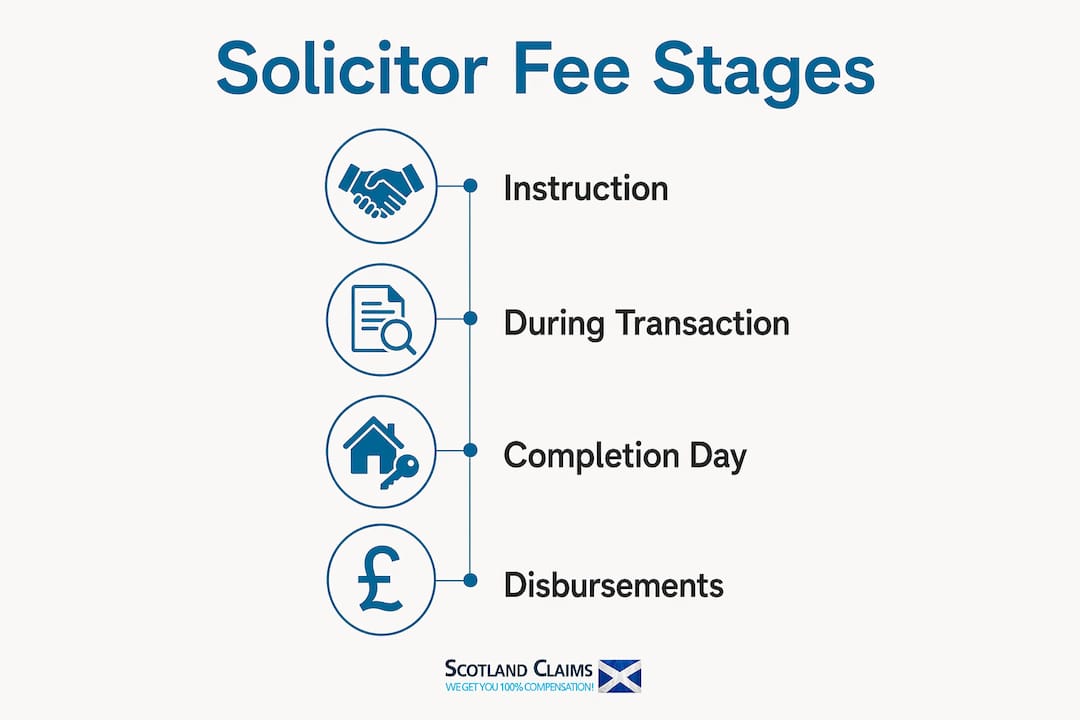
Solicitor fees do not all land at once. They arrive at three distinct points across the transaction, and knowing when each one hits helps you plan your cash flow properly.
Stage 1: On instruction (day one to two weeks)
Within days of instructing your solicitor, you will be asked to pay a payment on account of approximately £200–£400. This covers the cost of ordering property searches, which must be paid upfront to the search providers. Your solicitor cannot begin substantive legal work until these searches are underway.

At this stage you will also complete anti-money laundering identity checks. Some firms include this in the legal fee; others charge separately, typically £20–£50 per person.
Stage 2: During the transaction (weeks two to eight, typically)
Most of the legal work happens in this window: reviewing the contract, raising enquiries, checking the mortgage offer, and reporting to you. No further payment is usually required during this phase unless unexpected complications arise, such as a title defect requiring indemnity insurance or a leasehold management pack that triggers additional disbursements.
Stage 3: On completion day
The balance of the legal fee, plus any remaining disbursements not covered by the initial payment on account, falls due on completion. Your solicitor will send a completion statement in advance showing the exact amount. This is also when the Land Registry registration fee is paid and when the CHAPS transfer fee is charged to move the mortgage funds to the seller.
For sellers, the solicitor’s fee is deducted directly from the sale proceeds on completion, so no separate payment is needed.
Fixed fee vs hourly rate: which charging method works better for you?
Most residential conveyancing solicitors now quote a fixed fee, and for good reason. Understanding the difference between the two models helps you ask the right questions before you instruct.
Fixed fee conveyancing
A fixed fee means the solicitor commits to a set charge for the legal work, regardless of how long the transaction takes. If your purchase hits delays, the fee stays the same. This is the dominant model for straightforward residential purchases, and it is what most online and panel conveyancing firms use.
The catch is that “fixed fee” does not always mean “all-inclusive.” Disbursements are almost always billed separately on top, and some firms add variable supplements for complications that arise mid-transaction. Read the terms carefully: a fixed fee that excludes bank transfer charges, leasehold supplements, and ID checks is not as fixed as it appears.
Fixed fee conveyancing reduces uncertainty and makes it easier to compare quotes. For a buyer on a budget, it is generally the safer choice.
Hourly rate conveyancing
Hourly billing is more common for complex or high-value transactions where the scope of work is genuinely unpredictable. A solicitor handling a purchase with a boundary dispute, a short lease, or a probate-related title issue may charge by the hour because the work cannot be scoped in advance.
Hourly rates for residential conveyancing solicitors in the UK typically range from £150 to £300 per hour, depending on the firm’s location and the seniority of the fee earner. A transaction that takes 15 hours at £200 per hour costs £3,000 in legal fees before VAT, well above the fixed-fee market rate for a standard purchase.
Which should you choose?
For a standard freehold purchase, a fixed fee is almost always the better option. It gives you cost certainty and makes comparison straightforward. For a leasehold flat with a short lease, a new build with a complex Help to Buy arrangement, or any purchase involving a legal complication beyond the property itself, ask the solicitor directly whether a fixed fee is realistic or whether hourly billing better reflects the likely work involved.
Pro Tip: If a solicitor quotes hourly for what sounds like a standard purchase, ask them to estimate the total hours and cap the fee. A good firm will give you a realistic ceiling rather than leaving you exposed to an open-ended bill.
What UK 2026 data tells us about conveyancing costs
The average conveyancing fee to buy in the UK is £1,624 in 2026, with most buyers paying somewhere between £1,298 and £2,236 once all costs are included.
Key figure: The average total cost of buying a freehold property, including legal fees and disbursements, sits between £1,200 and £2,500 in 2026.
Several patterns stand out from current market data:
- Leasehold costs more, consistently. The average fee for buying a leasehold property is £1,844, compared to £1,518 for a freehold purchase. The gap reflects genuine extra work, not arbitrary pricing.
- Disbursements are often underestimated. Buyers focus on the headline legal fee and overlook the cumulative effect of searches, Land Registry fees, and bank transfer charges, which together can add £300–£700 to the bill.
- Upfront search fees are non-refundable. If a purchase falls through before exchange, the average upfront search payment of around £374 is lost. “No sale, no fee” arrangements protect the legal fee but not the disbursements already spent.
- Buying and selling simultaneously costs more. The combined average is around £2,334, though some firms offer a modest dual-instruction discount.
- Surveys are a separate and often forgotten cost. According to MoneyHelper, many buyers underestimate total moving costs by overlooking building surveys, which run from £400 to £1,500 depending on the survey type and property size.
For anyone managing a tight budget, the practical takeaway is straightforward: get at least three fully itemised quotes, confirm which elements are fixed and which are variable, and set aside a contingency of around £300–£500 above the quoted total to cover unexpected disbursements or complications.
Understanding fee transparency in solicitor services is something worth researching before you commit to any firm. A solicitor who is upfront about every line item from day one is a much safer pair of hands than one whose quote looks attractive until the completion statement arrives.
Are you dealing with a personal injury in Scotland?
If you have been injured in an accident in Scotland, whether a road traffic collision, a slip or trip, or a workplace accident, the cost of legal representation is a separate concern entirely. Scotland Claims Injury Lawyers operates on a genuine No Win No Fee basis, and unlike most firms, takes no success fee from your compensation. You keep 100% of what you are awarded.
Most solicitors in Scotland charge a success fee of up to 20% (including VAT) from your settlement. Scotland Claims Injury Lawyers charges nothing. That is the difference between walking away with your full compensation and handing a fifth of it back to your lawyer.
Find out what your claim could be worth with the compensation calculator, or speak to the team directly about your No Win No Fee claim today.
Key takeaways
The total cost of solicitors for buying a house in the UK generally falls within a defined range, covering legal fees, disbursements, and VAT, with leasehold properties and complex transactions pushing costs higher.
| Point |
Details |
| Total cost range |
Budget £1,200–£2,500 for a standard purchase, including legal fees, disbursements, and VAT. |
| Upfront payment on account |
Expect to pay £200–£400 shortly after instructing your solicitor to cover initial search fees. |
| Leasehold costs more |
Leasehold purchases add approximately £200–£400 to the base legal fee due to extra legal work. |
| Fixed fee is safer |
Fixed-fee conveyancing gives cost certainty; always confirm what is excluded before instructing. |
| Get itemised quotes |
Ask for a full breakdown of legal fees versus disbursements to compare quotes accurately. |
FAQ
How much should I expect to pay for a solicitor when buying a house?
For a standard freehold purchase in the UK, total solicitor costs including disbursements and VAT typically range from £1,200 to £2,500, with the average conveyancing fee sitting at £1,624 in 2026.
Who pays the solicitor fees, buyer or seller?
Buyer and seller each pay their own solicitor separately. There is no shared arrangement; buyers fund their own legal costs and disbursements, while sellers typically have their fees deducted from the sale proceeds on completion.
What are the hidden costs when buying a house?
The most common unexpected costs are leasehold supplements, gifted deposit checks, bank transfer fees, and building surveys. Building surveys can cost a significant amount and sit entirely outside the solicitor’s fee.
How much should you save for legal fees when buying a house?
Set aside between £1,200 and £2,500 to cover solicitor fees, disbursements, and VAT for a standard freehold purchase, plus a contingency of £300–£500 for unexpected charges. Leasehold buyers should budget £200–£400 more than this range to account for the extra legal work involved.
Recommended