There’s no single average payout for a car accident in Scotland in 2026. Guide figures for the injury itself range from about £2,000 to more than £485,000, with financial losses claimed separately. The difference reflects how seriously you were injured and how the accident affects your life.
It’s understandable to want a clear figure, especially when you’re facing recovery costs, time away from work or damage to your car. But an injury-only estimate won’t show the full picture. Treatment and rehabilitation expenses, lost earnings, vehicle damage and other documented losses can also affect the value of a claim.
This article explains how Scottish compensation figures are assessed, how injury severity and recovery time influence an award, and which property losses and expenses may be included. You’ll also learn why whiplash claims in Scotland are assessed differently from claims in England and Wales, and what to consider when working out how the accident has affected you.
Key Takeaways
- In Scotland, guide figures for the injury itself range from about £2,000 to more than £485,000. The severity and lasting effects of your injuries shape where a claim may fall.
- Separate injury compensation from financial losses: vehicle damage, damaged belongings, insurance excess and lost earnings may also affect the total claim.
- Scottish whiplash claims are assessed on their individual facts, rather than under the fixed tariff that applies to qualifying claims in England and Wales.
- Keep a clear record of treatment, rehabilitation and travel expenses, as these costs may form part of a claim.
- Responsibility for the accident can affect the amount recovered, and Scottish personal injury claims generally have a three-year time limit.
Serious Injuries: How much compensation will you receive?
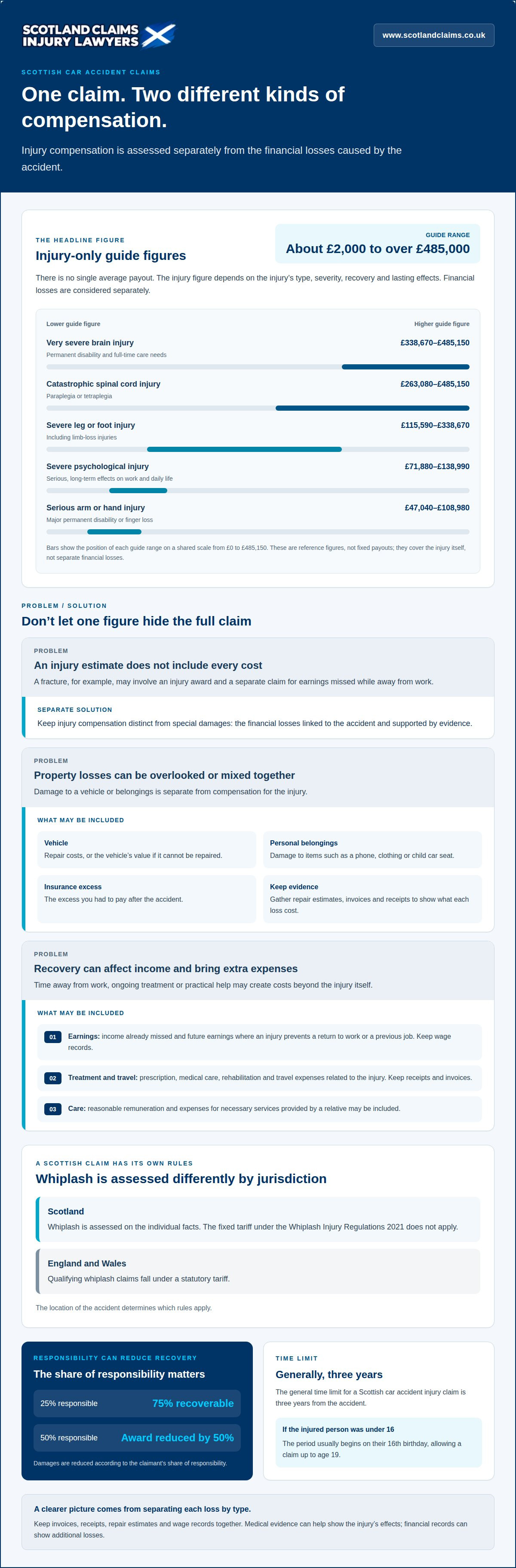
In Scotland, compensation for the injury itself can range from about £2,000 to more than £485,000. Financial losses, such as lost earnings and treatment expenses, are considered separately.
Factors affecting serious injury compensation
Compensation for a serious injury reflects its type, severity, recovery and lasting effects. These factors matter because lasting physical or psychological impacts can affect everyday activities, work and future earnings. Medical evidence helps show the injury’s consequences, while evidence of financial losses helps establish what additional compensation may be claimed.
Responsibility also matters. Under section 1, damages are reduced to the extent the court considers just and equitable based on the claimant’s share of responsibility, according to the UK Government. If you’re found 25% responsible, you recover 75% of the claim’s value.
Compensation by injury type and severity
Typical Scottish compensation ranges vary by injury and its effects. They help illustrate how severity changes the potential injury award, but aren’t a fixed payout for every claim. For example, very severe brain injuries involving permanent disability and full-time care needs are valued at £338,670 to £485,150. Catastrophic spinal cord injuries causing paraplegia or tetraplegia are valued at £263,080 to £485,150.
Other serious injuries also span substantial ranges. Severe or limb-loss leg and foot injuries are valued at £115,590 to £338,670, while serious arm and hand injuries involving major permanent disability or finger loss are valued at £47,040 to £108,980. These figures cover the injury itself, not separate financial losses.
Psychological injuries can form part of a claim alongside physical harm. In Scotland, severe psychological injuries with serious long-term effects on work and daily life are valued at £71,880 to £138,990. The diagnosis and documented effects help show the condition’s seriousness.
Sensory injury claims can involve sight, hearing, taste or smell. The effect on communication, independence and daily activities helps demonstrate the impact of sensory loss.
The general time limit for making a Scottish car accident injury claim is three years from the accident. If the injured person was under 16, the period usually begins on their 16th birthday, allowing a claim up to age 19.
Under a no-win, no-fee agreement, you don’t pay your solicitor’s fees if the claim is unsuccessful. Scotland Claims’ 100% Compensation promise means fees are recovered from the at-fault party, with the full settlement passed to you.
Contributory negligence reduces compensation according to your share of responsibility. If you’re found 50% responsible, your award may be reduced by 50%; a finding of 25% responsibility leaves 75% of the claim’s value recoverable. For guidance on Scottish claims, see personal injury claims in Scotland.
Special damages for vehicle and personal property
Special damages cover financial losses caused by an accident, rather than compensation for the injury itself. In a Scottish claim, they can include damage to your vehicle or personal belongings, lost earnings, treatment and travel expenses. The amount depends on the losses linked to the crash and supported by evidence.
Vehicle and property losses may include:
- Repair costs or the vehicle’s value if it cannot be repaired.
- Damage to possessions, such as a phone, clothing or child car seat.
- Your insurance excess, where you had to pay it after the accident.
- Prescription, medical care, rehabilitation and travel expenses related to your injury.
Keep invoices, receipts, repair estimates and wage records together. These show what each loss relates to and how much it cost. A solicitor can organise the evidence into separate heads of damages, so vehicle losses aren’t confused with personal injury compensation. For example, a fracture that keeps you away from work may involve both an injury award and a claim for lost earnings.
Lost earnings can include income already missed and future earnings where an injury prevents you returning to work or continuing in your previous job. Care can also count. Under section 8 of the Administration of Justice Act 1982, damages may include reasonable remuneration and expenses for necessary services provided by a relative, according to the UK Government. This can cover practical help during recovery.
Scotland and England and Wales use different approaches to qualifying whiplash claims. In Scotland, whiplash is assessed on the individual facts; the fixed tariff under the Whiplash Injury Regulations 2021 does not apply. In England and Wales, qualifying whiplash claims fall under a statutory tariff. The accident’s location matters because it determines which rules apply.
Bereavement awards also differ across UK jurisdictions. The £15,120 bereavement award applies in England and Wales, while £17,200 is cited for Northern Ireland; neither figure is a Scottish award. In Scotland, family claims following a fatal injury depend on factors including lost earnings, and such cases are typically settled for six-figure sums. Funeral expenses may also be claimed as reasonable costs.
For a clearer picture of the financial part of your claim, separate each loss by type and keep its supporting record. Estimate personal injury compensation with an assessment that considers the claim as a whole.
Judicial College Guidelines and Scottish valuation
The Judicial College Guidelines provide reference brackets for valuing different injuries. In Scotland, they can help explain how injury compensation reflects pain, suffering and reduced enjoyment of everyday activities. They don’t set one fixed payout for every crash. The relevant figure depends on the injury’s effects and the evidence supporting them.
Pain, suffering and loss of amenity are assessed as general damages. Pain and suffering concern the physical or psychological effects of an injury. Loss of amenity means the ways it limits normal activities, such as driving, hobbies or household tasks. A medical report can describe symptoms, treatment, recovery and lasting restrictions.
The Guidelines’ 18th edition was published on 9 April 2026. Its brackets distinguish injuries by seriousness, symptoms and prognosis. For a minor neck injury with full recovery within about two years, the cited bracket is up to £10,420. Moderate neck injuries involving recovery of up to five years, or an acceleration of existing problems, range from £10,420 to £18,150.
More serious neck injuries receive higher brackets. The 18th edition gives £33,020 to £50,850 for moderate neck injuries involving fractures or dislocations with chronic conditions. Severe cervical spine fractures with substantial movement loss range from £86,860 to £172,970. These examples show why a fracture’s impact and recovery matter, not just its name.
Scottish whiplash claims are assessed on their individual facts. The fixed tariff under the Whiplash Injury Regulations 2021 does not apply in Scotland.
Guideline ranges are reference points, not automatic awards. An assessment considers medical evidence, symptom duration and the effect on work or daily life. For example, two people with neck injuries may receive different awards if one recovers fully while the other has persistent pain and restricted movement. Clear treatment records and details of functional limitations help explain the difference.
Use a bracket as a starting point, then consider the facts specific to your injury. The Judicial College Guidelines can help frame the injury award, while financial losses are assessed separately. Scotland’s individual assessment of whiplash also means an England and Wales tariff figure cannot simply be applied to a Scottish claim.
Medical treatment, rehabilitation and travel expenses
Medical care, rehabilitation and travel expenses can form part of a Scottish car accident claim. They sit alongside compensation for the injury itself, so identify treatment-related losses separately. For example, a claim might include rehabilitation costs and journeys to appointments as well as an injury award.
Keep a clear record of each expense. Group items by type and retain the receipt, invoice or appointment record with each entry. This makes it easier to show how a cost relates to the accident. Relevant expenses can include:
- Prescription costs and medical care.
- Rehabilitation expenses.
- Travel to treatment or rehabilitation appointments.
- Specialist equipment or household modifications, such as a wheelchair or stair lift.
- Care provided by family, friends or other people.
Rehabilitation can address needs that continue beyond initial medical care. Records of sessions and associated travel, for example, can help explain the treatment required after the crash. If a course of rehabilitation changes, keep updated invoices and appointment details together. This gives a clearer account of the treatment received and the expenses arising from it.
Some serious injuries also create practical needs at home. A stair lift or wheelchair may be needed where mobility is reduced, while ongoing care can involve help from relatives or friends. In Scotland, settlements may include care costs and specialist equipment or household modifications. For care provided by a relative, section 8 of the Administration of Justice Act 1982 allows damages to include reasonable remuneration and expenses for necessary services, according to the UK Government.
Travel costs are easier to present when each journey has a clear purpose. Record the appointment date, destination and reason for travelling, then retain any relevant ticket or receipt. A journey to rehabilitation is easier to distinguish from ordinary travel when linked to a dated appointment. Keep these records with treatment invoices rather than combining them into one unexplained total.
Medical evidence connects expenses to the injury and its effects. Treatment records show the care received, while receipts show the related spending. Together, they help explain how the accident affected recovery, daily activities and costs. If symptoms persist or mobility is reduced, evidence of continuing needs can clarify why equipment, modifications or care form part of the claim.
List each expense once and keep its supporting record. This separates medical treatment, rehabilitation, travel and care costs from compensation for the physical injury. An organised account also makes it easier to identify which expenses relate to recovery and which reflect longer-term needs after the accident.
Support and advice for road crash victims
A Scottish road accident claim needs more than an injury estimate. Get medical attention, preserve evidence, record how the crash affects you and understand the time limit. These steps help connect the collision, your injury and the losses you claim.
After a crash, prioritise medical assessment and follow-up care. Tell the treating professional about physical symptoms and psychological effects, such as travel anxiety or disrupted sleep. Medical records can document when symptoms began and how they changed. If a problem develops later, note when it appeared and discuss it during treatment.
Build a clear record of the incident and its consequences. Keep the details together as your claim develops:
- Write down the date, location and circumstances of the collision.
- Keep photographs, witness details and relevant correspondence.
- Store medical records, appointment information and treatment details.
- Record time away from work and changes to your ability to do usual tasks.
- Keep receipts and records for accident-related expenses.
Evidence should explain more than the diagnosis. For example, a medical report may describe a neck injury, while work records show time away and your notes describe difficulty driving. Together, these give a fuller picture of the injury’s effects. Psychological symptoms matter too: record how they affect travel, sleep, work or daily activities, alongside relevant medical evidence.
Scottish personal injury claims generally have a three-year time limit. For someone injured before turning 16, the period usually starts on their 16th birthday, allowing a claim up to age 19. Acting within the applicable period helps preserve the opportunity to bring a claim; do not assume an injury’s recovery time changes the deadline.
Typical compensation figures and the Judicial College Guidelines can help you understand how claims are valued, but they are reference points, not a personal calculation. The evidence must show the injury’s severity, recovery, continuing symptoms and effects on earnings or daily life. If responsibility is disputed, evidence about how the collision happened also matters, as a claimant’s share of responsibility can reduce damages.
A solicitor can assess how the evidence relates to your injury and financial losses, explain the claims process and identify the information needed. With Scotland Claims Injury Lawyers, there are no upfront fees and you owe nothing if the claim is unsuccessful. The firm is regulated by the Law Society of Scotland. Clear advice is particularly useful when injuries continue, psychological effects emerge or the other party disputes responsibility.
Get advice on a Scottish injury claim
Scotland Claims Injury Lawyers: Road Traffic Accident Claims
Scotland Claims Injury Lawyers handles Road Traffic Accident Claims for people injured in collisions in Scotland. Turn to the firm when you need help assessing how injury, lost earnings, treatment expenses and responsibility affect your claim.
The firm works on a no-win, no-fee basis. Its 100% Compensation promise means it recovers its fees from the at-fault party and passes your entire settlement to you. A Personal Injury Compensation Calculator can also help you explore how different factors may influence a claim.
Clear advice can help you understand the evidence and losses involved before deciding how to proceed. Contact Scotland Claims Injury Lawyers for a free, no-obligation assessment of your road accident claim.
Make your next decision with a complete claim picture
The average payout for a car accident in Scotland in 2026 is only a reference point. Your next decision should be based on the full effect the crash has had on your health, work and daily life. Consider whether your records capture the ongoing impact, not only the first days of recovery.
Before settling a claim, make sure the injuries, expenses and changes to your routine are clearly represented. Scotland Claims Injury Lawyers handles Road Traffic Accident Claims, as well as Slip or Trip Claims and Work Injury Claims across Scotland. Discuss your circumstances with the firm to understand how the evidence relates to your situation.
A clear understanding of your position can help you move forward with greater confidence. Take the next step when you’re ready.
Frequently Asked Questions
How much compensation can you claim for a road traffic accident?
The amount depends on your injuries, their effects and the financial losses connected to the crash. Scottish guide figures for injury alone range from about £2,000 to more than £485,000. A claim may also include losses such as damaged belongings, travel to treatment or earnings missed because of the injury. For example, a serious injury affecting future work can involve different losses from a short-term injury.
How are compensation awards broken down?
A Scottish award can include compensation for the injury and separate financial losses. The injury element reflects its seriousness and impact; financial items may include vehicle repairs, damaged possessions, treatment expenses and lost earnings. For instance, someone recovering from a leg injury might claim for the injury itself, alongside documented travel to appointments and income lost while away from work. Support each part with relevant evidence.
Quick answer, is there an average whiplash payout?
There is no single Scottish whiplash average that applies to every claim. Guide figures are not set payments. An assessment considers symptom duration and effects, while associated losses are considered separately.
Should you accept the offer your insurer has made?
Before deciding, consider whether an offer accounts for your injury, its likely effects and all financial losses. Ask for a clear breakdown showing what relates to the injury and what covers expenses or earnings. Compare it with the available medical and financial evidence. An offer made before ongoing symptoms or treatment needs are documented, for example, may not reflect the full impact of your injury.
What determines the amount of compensation I get?
The main factors are injury type, severity, recovery, lasting symptoms and the effect on work and daily activities. Evidence also matters: medical records describe the injury, whilst wage information can show lost income. Responsibility for the crash can reduce damages. For example, a claimant found 25% responsible recovers 75% of the claim’s value, reflecting their share of responsibility.
What is included in compensation payouts in the UK?
A car accident claim may include injury compensation and related losses. Depending on the circumstances, these can cover vehicle damage, damaged possessions, insurance excess, prescriptions, medical care, rehabilitation and travel expenses. Lost earnings may also be claimed, including future earnings if the injury prevents a return to previous work. Scotland has its own approach to injury valuation, so rules elsewhere in the UK don’t automatically apply.
What are the average car accident compensation payouts in Scotland in 2026?
There is no single average payout for a car accident in Scotland in 2026. Injury guide figures range from about £2,000 to more than £485,000, before separate financial losses are considered. The broad spread reflects the difference between injuries that resolve and those causing permanent disability or care needs. To understand a particular claim, consider its injury evidence, losses and the accident’s effect on everyday life.
What are the 2026 Scottish injury compensation ranges for whiplash and soft tissue injuries?
Soft tissue, bruising and simple fracture injuries resolving within weeks or months typically range from £2,000 to £15,000 for the injury itself. Treatment costs and other losses are separate considerations.