Whiplash Compensation Explained: Key Facts for Scotland

Neck pain after a sudden road traffic accident can turn daily life upside down for people across Scotland. Understanding how whiplash compensation is determined is essential, especially since Scottish courts use individual assessments instead of fixed tariffs seen in England and Wales. Whether your injury is minor or severe, individualised assessment ensures that your claim reflects the real impact on your health and finances. Discover how the process works and what you need to secure a fair settlement with risk-free legal support.
Table of Contents
Key Takeaways
| Point |
Details |
| Individual Assessment |
Whiplash compensation in Scotland is based on individual circumstances and medical evidence, unlike fixed tariffs in England and Wales. |
| Injury Types and Impact |
The severity and type of whiplash injury significantly influence compensation amounts, with chronic cases attracting higher awards. |
| Claims Process |
Applicants must provide documented evidence of negligence and injuries, with a typical claims process lasting from weeks to months. |
| No Win No Fee Arrangement |
These agreements allow claimants to pursue compensation without upfront costs, only paying legal fees upon a successful claim. |
Defining Whiplash Compensation in Scotland
Whiplash compensation in Scotland is money awarded to individuals who suffer neck injuries from sudden acceleration and deceleration, typically from road traffic accidents. Unlike other parts of the UK, Scotland operates under its own legal system with distinct rules for calculating injury payouts.
Scotland doesn’t use fixed tariff amounts like England and Wales whiplash reforms. Instead, your compensation is assessed individually based on your specific injury, medical evidence, and personal circumstances.
To clarify Scottish whiplash compensation, here’s a comparison with practice in England and Wales:
| System Aspect |
Scotland |
England & Wales |
| Calculation Method |
Individual assessment |
Fixed tariffs |
| Consideration of Circumstances |
Detailed personal review |
Standardised categories |
| Medical Evidence Focus |
High priority |
Moderate emphasis |
| Range of Awards |
Flexible, broad range |
Predetermined limits |
Here’s what makes Scottish whiplash claims unique:
- Individualised assessment: Each claim is evaluated on its own merits, not against preset compensation bands
- Broader injury consideration: Courts examine the full impact of your injury on daily life and long-term health
- No fixed minimums or maximums: Compensation can range from a few hundred pounds to significantly higher amounts depending on severity
- Medical evidence focus: Your claim’s value depends heavily on professional medical reports and treatment records
Whiplash itself occurs when your neck experiences a sudden jerking motion, causing soft tissue damage to muscles, ligaments, and tendons. The injury often develops over hours or days after the accident, which is why many people don’t realise the extent of their damage immediately.
Compensation covers multiple elements, including medical treatment costs, lost wages, pain and suffering, and any long-term effects on your quality of life. If you’ve required physiotherapy, had time off work, or experienced ongoing discomfort, these all factor into your final payout.
The amount you receive depends on injury severity. Minor whiplash with recovery within weeks differs vastly from chronic pain lasting months or years. Scottish courts recognise that some people suffer lasting symptoms whilst others recover fully within weeks.
In Scotland, your whiplash compensation is built around your actual recovery and impact, not a predetermined price tag.
When pursuing whiplash injury claims in Scotland, it’s crucial to gather comprehensive medical evidence from the accident’s immediate aftermath. This documentation proves the direct link between the accident and your symptoms, strengthening your case significantly.
Your solicitor will work with medical experts who assess your injury’s severity and prognosis. These reports become central to negotiations with insurance companies or court proceedings, directly influencing the final compensation amount you receive.
Pro tip: Keep detailed records of all expenses, medical appointments, and how your injury affected work and daily activities from the accident onwards—this documentation directly strengthens your compensation claim.
Types of Whiplash Injuries and Claims
Whiplash injuries vary considerably in severity, and understanding the different types helps you recognise what compensation level your claim might attract. Not all whiplash is the same, which is why Scottish courts assess each case individually.
Acute whiplash develops immediately or within hours of the accident and causes sharp neck pain, stiffness, and limited movement. Most acute cases resolve within weeks with proper physiotherapy and rest, resulting in lower compensation awards.
Chronic whiplash persists for months or years after the initial injury, causing ongoing pain, headaches, and sometimes nerve damage. These claims typically attract higher compensation because they demonstrate lasting impact on your quality of life and earning capacity.
Common whiplash injury types include:
- Soft tissue damage: Muscle and ligament strains causing pain and reduced mobility
- Cervical strain: Neck injuries affecting the vertebrae and supporting structures
- Nerve compression: Pressure on nerves causing radiating pain into shoulders and arms
- Chronic pain syndrome: Long-term pain conditions requiring extended treatment
- Psychological injury: Anxiety or depression resulting from the accident and ongoing symptoms
Low-value claims typically involve minor whiplash with quick recovery, usually under £3,000 in compensation. These cases require minimal medical evidence and settle relatively quickly through insurance negotiations.
Mid-range claims involve moderate whiplash lasting several months, typically ranging from £3,000 to £10,000. Medical reports become crucial at this level, demonstrating ongoing treatment needs and functional impact.
High-value claims involve severe or chronic whiplash causing significant long-term disability, often exceeding £10,000. These claims require comprehensive medical evidence and sometimes expert court proceedings to establish fair compensation.
Here’s a summary of whiplash injury types and their usual compensation bands in Scotland:
| Injury Type |
Typical Symptoms |
Likely Compensation Range |
| Acute Whiplash |
Short-term pain, stiffness |
Up to £3,000 |
| Moderate Whiplash |
Months of discomfort |
£3,000 – £10,000 |
| Chronic Whiplash |
Persistent pain, nerve issues |
Over £10,000 |
| Psychological Impact |
Anxiety, depression |
Variable, case-specific |
The severity of your whiplash symptoms and their duration directly determine whether your claim falls into low, mid, or high-value categories.
When preparing your claim, understanding how claims progress after submission helps you know what to expect during the legal process. Your solicitor will gather medical evidence, accident reports, and witness statements to build a strong case.
Soft tissue injuries are particularly common in rear-impact collisions, where your vehicle is hit from behind, propelling your body forward whilst your head lags momentarily. This sudden acceleration and deceleration causes the characteristic whiplash mechanism.

Pro tip: Obtain medical assessment within 48 hours of your accident, as early diagnosis and treatment records significantly strengthen your claim value and demonstrate the injury’s legitimacy.
Legal Eligibility and Claim Process Explained
To claim whiplash compensation in Scotland, you must meet specific eligibility criteria and follow a structured legal process. Understanding these requirements helps you determine whether you have a valid claim and what to expect moving forward.
You’re eligible to claim if you suffered a whiplash injury caused by another party’s negligence, typically in a road traffic accident. The accident must not have been your fault, and you must have sustained documented injuries requiring medical treatment.
Key eligibility requirements include:
- Negligence from another party: The accident must have resulted from someone else’s careless or reckless driving
- Documented injury: Medical evidence proving your whiplash injury exists
- Treatment records: Proof of physiotherapy, GP visits, or specialist consultations
- Time within limits: Your claim must be filed within three years of the accident date
- Not your responsibility: You cannot be primarily at fault for the accident
The claims process follows several stages that typically take weeks or months depending on complexity. Most claims settle through insurance negotiations without reaching court.
First, your solicitor gathers evidence including the accident report, witness statements, and medical records. They’ll request medical assessments from specialists who examine your injury’s extent and prognosis, which becomes crucial for calculating fair compensation.
Next, your solicitor sends a detailed claim letter to the other party’s insurance company, outlining your injuries and compensation demand. The insurer investigates and either accepts liability or disputes it.
If liability is accepted, negotiations begin. No Win No Fee arrangements mean you pay nothing upfront whilst your solicitor pursues the case on your behalf. You only pay legal fees if your claim succeeds, taking a small percentage from your compensation.
Most cases settle at this stage through negotiation. If the insurer refuses a reasonable offer, your case proceeds to court where a judge decides the outcome.
Your claim succeeds when you prove the accident wasn’t your fault and caused your documented whiplash injury.
Timeline expectations vary, but straightforward cases often settle within 6 to 12 months. Complex cases involving significant injuries may take longer.
Pro tip: Report the accident to police immediately and collect contact details from all witnesses at the scene, as this documentation significantly strengthens your eligibility and claim value.
Key Factors Influencing Compensation Amounts
Your whiplash compensation amount depends on multiple factors that Scottish courts assess individually. Understanding what influences your payout helps you anticipate a realistic settlement figure and recognise whether an offer is fair.
Injury severity is the primary factor determining compensation. Courts distinguish between minor whiplash resolving quickly and severe injuries causing long-term disability or chronic pain. A neck strain causing mild discomfort for weeks attracts far less compensation than nerve damage requiring ongoing specialist treatment.
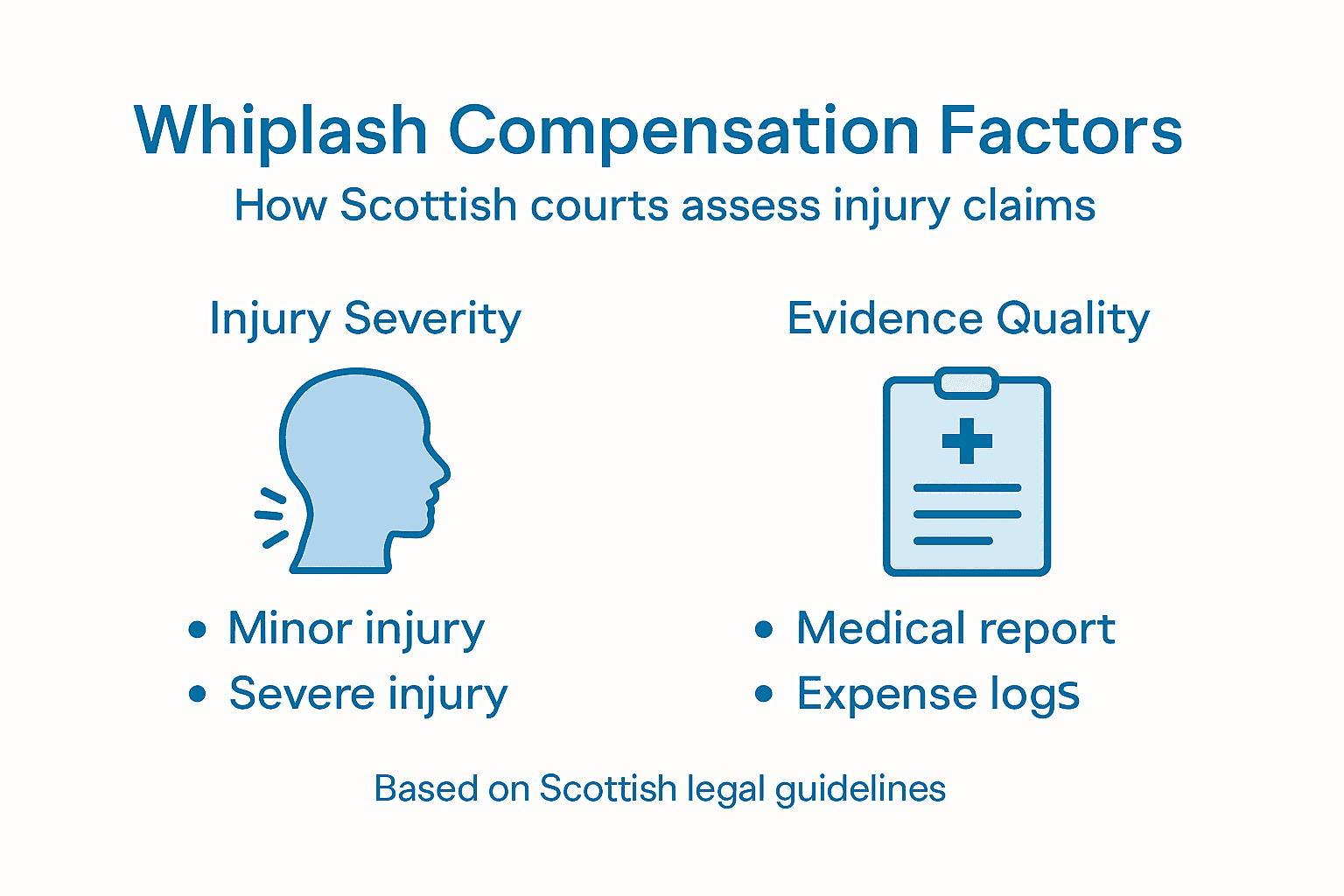
Scottish courts consider both general damages for pain and suffering and special damages for financial losses when calculating your total payout.
Key factors affecting compensation include:
- Recovery duration: Longer recovery periods justify higher compensation for prolonged pain and inconvenience
- Medical treatment costs: Physiotherapy, GP visits, and specialist consultations are all recoverable expenses
- Lost earnings: Wages lost during recovery or inability to work are fully compensated
- Permanent effects: Long-term symptoms, chronic pain, or reduced work capacity significantly increase payouts
- Treatment necessity: More intensive treatment indicates greater injury severity
- Age and occupation: Younger individuals with longer working lives may receive higher compensation for lost earning capacity
Evidence quality directly impacts your compensation amount. Medical reports from physiotherapists and consultants carry significant weight. Strong documentation showing sustained treatment and ongoing symptoms justifies larger awards.
Withness statements and accident reports help establish liability and injury severity. Photographic evidence of vehicle damage supports claims about accident force and impact intensity.
Pre-existing conditions may reduce compensation if your whiplash aggravated rather than caused them. Courts assess the additional injury from the accident separately, not assuming you suffered no effect from pre-existing issues.
The most valued compensation claims combine strong medical evidence with documented financial losses and clear proof of lasting impact.
Your solicitor will gather comprehensive evidence demonstrating each compensation factor. They prepare detailed medical assessments showing your specific symptoms and functional limitations.
Calculating realistic compensation figures requires understanding local Scottish settlement patterns. Courts follow established guidelines whilst remaining flexible for individual circumstances.
Pro tip: Use a compensation calculator tool early in your claim to understand potential payout ranges, then share detailed medical evidence with your solicitor to maximise your final award within realistic expectations.
No Win No Fee Agreements and Risks
No Win No Fee arrangements remove financial barriers to claiming whiplash compensation. These agreements mean you pay nothing upfront and only contribute legal fees if your claim succeeds, making justice accessible regardless of your financial situation.
How No Win No Fee works is straightforward. Your solicitor takes your case on the understanding that they receive payment only when you win. If your claim fails, you owe them nothing for their legal work or case preparation.
This arrangement protects you from financial risk. You cannot lose money pursuing a legitimate claim, and your solicitor absorbs the risk of unsuccessful cases. This incentivises solicitors to accept only cases with genuine prospects of success.
Key features of No Win No Fee agreements:
- No upfront costs: You pay nothing to start or progress your claim
- No payment if unsuccessful: Failed claims incur zero legal fees from you
- Success fee deduction: Successful claims involve a percentage of your compensation going to your solicitor
- Full compensation retention: You keep the vast majority of your award after success fee deduction
- Insurance protection: Adverse costs insurance typically covers the other party’s legal fees if you lose
Risks exist but are minimal under proper agreements. The primary risk involves adverse costs, where you might pay the other party’s legal fees if your claim fails. Quality No Win No Fee solicitors include insurance covering this scenario.
Success fees typically range from 20 to 40 percent of your compensation, depending on claim complexity and anticipated difficulty. Your solicitor must explain fees clearly before you proceed.
Insurance costs may apply to cover potential adverse costs. These premiums are often deducted from your final compensation if successful, meaning you don’t pay them upfront. Some solicitors include insurance within their success fee arrangement.
No Win No Fee arrangements exist specifically to help injured people access legal representation without financial risk or upfront investment.
When pursuing whiplash claims, understanding no win no fee terms before signing agreements ensures you grasp fee structures and your financial obligations. Read contracts carefully and ask questions about anything unclear.
Your solicitor should provide written fee agreements detailing success fees, insurance arrangements, and what happens if your case settles versus proceeding to court.
Pro tip: Ask your solicitor specifically whether their fee agreement includes adverse costs insurance, as this protects you completely if your claim ultimately fails.
Secure the Whiplash Compensation You Deserve with Scotland Claims
If you have suffered a whiplash injury from a road traffic accident in Scotland you understand how complex and stressful pursuing compensation can be. The challenge lies in proving your injury’s severity through thorough medical evidence while navigating Scotland’s individualised assessment system. You may worry about mounting legal fees or face uncertainty about your claim’s value and timeline.
At Scotland Claims we specialise in helping people just like you overcome these obstacles with expert personal injury solicitors who work on a No Win No Fee basis so you pay nothing upfront. We handle all the paperwork and medical report gathering to ensure your case fully reflects the lasting impact of your whiplash injuries. Use our compensation calculator to estimate your potential payout and understand how various factors influence your claim.
Don’t delay your claim as strict time limits apply. Contact Scotland Claims now to get started on your whiplash injury claim. Let us guide you through the process and fight to secure the maximum compensation you are entitled to without any financial risk. Take the first step toward justice and peace of mind today.
Frequently Asked Questions
What is whiplash compensation?
Whiplash compensation refers to the money awarded to individuals who suffer neck injuries, typically from sudden acceleration and deceleration during road traffic accidents. The amount is based on individual assessments rather than fixed tariffs.
How is whiplash compensation calculated in Scotland?
In Scotland, whiplash compensation is calculated through individual assessments that consider medical evidence, the severity of the injury, and personal circumstances, rather than using predetermined amounts.
What types of injuries can qualify for whiplash compensation?
Whiplash injuries can vary in severity, including acute whiplash (short-term pain), chronic whiplash (long-term symptoms), soft tissue damage, cervical strain, nerve compression, and psychological injuries.
How long do I have to make a whiplash claim?
You must file your whiplash claim within three years from the date of the accident in which you sustained your injury.
Recommended