What is a slip or trip claim? Guide to Scotland 2026

Every year, over 230,000 workplace slip and trip accidents occur across the UK. Many victims in Scotland remain confused about their rights and hesitate to pursue compensation. Understanding slip or trip claims empowers you to seek justice and financial redress after suffering an injury caused by negligence. This guide clarifies your legal options, the claims process, and how No Win No Fee arrangements eliminate financial barriers.
Table of Contents
Key takeaways
| Point |
Details |
| Legal basis |
Slip or trip claims require proof the responsible party was negligent and that negligence directly caused your injury. |
| Evidence matters |
Gathering photos, witness statements, CCTV footage, and maintenance records strengthens your case significantly. |
| No financial risk |
No Win No Fee agreements mean no upfront fees and nothing payable if your claim fails. |
| Time limits apply |
You have three years from the injury date to file a claim under Scottish law. |
| Compensation varies |
Payouts depend on injury severity, recovery time, pain levels, and financial losses like lost earnings. |
Understanding slip or trip claims in Scotland
Slip or trip claims form a specific category of personal injury law. To succeed, you must demonstrate four elements: the defendant owed you a duty of care, they breached that duty through negligence, their breach directly caused your accident, and you suffered actual injury as a result.
These claims typically arise in scenarios involving specific hazards. Common situations include:
- Wet or slippery floors without warning signs
- Uneven pavements or surfaces with cracks and holes
- Poor lighting in walkways or stairwells
- Obstructed pathways blocked by debris or objects
- Defective flooring or carpets with loose edges
What distinguishes slip & trip injury claims from general personal injury cases is the focus on premises liability. Property owners, employers, and local councils must maintain safe environments. When they fail to address known hazards or inspect regularly, they become liable for resulting injuries.
Your claim remains valid only if the injury was reasonably foreseeable and preventable. If you were trespassing, intoxicated, or ignoring clear warning signs, your claim may fail. Scottish courts assess whether the responsible party took reasonable steps to prevent accidents.
Pro Tip: Document the accident scene immediately after the incident. Take multiple photos from different angles showing the hazard, surrounding area, and any warning signs or their absence.
Common causes and evidence of negligence
Understanding what constitutes negligence helps you recognise valid claims. Common causes leading to slip or trip injuries include wet or uneven floors, inadequate lighting, obstructed walkways, and poorly maintained surfaces. Premises owners must conduct regular inspections and address hazards promptly.
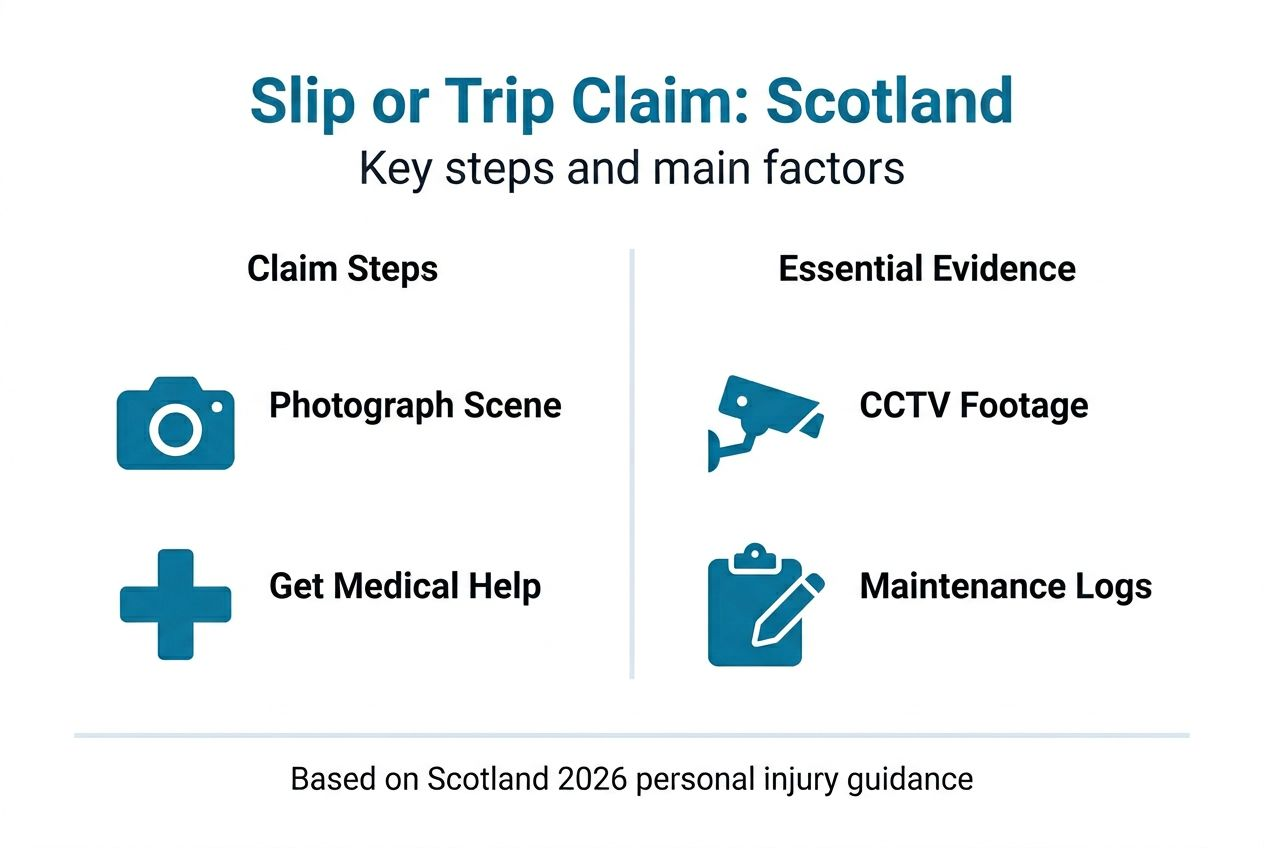
Building a strong case requires comprehensive evidence. Key documentation includes:
- Witness statements from people who saw the accident
- CCTV footage capturing the incident and hazard
- Maintenance logs showing inspection schedules and repairs
- Photographs of the dangerous condition
- Medical records detailing your injuries and treatment
- Accident report forms filed with the premises owner
Premises maintenance records carry significant weight. If an owner knew about a hazard but delayed repairs, this demonstrates clear negligence. Conversely, if regular inspections occurred and the hazard appeared suddenly, establishing liability becomes more challenging.
| Evidence type |
Strength |
How it helps |
| CCTV footage |
Very strong |
Shows exactly how the accident occurred and proves hazard existence |
| Witness statements |
Strong |
Provides independent verification of conditions and your account |
| Maintenance logs |
Strong |
Reveals whether owner knew about hazard or failed to inspect |
| Photographs |
Moderate to strong |
Documents hazard appearance but timing matters |
| Medical records |
Essential |
Proves injury severity and links it to the accident |
Timeliness matters enormously. Hazards may be repaired quickly, CCTV footage gets overwritten, and witnesses’ memories fade. Acting immediately after your accident maximises your chances of securing crucial evidence.

Pro Tip: Request copies of accident reports and maintenance logs from the premises owner within days of your injury. They must provide these under data protection laws, and early requests prevent convenient disappearances.
Don’t assume minor hazards cannot support claims. Even small defects causing significant injuries warrant claim injury compensation in Scotland if negligence is proven.
No Win No Fee agreements explained
Financial concerns prevent many injured people from pursuing valid claims. No Win No Fee agreements mean no upfront fees and capped success fees, with nothing payable if the claim fails. This arrangement, formally called a Conditional Fee Agreement, transforms access to justice.
How it works in practice:
- You pay nothing to start your claim or during the process
- Your solicitor covers all legal costs and expenses
- If your claim fails, you owe nothing to your solicitor
- If you win, a success fee is deducted from your compensation
- Success fees are capped by law at 25% of damages
- You retain the vast majority of your compensation
This funding model removes financial barriers entirely. You risk nothing by exploring whether you have a valid claim. Solicitors working on this basis carefully assess cases before accepting them, giving you confidence in your claim’s merits.
Common misconceptions create unnecessary hesitation. Many people wrongly believe they need savings to afford legal representation or that losing means owing thousands in fees. Understanding No Win No Fee claims in Scotland dispels these myths.
The success fee seems concerning to some claimants initially. However, consider the alternative: without legal representation, you likely receive nothing. The fee represents a small portion of compensation you wouldn’t have obtained otherwise. Professional solicitors maximise your award, often securing substantially more than the success fee costs.
Pro Tip: Ask your solicitor about After the Event insurance during your initial consultation. This covers the opponent’s legal costs if you lose, providing complete financial protection throughout the claims process.
No Win No Fee injury claims have democratised access to justice. You can challenge negligent corporations, councils, and property owners without financial disadvantage.
Compensation for slip or trip injuries
Compensation aims to restore you financially to your pre-accident position as much as possible. Compensation depends on injury severity, impact on daily life, and financial losses incurred. Awards split into general damages for pain and suffering, and special damages for financial losses.
Factors influencing your compensation amount:
- Injury type and location, such as fractures, soft tissue damage, or head injuries
- Recovery duration and whether disabilities remain permanent
- Pain intensity and suffering experienced during recovery
- Impact on daily activities, work capacity, and quality of life
- Medical expenses including treatment, medication, and rehabilitation
- Lost earnings during recovery and future earning capacity reduction
- Care costs if you required assistance during recovery
Compensation ranges vary considerably based on these factors:
| Injury severity |
Typical compensation range |
Example injuries |
| Minor |
£1,000 to £6,500 |
Soft tissue injuries healing within months, minor bruising |
| Moderate |
£6,500 to £26,000 |
Fractures requiring surgery, extended recovery periods |
| Severe |
£26,000 to £85,000+ |
Multiple fractures, permanent disabilities, life-changing injuries |
| Catastrophic |
£85,000 to several million |
Spinal injuries, traumatic brain injuries, permanent care needs |
These figures represent general damages only. Special damages add considerably to final awards. Someone unable to work for six months loses substantial income. Care costs for severe injuries can reach thousands monthly.
Using a compensation calculator provides initial estimates. However, every case differs. Two people suffering identical injuries may receive different awards based on age, occupation, and impact on their specific circumstances.
Early legal advice maximises your compensation. Solicitors ensure you claim all eligible losses. Many people forget to include travel costs to medical appointments, prescription expenses, or the cost of hiring help for tasks they couldn’t perform during recovery.
Time limits and claim process in Scotland
Scottish law imposes strict deadlines. The legal time limit for slip or trip claims in Scotland is three years from the date of injury. Missing this deadline typically bars you from pursuing compensation entirely, regardless of how strong your case appears.
The claims process follows structured steps:
- Document your injury immediately with photographs, medical attention, and written notes about the accident circumstances.
- Gather evidence including witness contact details, CCTV requests, and copies of accident reports from the premises owner.
- Contact a specialist personal injury solicitor experienced in slip and trip claims as soon as possible.
- Your solicitor investigates, obtaining expert medical reports and collecting additional evidence supporting negligence.
- They send a formal letter of claim to the defendant outlining your case and compensation sought.
- The defendant has a set period to respond, either admitting or denying liability.
- Negotiations occur between solicitors, often resulting in settlement without court proceedings.
- If settlement fails, your solicitor may advise court action to secure your compensation.
Most claims settle without reaching court. Defendants often recognise clear liability and prefer avoiding legal costs and publicity. Your solicitor handles all communications, negotiations, and paperwork throughout.
Timing significantly affects success rates. Fresh evidence, clear memories, and prompt action demonstrate the seriousness of your claim. Waiting years before claiming raises questions about injury severity and suggests you’re not genuinely affected.
Pro Tip: Even if you’re still recovering, contact a solicitor early. They can begin building your case while you focus on healing, and claims remain open until your injuries fully resolve or stabilise.
Understanding the accident claim process Scotland removes uncertainty. Knowledge empowers you to take timely action rather than letting valid claims expire worthlessly.
Common misconceptions about slip or trip claims
Misunderstandings prevent many valid claims from being pursued. Addressing these myths empowers you to seek deserved compensation.
Myth: You need an obvious hazard everyone would notice. Reality: Negligence includes failing to warn about hazards or inspect regularly. Even subtle defects can support claims if the owner should have identified and addressed them.
Myth: Only severe injuries warrant claiming. Reality: Any injury causing pain, medical expenses, or time off work justifies a claim. Minor fractures, sprains, and soft tissue damage regularly result in successful compensation awards.
Myth: Legal fees will consume your compensation. Reality: No Win No Fee claims Scotland arrangements mean you pay nothing upfront and retain the majority of your award. Success fees are capped and deducted only from damages won.
Myth: Claims take years and cause stress. Reality: Most slip or trip claims settle within months through negotiation. Your solicitor handles the process, minimising your involvement and stress.
Myth: Claiming damages greedy or fraudulent. Reality: Property owners carry insurance specifically for injury claims. Pursuing legitimate compensation holds negligent parties accountable and prevents future accidents.
These misconceptions create barriers where none should exist. If someone’s negligence injured you, claiming compensation is your legal right. You’re not exploiting the system but using protections society established for accident victims.
Real-world examples and how to proceed
Real cases illustrate how slip and trip claims succeed. Consider a shopper who slipped on a wet supermarket floor with no warning sign. She suffered a fractured wrist requiring surgery and couldn’t work for four months. Successful claims often depend on early evidence gathering and using specialist No Win No Fee lawyers. Her solicitor obtained CCTV showing staff mopped the area minutes before without placing warning signs, proving clear negligence.
Another example involves a pedestrian who tripped on a broken paving slab the local council knew about but hadn’t repaired. Maintenance logs revealed multiple complaints over six months. He sustained knee injuries requiring physiotherapy. His claim succeeded because the council failed to act on known hazards.
These cases share common success factors:
- Victims documented evidence immediately after accidents
- They sought medical attention, creating official injury records
- Witnesses provided statements corroborating their accounts
- Solicitors obtained maintenance records proving negligence
- Claims were filed promptly, well within the three-year limit
Your next steps should mirror these approaches. Photograph the hazard from multiple angles if you’re able. Get contact details from anyone who witnessed your accident. Visit your GP or hospital to document injuries officially. Keep receipts for all accident-related expenses.
Contact Scotland Claims early to benefit from specialist expertise. Their solicitors assess your case at no cost and explain whether you have valid grounds for compensation. The earlier you engage legal support, the stronger your case becomes through preserved evidence and expert guidance.
Explore slip or trip claim examples to understand how similar cases resolved. Every situation differs, but patterns emerge showing what evidence and circumstances lead to successful outcomes. Professional legal advice tailored to your specific accident ensures you maximise compensation for your suffering and losses.
Don’t let uncertainty prevent you from exploring your options. No Win No Fee claims eliminate financial risks, making investigation cost-free.
Get started with Scotland Claims today
You now understand your rights after suffering slip or trip injuries in Scotland. Taking action transforms knowledge into compensation. Scotland Claims connects you with specialist solicitors experienced in securing maximum awards for injured clients.
No Win No Fee claims in Scotland remove all financial barriers. You pay nothing to start, nothing during the process, and nothing if your claim doesn’t succeed. This arrangement allows you to pursue justice without risking your finances.
Use the compensation calculator to estimate your potential award. Whilst every case differs, this tool provides initial guidance on what your injuries might be worth based on severity and circumstances.
Expert solicitors guide you through every stage. They handle evidence gathering, negotiations with defendants, and all legal complexities. You focus on recovery whilst professionals fight for your compensation. Their experience in slip & trip injury claims means they understand exactly what evidence courts require and how to present your case compellingly.
Time limits mean delay costs you money. Every day that passes makes evidence harder to obtain and witnesses harder to locate. Contact Scotland Claims now to protect your rights and begin your journey toward deserved compensation.
Frequently asked questions
What evidence do I need if no witnesses saw my accident?
You can still pursue a claim successfully. Focus on photographs of the hazard, medical records documenting your injuries, and any CCTV footage from the premises. Maintenance logs showing the owner knew about the hazard or failed to inspect properly also support your case strongly.
How does injury severity affect my compensation amount?
More severe injuries resulting in longer recovery, permanent disabilities, or significant life impact receive higher compensation. Courts consider pain levels, treatment duration, inability to work, and effects on daily activities. Minor injuries still warrant claims if they caused genuine suffering and financial losses.
What are the main benefits of No Win No Fee for someone unsure about costs?
No Win No Fee claims eliminate all financial risk. You pay nothing upfront, nothing during the case, and nothing if you lose. Success fees only apply if you win and are capped by law, ensuring you retain most of your compensation. This arrangement makes legal representation accessible regardless of your financial situation.
Seek medical attention first to address injuries and create official records. Photograph the hazard and surrounding area if possible. Get contact details from any witnesses. Report the accident to the property owner or manager and request a copy of the accident report. Note exact location, time, and conditions. Contact a specialist solicitor as soon as practical.
How long do I have to make a slip or trip claim in Scotland?
You have three years from the accident date to file your claim under Scottish law. Missing this deadline typically bars you from pursuing compensation entirely. However, don’t wait until the deadline approaches. Early claims benefit from fresher evidence and memories. Contact claim injury compensation in Scotland specialists promptly to protect your rights.
Recommended