Understanding adjusters in Scottish injury claims 2026

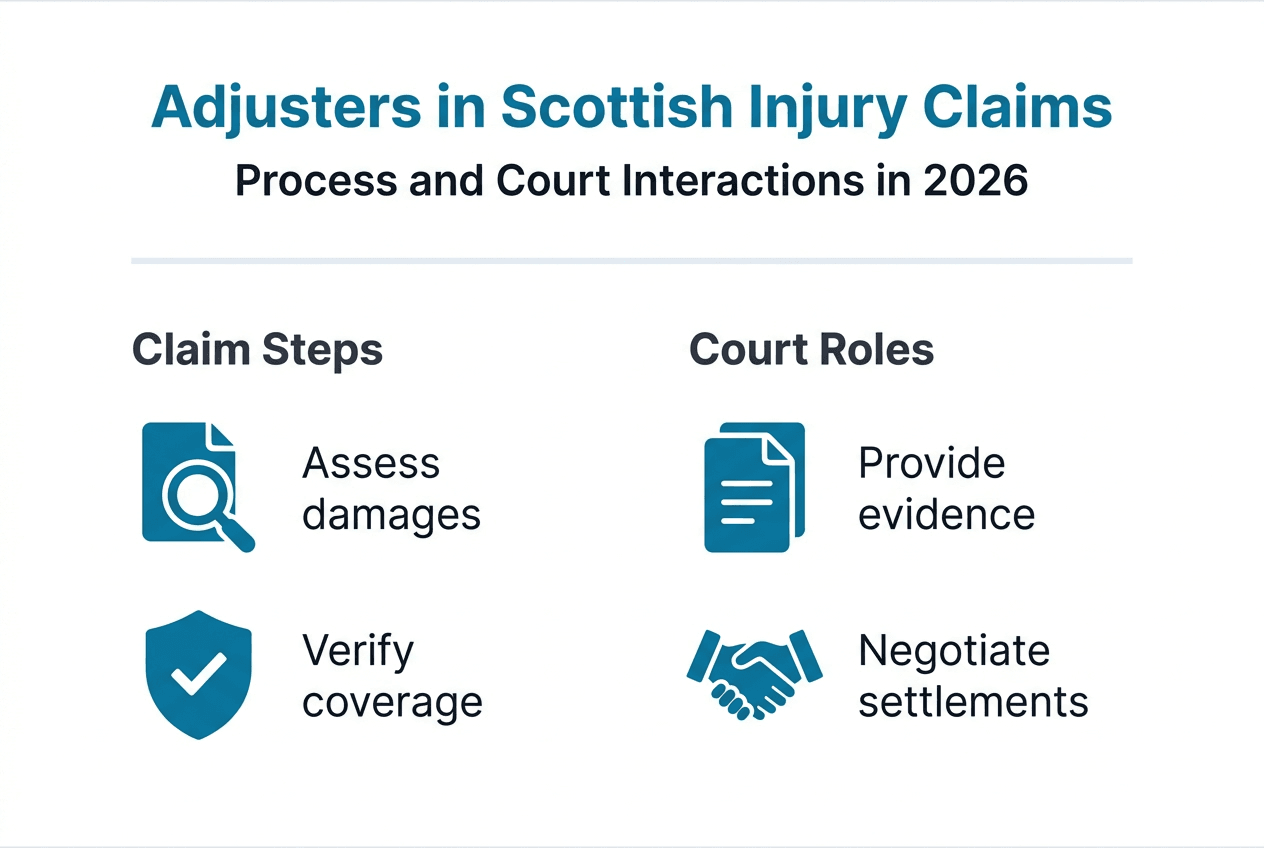
Many people assume insurance adjusters are neutral experts working to ensure fair outcomes for all parties. This misconception can leave claimants unprepared for the realities of the claims process. In Scottish personal injury claims, adjusters play a crucial role on behalf of insurers, evaluating damages, verifying coverage, and negotiating settlements. Understanding their function, the procedural rules governing injury claims, and how adjusters interact with Scottish courts helps you navigate your claim more effectively and protect your interests throughout the process.
Table of Contents
Key takeaways
| Point |
Details |
| Adjusters assess and negotiate |
Insurance adjusters evaluate damages, verify policy coverage, and negotiate settlements on behalf of insurers in personal injury claims. |
| Scottish procedural rules apply |
Claims under £25,000 must follow the Compulsory Pre-Action Protocol, and a three-year time limit applies to most injury claims. |
| Court choice belongs to pursuers |
Claimants select from the local Sheriff Court, All-Scotland Sheriff Personal Injury Court, or Court of Session based on claim value and preferences. |
| QOCS protects unsuccessful claimants |
Qualified One-way Costs Shifting shields most unsuccessful pursuers from paying the defender’s legal expenses. |
| Settlements include expenses |
Scottish injury settlements are typically awarded ‘plus expenses’, calculated at the end of the case using set rates. |
Who are insurance adjusters and what do they do?
Insurance adjusters are specialist professionals employed by insurers to investigate, evaluate, and manage claims. They possess expertise in assessing damages, determining liability, and applying policy terms to specific incidents. While some adjusters handle property claims, others specialise in personal injury cases, applying medical knowledge and legal understanding to evaluate injury severity, treatment costs, and long-term impacts.
Three main types of adjusters operate in the UK market. Claims adjusters typically work directly for insurance companies, handling straightforward cases internally. Loss adjusters operate as independent contractors hired by insurers to investigate complex or high-value claims. Chartered loss adjusters have achieved professional qualifications through organisations like the Chartered Institute of Loss Adjusters, demonstrating advanced expertise. TopMark Adjusters Ltd. handles various claims, including commercial property, business interruption, and liability claims, exemplifying the breadth of adjuster work.
Key tasks performed by adjusters include:
- Investigating the circumstances surrounding an incident
- Gathering evidence including witness statements, medical records, and expert reports
- Assessing the extent of injuries and associated treatment costs
- Verifying whether the policy covers the claimed damages
- Negotiating settlement amounts with claimants or their legal representatives
- Recommending claim acceptance, partial settlement, or rejection to insurers
Adjusters work to protect insurers’ financial interests whilst ensuring claims are handled fairly within policy terms. For claimants pursuing back injury claims Scotland or other personal injury compensation, understanding adjusters’ role helps set realistic expectations about the claims process and potential settlement negotiations.
Pro Tip: Adjusters are skilled negotiators trained to minimise insurer payouts. Having your own legal representation ensures your interests receive equal advocacy during settlement discussions.
How adjusters influence the personal injury claims process in Scotland
Scottish personal injury claims follow specific procedural frameworks that shape how adjusters operate. For claims worth £25,000 or less, the Compulsory Pre-Action Protocol dictates steps parties must take before initiating court proceedings. This protocol requires claimants to notify defenders of their claim, provide relevant documentation, and allow reasonable time for investigation before raising court action.
Timing matters significantly in Scottish injury claims. A three-year time limit applies from the date of injury, with certain exceptions for cases involving children or individuals lacking capacity. Service of court proceedings interrupts this time bar, protecting the claim from becoming time-barred. Adjusters often use this timeline strategically, knowing that approaching deadlines may pressure claimants into accepting lower settlements.
Adjusters gather and analyse evidence throughout the claim lifecycle, acting as intermediaries between claimants and insurers. They liaise with medical experts, review treatment records, and assess how injuries impact daily life and earning capacity. This investigation informs their settlement recommendations to insurers, directly influencing whether offers are made and at what level.
The key steps adjusters typically follow include:
- Receiving notification of the claim from the insurer
- Contacting the claimant or their solicitor to request documentation
- Reviewing medical evidence, employment records, and financial losses
- Consulting medical or other technical experts when necessary
- Assessing liability and causation based on available evidence
- Calculating potential compensation ranges for injuries and losses
- Making settlement recommendations to the insurer
- Negotiating with the claimant’s representatives to reach agreement
Those pursuing [claim injury compensation Scotland](https://www.scotlandclaims.co.uk/how to claim injury compensation scotland.aspx) should recognise that adjusters’ investigations can significantly delay proceedings. Requests for additional medical examinations or expert reports extend timelines, sometimes deliberately to pressure claimants facing financial hardship.
Failure to comply with pre-action protocol requirements or court procedural rules can result in claim dismissal or adverse costs consequences, regardless of claim merit.
Understanding these procedural requirements helps claimants work effectively with their legal representatives to ensure compliance, maintain claim viability, and negotiate from a position of knowledge rather than uncertainty.
Where personal injury claims and adjusters intersect with Scottish courts
Scottish injury claims proceed through specific courts chosen by the pursuer, with adjusters providing evidence and recommendations relevant to each forum. Understanding these courts clarifies how adjusters’ work fits within the broader legal system.
The local Sheriff Court handles personal injury claims of any value within its geographical jurisdiction. The All-Scotland Sheriff Personal Injury Court, based in Edinburgh, accepts cases from across Scotland valued over £5,000. The Court of Session, Scotland’s supreme civil court, hears high-value or complex injury claims, typically those exceeding £100,000 or involving novel legal points.
| Court |
Jurisdiction |
Typical claim value |
Case types |
| Local Sheriff Court |
Geographical area |
Any value |
All injury claims within the sheriffdom |
| All-Scotland Sheriff Personal Injury Court |
Nationwide |
Over £5,000 |
Injury claims from across Scotland |
| Court of Session |
Nationwide |
Over £100,000 or complex |
High-value or legally complex injury cases |
Adjusters contribute evidence and expert reports used in court proceedings, though many claims settle before reaching trial. Their assessments influence whether insurers defend claims vigorously or seek early settlement. When cases proceed to court, adjusters may attend hearings, provide testimony, or assist defence solicitors in preparing legal arguments.
Factors influencing court choice by pursuers include:
- Claim value and complexity
- Geographical convenience for the pursuer and witnesses
- Perceived expertise of judges in specific courts
- Speed of case progression through different court systems
- Strategic considerations regarding evidence presentation
Working with experienced [injury lawyers in Scotland](https://www.scotlandclaims.co.uk/injury lawyers scotland.aspx) ensures appropriate court selection and effective presentation of evidence to counter adjusters’ assessments when necessary. Solicitors familiar with Scottish court procedures anticipate adjusters’ tactics and build cases that withstand scrutiny across all judicial forums.
Understanding settlements, costs, and the impact of adjusters
Settlements represent the financial resolution of injury claims, typically negotiated between adjusters and claimants’ solicitors. Scottish injury settlements are ‘plus expenses’, meaning the compensation award covers injuries and losses, whilst legal expenses are calculated separately at the case’s conclusion based on set rates. This structure differs from systems where legal costs are deducted from compensation awards.

Adjusters negotiate settlement amounts by analysing comparable cases, applying valuation guidelines like the Judicial College Guidelines, and assessing the strength of available evidence. They balance the cost of settling against the risk and expense of defending claims through trial. Claimants with strong evidence and legal representation typically secure higher settlements than those negotiating directly with adjusters.
Qualified One-way Costs Shifting protects most pursuers from paying defenders’ expenses if their claims fail. This protection removes a significant financial risk that previously deterred many claimants from pursuing legitimate claims. Exceptions exist for fraudulent claims or cases pursued unreasonably, but these apply narrowly.
| Aspect |
Traditional costs risk |
QOCS protection |
| Unsuccessful pursuer liability |
Liable for defender’s legal expenses |
Generally not liable for defender’s expenses |
| Financial risk |
High, potentially exceeding claim value |
Minimal, limited to exceptional circumstances |
| Access to justice |
Deterred many legitimate claimants |
Enables more claimants to pursue valid claims |
| Exceptions |
Not applicable |
Fraud, fundamental dishonesty, unreasonable conduct |
Adjusters typically negotiate and document the following settlement elements:
- Compensation for pain, suffering, and loss of amenity (solatium in Scots law)
- Past and future wage losses or earning capacity reduction
- Medical treatment costs including private care and rehabilitation
- Travel expenses related to medical appointments and treatments
- Care costs provided by family members or professional carers
- Adaptations to housing or vehicles necessitated by injuries
Pro Tip: Understanding QOCS protection reduces anxiety about potential legal costs if your claim is unsuccessful, enabling you to pursue legitimate compensation without fear of financial ruin from adverse expenses awards.
Those considering [No win no fee injury claims Scotland](https://www.scotlandclaims.co.uk/no win no fee injury claims scotland 2026.aspx) benefit from both QOCS protection and conditional fee arrangements that eliminate upfront legal costs. This combination ensures access to justice regardless of financial circumstances, levelling the playing field when negotiating with adjusters backed by substantial insurer resources.
Get expert support with your injury claim in Scotland
Navigating insurance adjusters, procedural requirements, and court systems requires specialist legal knowledge and experience. Professional injury solicitors understand adjusters’ tactics, gather compelling evidence, and negotiate settlements that reflect the true value of your injuries and losses. Working with No win no fee injury lawyers Scotland eliminates financial barriers to accessing expert representation.
Specialist solicitors experienced in Scottish claims procedures protect your interests throughout the process. Whether you’re pursuing back injury claims Scotland or knee injury claims Scotland, professional support offers:
- Expert evaluation of claim strength and potential compensation
- Thorough evidence gathering and medical expert consultation
- Skilled negotiation with adjusters to maximise settlement values
- Court representation if settlement negotiations fail
- Guidance on procedural compliance and time limits
Don’t navigate the claims process alone when adjusters and insurers have substantial resources and expertise working against your interests.
FAQ
What is the role of an insurance adjuster in a personal injury claim?
Adjusters evaluate damages, verify coverage, and negotiate settlements on behalf of insurers. They act as intermediaries ensuring claims are properly assessed according to policy terms whilst protecting insurers’ financial interests.
How long do I have to make a personal injury claim in Scotland?
The standard time limit is three years from the date of injury. Exceptions apply for children and individuals lacking capacity, and serving court proceedings interrupts the time bar.
Are unsuccessful claimants responsible for the defender’s legal costs in Scotland?
Under QOCS, unsuccessful pursuers generally avoid paying defenders’ expenses. Exceptions exist for fraudulent claims or cases pursued with fundamental dishonesty, but these apply narrowly.
Which court should I use for my personal injury claim in Scotland?
You can choose from the local Sheriff Court, All-Scotland Sheriff Personal Injury Court, or Court of Session. Selection depends on claim value, geographical convenience, case complexity, and strategic considerations regarding evidence presentation.
What does ‘plus expenses’ mean in Scottish injury settlements?
Settlements awarded ‘plus expenses’ mean your compensation covers injuries and losses separately from legal costs. Expenses are calculated at the case’s conclusion using set rates rather than being deducted from your award.
Recommended