Proven personal injury claim examples in Scotland: What works

TL;DR:
- Successful Scottish injury claims depend on clear liability proof and comprehensive medical evidence.
- Well-documented minor injuries with admitted liability can outperform poorly documented serious injuries.
- Gathering strong evidence, understanding damages, and working with expert solicitors increase claim success.
Many people assume the most dramatic or severe injuries automatically lead to the highest payouts. That assumption costs Scottish claimants thousands of pounds every year. The truth is, a relatively minor injury backed by watertight evidence and admitted liability can outperform a serious injury claim that is poorly documented. Understanding what genuinely drives success, through real Scottish cases, changes how you approach your own situation. This article breaks down two detailed Scottish examples, extracts the patterns that made them work, and gives you practical lessons you can apply before you even speak to a lawyer.
Table of Contents
Key Takeaways
| Point |
Details |
| Strong evidence is crucial |
Admitted liability and thorough documentation are key drivers in winning personal injury claims. |
| Partial fault reduces compensation |
Awards can be reduced if you share blame, as seen in contributory negligence cases. |
| Compensation covers more than injury |
Losses for services, employability, and pain and suffering are considered when calculating awards. |
| Expert advice strengthens claims |
Legal guidance and proper preparation can make a decisive difference in complex claims. |
What makes a personal injury claim successful in Scotland?
Before examining the actual case studies, it is crucial to know what the law considers a “successful” claim. In Scotland, success is not simply about suffering an injury. It is about proving that someone else was responsible, and then demonstrating the full extent of what that injury has cost you, financially, physically, and emotionally.
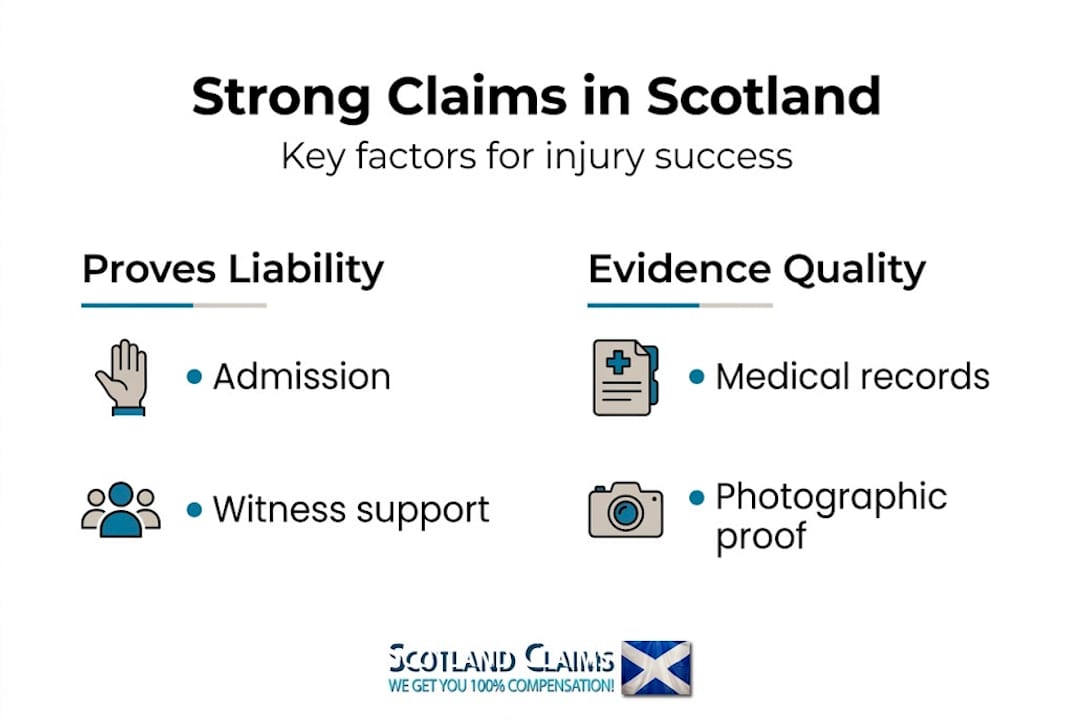
Liability is everything. Liability means legal responsibility. When a defender (the party being claimed against) admits liability, your case moves faster and your solicitor can focus energy on valuing your claim rather than fighting over who was at fault. When liability is disputed, you need compelling evidence: medical reports, witness statements, site photographs, health and safety records, and sometimes expert testimony from professionals such as occupational health consultants or medical specialists.
Valuing your claim correctly matters just as much. Scottish courts and insurers use the Judicial College Guidelines to calculate solatium (the Scottish term for pain and suffering compensation). These guidelines assign monetary ranges to specific injuries and conditions. Using them correctly, and understanding how multiple injuries interact, is something specialist solicitors do as a matter of routine. Getting it wrong means undervaluing your claim.
Most claims settle before court. Negotiations between your solicitor and the defender’s insurers resolve the vast majority of Scottish personal injury claims. Court is the exception, not the rule. That said, presenting your case as though it will go to court, with solid evidence and credible expert input, almost always produces a better negotiated outcome. Insurers respond to strength.
Common pitfalls that derail otherwise strong claims include:
- Inadequate documentation at the time of the incident, particularly missing accident book entries or delayed medical attention
- Unclear liability, especially in workplace accidents where multiple parties or contractors are involved
- Undervalued solatium, where psychological injuries such as PTSD or anxiety are not properly evidenced or quantified
- Missed special damages, including care provided by family members, travel costs, and lost earnings that are not formally recorded
Our step-by-step compensation guide walks through exactly how these elements combine into a final figure, which is well worth reading before you begin your claim.
| Factor |
Strong claim |
Weak claim |
| Liability |
Admitted or clearly evidenced |
Disputed with limited evidence |
| Medical evidence |
Specialist reports, full history |
GP notes only, delayed treatment |
| Special damages |
Fully itemised and documented |
Vague or undocumented estimates |
| Solatium calculation |
Judicial College Guidelines applied |
Informal estimate, injuries underreported |
Pro Tip: Request a copy of the accident book entry and your GP or A&E records as soon as possible after an incident. These two documents alone can make or break liability arguments later.
Case study: NHS nurse injured by falling chisel
Having established the foundations for success, let us see them in action through a real Scottish case. Tracy McFadyen, an NHS nurse, was walking near a property where council workers were operating when a chisel head fell from above and struck her. The resulting injuries were significant: a skull fracture, tinnitus (persistent ringing in the ears), post-traumatic stress disorder (PTSD), and ongoing headaches. Her case became a clear illustration of how a well-assembled claim, backed by admitted liability, produces a strong outcome.
The council admitted liability relatively early in proceedings. This admission was not coincidental. The circumstances of the incident clearly pointed to a failure by the council’s workers to secure their tools and maintain a safe working environment around members of the public. Once liability was no longer in dispute, attention turned entirely to the value of her claim.
Her legal team faced an interesting challenge in calculating solatium. Tracy had suffered a physical injury (the skull fracture and resulting tinnitus) alongside a recognised psychological condition (PTSD). Rather than treating these as entirely separate injuries and adding the figures together, the court applied the Judicial College Guidelines to treat the head injury and PTSD as a combined, overlapping condition. This is a subtle but important legal point. It prevents double recovery, but it also ensures the full impact on the individual is properly captured in a single, realistic figure.
| Damages head |
Amount awarded |
| Solatium (pain, suffering, loss of amenity) |
£60,000 |
| Services (care provided by family/others) |
£20,000 |
| Loss of employability |
£0 |
| Total award |
£88,693 |
“The combination of admitted liability and comprehensive medical evidence allowed the full impact of Tracy’s injuries to be properly valued, resulting in an award of £88,693.”
Crucially, Tracy’s job as a nurse was secure throughout the claim. Because there was no actual loss of future earnings and no realistic risk to her career, no award for loss of employability was made. This shows how courts assess claims with precision. Every head of damages must be justified by specific evidence. The £20,000 for services reflected the practical assistance she required during recovery, likely provided by family members, which had been carefully recorded and presented.
The lessons from this case are directly applicable to anyone pursuing a similar claim. Start with strong, thorough preparing injury evidence from the outset. Understand your top personal injury rights under Scottish law, particularly around how psychological injuries interact with physical ones. And never underestimate the value of admitted liability: it removes the most expensive and time-consuming part of the process entirely.
Not all cases have clear-cut liability, as demonstrated by claims where both employer and employee share responsibility. Thomas Ward, a lorry driver, sustained a fracture to his foot when he fell from a trailer while assisting with unloading operations. The circumstances involved a routine working procedure, but one that lacked adequate risk assessment, proper training, and a safe system of work. His employer, VR Ltd., had failed on multiple counts.

What made this case particularly instructive was the finding of contributory negligence. This legal concept (meaning the claimant contributed to their own injury through their own conduct) resulted in a 30% reduction to Thomas’s total entitlement. In practical terms, this is significant. The court found contributory negligence reduced his award by nearly a third, bringing his final compensation to £56,818.
The case also had an additional layer of complexity. Thomas had previously received a settlement of approximately £110,000 from another party involved in the same incident. A key question was whether that prior settlement represented full satisfaction of his damages, which would have prevented any further claim. The court determined it did not. Prior settlements do not automatically bar claims against other responsible parties, particularly when those settlements did not cover the total loss suffered or did not include all liable defenders.
Here is a clear breakdown of the key factors at play:
- Establish all potentially liable parties early. In this case, multiple parties bore some responsibility. Identifying each one before settling with any of them matters enormously.
- Understand that routine procedures can still constitute negligence. Thomas’s employer argued the activity was standard practice. The court disagreed, finding that the absence of a formal risk assessment and training programme was enough to establish employer fault.
- Document your own conduct carefully. Contributory negligence findings often arise when the claimant cannot demonstrate they acted with reasonable care. Keeping records of how you followed (or were not given) safety instructions protects you.
- Do not assume a prior settlement closes the matter. If you have already received compensation from one party, seek specialist advice before assuming your options are exhausted.
“Employer liability was established despite the activity being described as routine, because the absence of proper training and risk assessment constituted a failure to provide a safe system of work.”
Pro Tip: If you are involved in a workplace accident where multiple contractors or employers are present, write down the names of all companies and individuals on site as soon as possible. This information becomes critical when identifying who bears legal responsibility.
Our injury claims management guide covers how solicitors navigate complex, multi-party workplace claims, including how prior settlements are assessed when calculating residual entitlement.
Key themes from successful claims: What you can apply
After exploring what worked (and why) in specific claims, several clear lessons emerge for future claimants. The two cases above are not exceptions. They reflect patterns that appear consistently across successful personal injury claims in Scotland.
Admitted liability or strong evidence drives success. This is the single biggest factor. When a defender admits fault, the process accelerates and your energy goes into maximising your award rather than proving someone was negligent. When liability is disputed, expert evidence, whether from medical professionals, health and safety consultants, or engineers, becomes the deciding factor.
Your medical records are your foundation. Every appointment, every prescription, every specialist referral creates a paper trail that supports your claim. Gaps in treatment suggest the injury was less serious than claimed. Consistent engagement with healthcare professionals, and requesting formal reports from specialists, is non-negotiable for a strong claim.
Contributory negligence can significantly reduce your award. As seen in the lorry driver case, even a 30% finding can mean tens of thousands of pounds less in your pocket. Think carefully about your own behaviour at the time of the incident and discuss it openly with your solicitor. Trying to hide awkward facts rarely works and can undermine credibility entirely.
Special damages must be itemised and evidenced. Lost earnings, travel costs, prescription charges, and care provided by family members all count as special damages. But they only feature in your award if you have documented them. Keep payslips, receipts, and a diary of the help you have received from others.
Job security affects employability loss claims. If your job is secure throughout your recovery, as Tracy McFadyen’s was, you will not receive an award for loss of employability. If your injury has genuinely threatened your career prospects, that must be evidenced through medical opinion on long-term prognosis and, if appropriate, a specialist employment report.
Prior settlements do not always close all doors. The Ward v VR Ltd case confirmed that receiving compensation from one party does not automatically exhaust your rights against others. If multiple parties contributed to your injury, each may carry independent liability.
Understanding the types of compensation available under Scottish law helps you ensure your solicitor is accounting for every head of damages you are entitled to pursue.
Our view: Why evidence and legal advice are non-negotiable
Most claimants come to us believing their case is straightforward because the facts feel obvious to them. They were hurt. Someone else was clearly responsible. Surely the rest takes care of itself. It does not.
We have seen strong cases weaken because a claimant delayed seeking medical attention, assumed an accident book entry existed when it did not, or accepted a first offer from an insurer without understanding what they were entitled to. The gap between what someone deserves and what they ultimately receive is almost always explained by the quality of preparation, not the severity of the injury.
The cases above demonstrate something important: the claimants who succeeded did so because their legal teams built cases that could withstand scrutiny. Admitted liability in the nurse’s case did not happen by accident; it happened because the facts were well-documented and the legal argument was sound. The lorry driver’s award, even after a contributory negligence reduction, reflected expert assessment of every element of his loss.
Working with claimant representatives who understand Scottish law, specifically the nuances around solatium, contributory negligence, and multi-party liability, is what separates a settled claim from a maximised one. Good intentions and a clear conscience are not enough on their own.
Take the next step with expert support
By applying these principles and seeking the right help, you can improve your claim’s prospects and peace of mind. Scotland Claims connects you with specialist injury lawyers in Scotland who understand exactly how cases like the ones above are built and won. Every case begins with a no-obligation review, so you can understand your position before committing to anything. Our No Win No Fee claims arrangement means you pay nothing upfront and nothing if your case does not succeed. If you want a quick sense of what your claim might be worth, try our compensation calculator for an initial estimate based on your injury type and circumstances.
Frequently asked questions
What is the average settlement for a personal injury claim in Scotland?
Settlements vary widely based on injury type, severity, and liability, but successful claims typically reflect pain and suffering, lost earnings, and documented special damages, with awards ranging from a few thousand pounds to well over £80,000 in complex cases.
Can I still claim if I was partly at fault?
Yes, you can still pursue a claim, but your compensation will be reduced proportionally to reflect your share of responsibility, as seen in the Ward v VR Ltd ruling where a 30% contributory negligence finding reduced the final award accordingly.
What evidence should I collect for a successful personal injury claim?
You should gather medical records, accident book entries, photographs of the scene, witness contact details, and any health and safety documentation, as admitted liability and expert evidence consistently emerge as the most critical success factors in Scottish claims.
Does a prior settlement prevent me from making another claim?
Not necessarily; as confirmed in Ward v VR Ltd, a prior settlement with one party does not automatically bar claims against other responsible parties if the original settlement did not represent full satisfaction of your total losses.
Recommended